Sunday, October 2, 2022

Saturday, October 1, 2022

Roman-era anchor found at windfarm on display in Ipswich


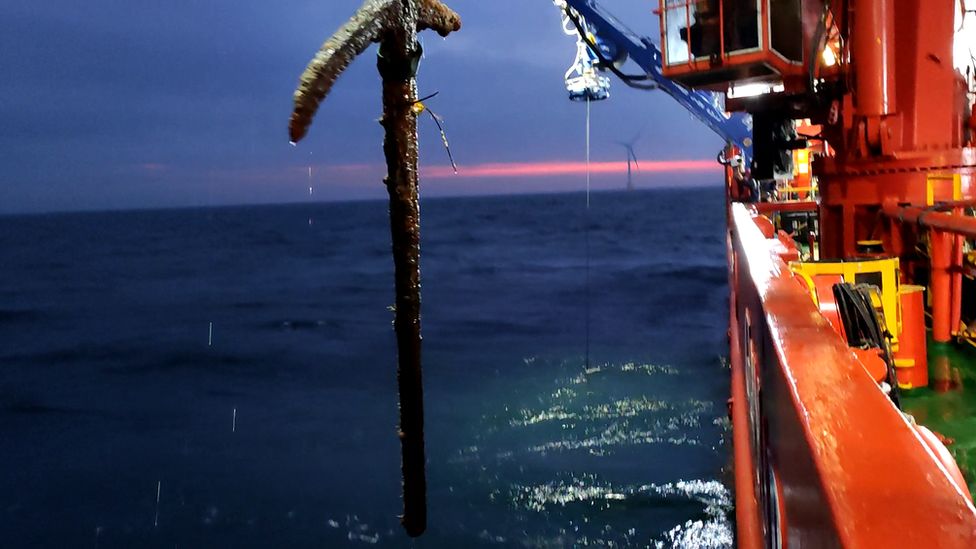
The anchor could provide evidence of the seafaring activity off the east coast during Roman times
 
From BBC

An "incredibly rare" wrought iron anchor thought to be up 2,000 years old is going on display for one day after being found at an offshore windfarm.

The anchor, believed to be Roman or late Iron Age, was found off the Suffolk coast in 2018 during survey work on the East Anglia One windfarm.

 
It will be on show for the first time at Ipswich Museum on Tuesday, before being moved for further analysis work.
Experts said it was an "incredibly rare, distinctive" anchor.
It was thought to have come from a 500-600 tonne vessel and was believed to be between 2,000 and 1,600 years old.
The anchor was found in 2018 and removed from the sea last year

"Everything points to this being a Roman anchor of almost 2,000 years old; if this is confirmed it would be hard to overstate its significance," said Brandon Mason from Maritime Archaeology Ltd.
"We only know about three pre-Viking anchors from northern European waters outside the Mediterranean region, and only two actually survived.
"We believe this find could be the oldest and one of the largest surviving examples, giving us hard evidence of the incredible amount of activity that must have been going on in the waters in Roman times, but that we know relatively little about."


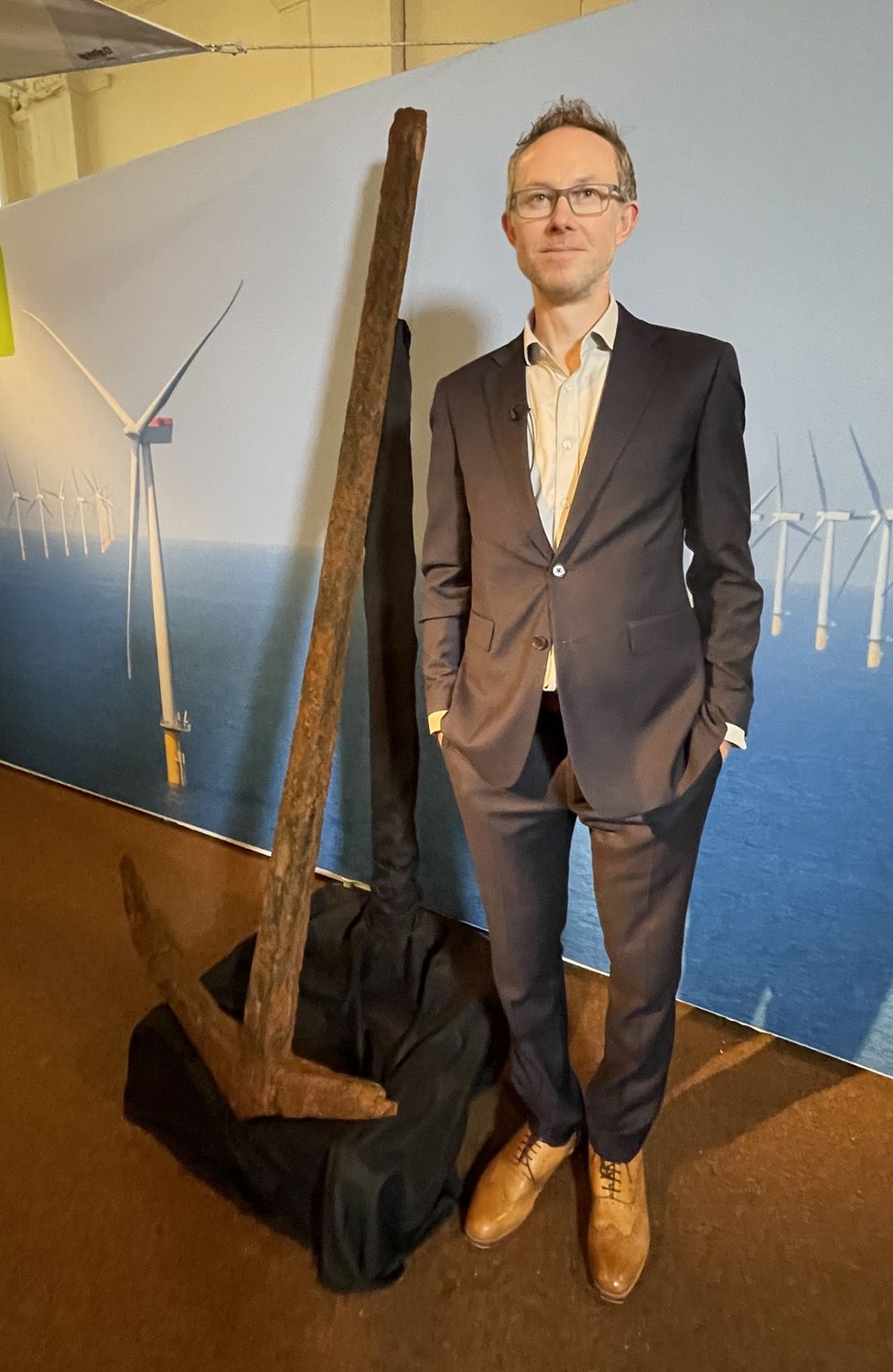
Ross Ovens of Scottish Power Renewables with the anchor at Ipswich Museum where it is appearing for one day only before more research is carried out on it

Image Scottish Power

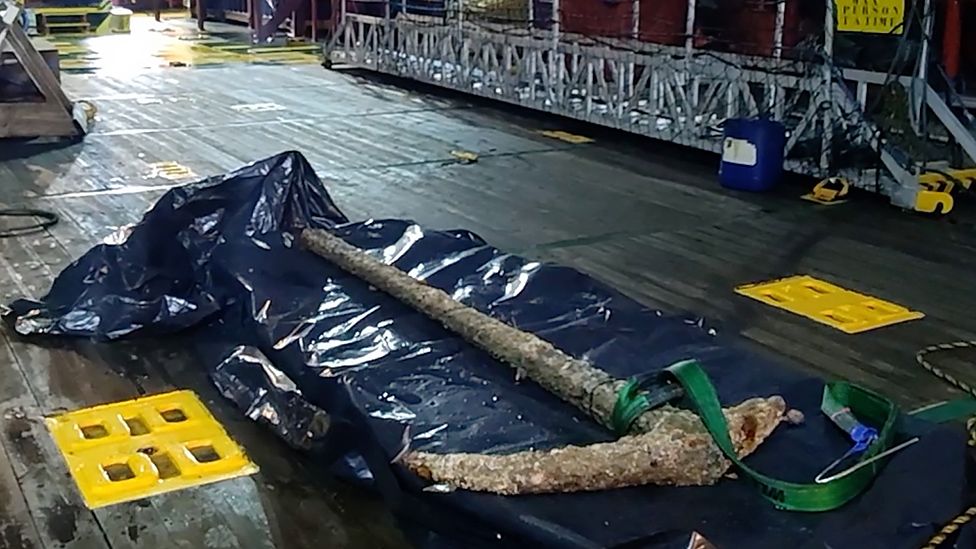
The anchor will undergo further tests to find its age

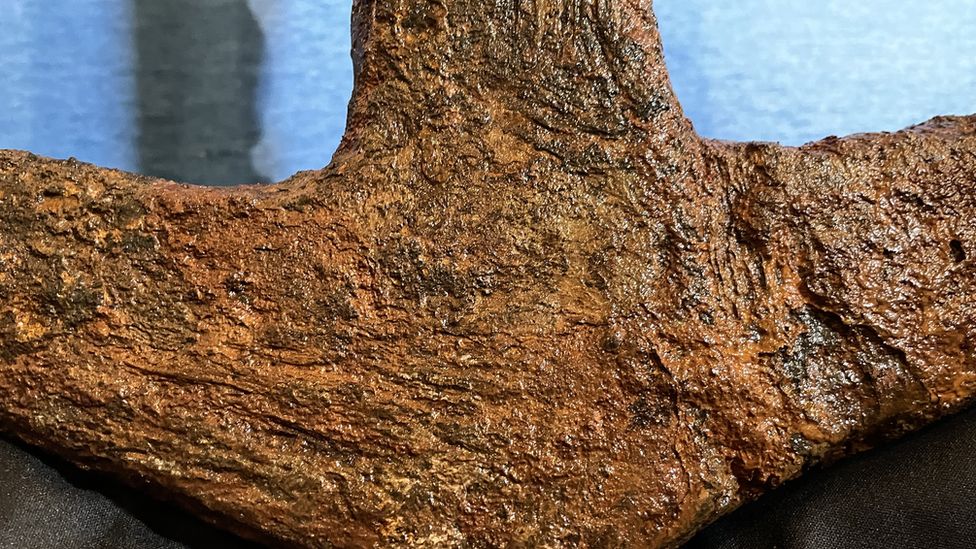
Detail of the corrosion on the wrought iron anchor, which weighs 100kg (220lb)
Image  Mike Liggins / BBC Image

After its discovery, the anchor was protected by an exclusion zone installed on the seabed during construction work on the wind turbines.

Measuring two metres (6.5ft) long and weighing around 100kg (220lb), the anchor was recovered from the North Sea in 2021.

Once the analysis and conservations works are complete, the anchor will go on permanent display in conjunction with Colchester and Ipswich Museums.

German submarine

Although it has yet to be dated more precisely, archaeologists said there were several features that suggested it could come from the Imperial Roman period.

If confirmed, it would provide evidence of ancient Romans seafaring and trading in the southern North Sea, off the coast of the East of England.

The Imperial Roman period lasted from about 27BC to the late 3rd and 4th Century when the empire expanded, especially to the west.

In 54-55BC Julius Caesar tried to invade Britain, but failed, and then in AD43 the Roman army landed in Kent and began to conquer what is now England and Wales.

Scottish Power Renewables, which built the windfarm, said it made other finds during the work including a missing German submarine from World War One and an ancient wild cattle skull, which has been radiocarbon-dated to more than 6,000 years old.

The East Anglia One windfarm is located around 40km (25 miles) off the coast of Suffolk and will have 102 turbines when finished.
 
Links :


Friday, September 30, 2022

France & misc. (SHOM) layer update in the GeoGarage platform

2 new nautical raster charts added and 157 charts updated
 

The race to find the Nord Stream saboteurs


Photograph: Danish Defence/Anadolu Agency/Getty Images
 
From Wired by Matt Burgess

Damage to the pipeline that runs between Russia and Germany is being treated as deliberate.
Finding out what happened may not be straightforward.


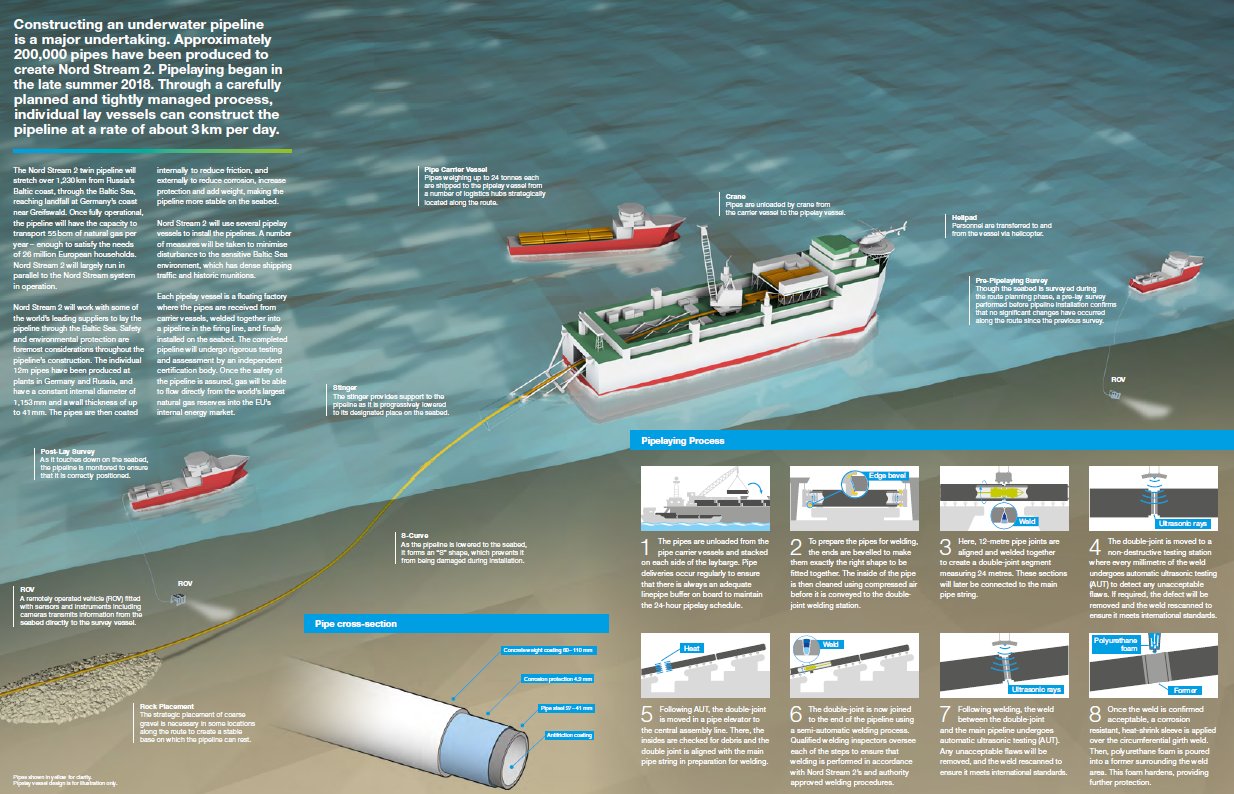
The Nord Stream gas pipelines are colossal pieces of infrastructure.
Running more than 1,200 kilometers from Russia, across the Baltic Sea to Germany, the pipes can carry up to 110 billion cubic meters of gas, enough for 26 million homes.
The Nord Stream 1 pipeline alone is constructed of 202,000 huge pieces of piping.
Each section is 12 meters long and contains piping that uses around 4 centimeters of steel, which is covered with 11 centimeters of concrete.
The pipes are not built to break.
 

Sources: European Network of Transmission System Operators for Gas (ENTSOG); Danish and Swedish maritime authorities
 see also GEUS
 
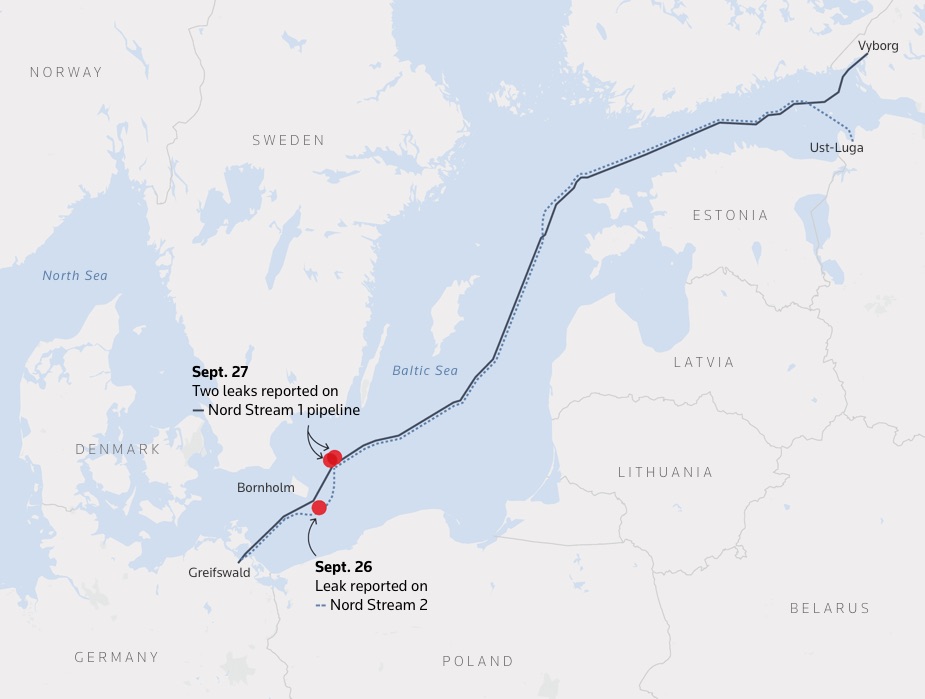
Locations of the current navigation warnings due to Nord Stream 1 and 2 leaks marked on map containing both pipelines.

 source : @OAlexander
 
DGA raster chart

ENC DKBORNH with Nord Stream I & II display
Title : Baltic Sea.
(the water depth at the location of the leak, near the island of Bornholm,
should reach about 50-70 meters)
Scale : 180000 / Cat : 2 / Type : General
Edition_date : 20010917 / Edition : 41 - Update_date : 20220906 / Update : 4
 
Going by the coordinates of the leak in Nord Stream 2 (54.876670, 15.410000) and the leaks basically being confirmed as caused by the explosions, the first explosion was 1.41km away from Danish territorial waters.
source : @OAlexanderDK
 
So when the pressure in one of the Nord Stream pipes dropped on June 26, alarm bells started ringing.
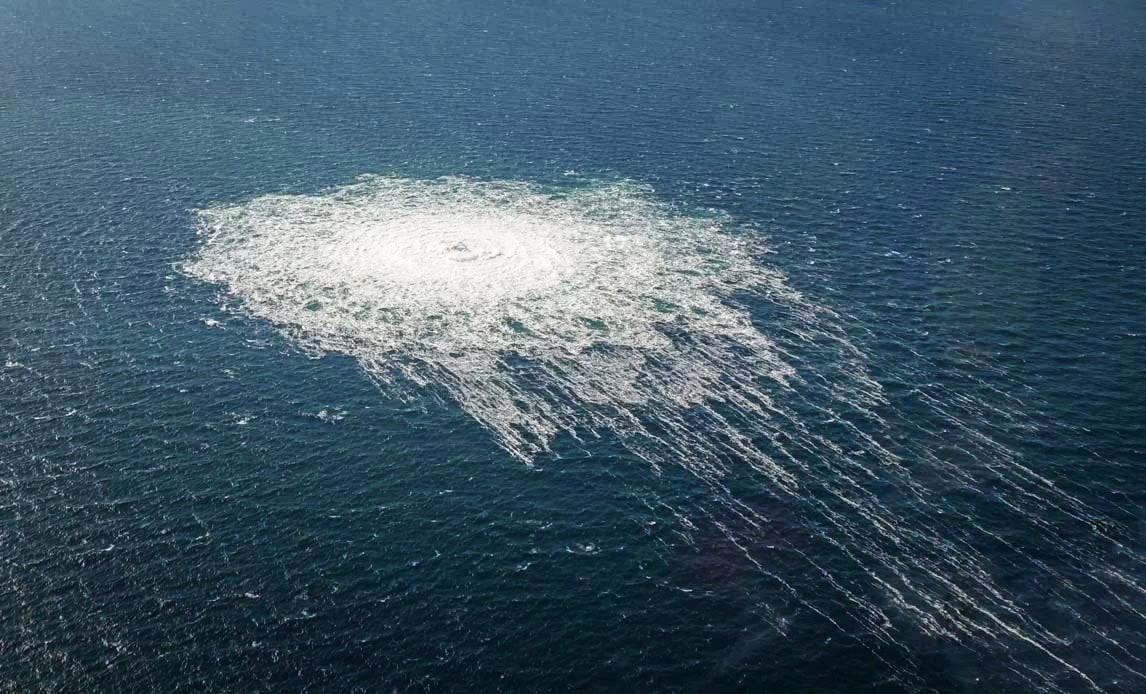
Danish authorities told ships to steer clear of the pipes as methane gas was bubbling into the sea.
Hours later, two more leaks were detected, one in Nord Stream 2 and a second in Nord Stream 1.
Now, authorities are suspecting foul play.
“We are not talking about an accident,” Mette Frederiksen, the Danish prime minister said.
 

 A leak in NordStream2 is visible in Sentinel1 SAR image captured 29 Sep
 
Orbital EOS team, while analyzing European Space Agency - ESA´s Sentinel 2 data.
The anomaly has a radius of 350-400 m, presumed to be liberating a large amount of methane into the atmosphere.
 
NordStream gas pipeline leak seen from space (Airbus Pléiades)
 

Ursula von der Leyen, head of the European Commission, believes the leaks may be a result of “sabotage” and said any “deliberate disruption” of energy infrastructure will “lead to the strongest possible response.” NATO officials agree; the US has pledged its support to help Europe find out what happened.
However, the incidents have raised fears about attacks on critical infrastructure and the security protections in place around systems that can provide the world’s fuel.
The incident comes on top of Russia reducing its supply of gas to Europe, with large parts of the continent facing winter energy crises.

While officials have indicated the leaks may have been caused deliberately, very little evidence about the attacks has emerged so far.
Military flights over the region show gas bubbling at the surface more than a kilometer wide, and Swedish seismic experts say they are convinced explosions took place after they recorded tremors equal to a magnitude 2.3 earthquake.
 

Unexplained leaks in two Russian gas pipelines that churned up the Baltic Sea with bubbles on Tuesday, raised concerns from Copenhagen to Moscow about sabotage on infrastructure at the heart of a European energy standoff.
 
Fingers immediately pointed at Russia, which partly owns the pipes.
Ukraine has said it is a “terrorist attack,” and German newspaper Der Spiegel reported that the CIA warned German officials about possible attacks against Baltic pipelines several weeks ago.
(Right-wing commentators in the US and one Polish MP accused the US of being involved after President Joe Biden said, in February, he would “put an end” to Nord Stream 2 if Russia invaded Ukraine.)

"It's a very classic Russian hybrid warfare approach,” says Hans Tino Hansen, the CEO of Risk Intelligence, a Denmark-based security firm that deals with maritime issues.
Hansen says if Russia did attack the Nord Stream pipelines it would show they have “complete deniability.” Because Russia partly owns the Nord Stream infrastructure, it makes people question why it would be behind any attacks against it.
(The Kremlin claimed suggestions it is behind the leaks are “stupid.) “They are showing that they can attack seabed energy infrastructure, with the pipelines, which then sends the signal that they can attack and destroy any energy infrastructure in Europe," Hansen says.

Investigators across Europe, including intelligence agencies, will now be trying to piece together exactly who and what caused the apparent explosions.
This is likely to involve multiple steps, such as examining what data is held about the area, including seismic data and other sensors, checking whether any communications around the incident have been intercepted, and examining the pipelines to see if there are any signs of intentional destruction.

Neither of the pipes is operational—Nord Stream 1 was paused for repairs in August and Nord Stream 2 has not officially opened after Germany pulled support for it ahead of Russia’s full-scale invasion of Ukraine in late February—but both pipes are holding gas.
All three leaks happened relatively close to each other, near the Danish island of Bornholm, in the Baltic sea.
The island is surrounded by Denmark to the west, Sweden to the north, and both Germany and Poland to the south.
The leaks are in international waters, but also sit in both Denmark and Sweden’s exclusive economic zones.
“It's quite shallow, around 50 meters on average in this region,” says Julian Pawlak, a research associate at the Helmut Schmidt University and the German Institute for Defence and Strategic Studies.

Security sources have speculated if the attacks were deliberate, they could have been conducted by unmanned underwater drones, involve mines being dropped or planted by boats, been carried out by divers, or even from within the pipes themselves.
“We still don't know what the origin is of those explosions or where they came from—if they originated from the outside or if they originated from the inside of the pipelines,” Pawlak says.
In a process called “pigging,” cleaning and inspection machines can be sent down the pipes from Russia in the direction of Germany.
It’s possible pigging was repurposed to carry out an attack.

Back in 2007, before the first Nord Stream pipeline was constructed, a review of the project by the Swedish Defence Research Agency (FOI) warned about potential explosions around the pipe, in the context of terrorism.
“Despite its concrete coating, a pipeline is rather vulnerable, and one diver would be enough to set an explosive device,” its report said.
“However, the impact of such an assault would probably be rather modest and most likely a minor incident of this type would not result in a large explosion.”

"They [Russia] have the capability for subsea warfare, with the divers, but also with mini-submarines and drones,” Hansen says.
However, confirming any responsibility isn’t necessarily straightforward.
The relatively shallow depth of the area around the Nord Stream pipes means it is unlikely that any large submarines would have been operating nearby, as they would be easy to detect.

Pawlak says any vessels in the area could potentially detect others that may have caused the damage.
Undersea sensors could equally spot something in the area moving, but it is unclear where any of these systems are.
“It's still not the case that all of the Baltic Sea is filled up with sensors and that NATO knows every movement,” Pawlak says.
“On the surface, but especially on the seabed, it's still not possible to know, at every time, at every place, what's moving, what's going on.”

However, the Nord Stream incidents draw into focus the protections that are placed around critical infrastructure.
In recent years, cyberattacks have shut down the US Colonial Pipeline, cutting off fuel supplies.
And ahead of Russia’s full-scale invasion of Ukraine, its military hackers used the country as a cyberwarfare testing ground, shutting down power grids with their code.

Undersea infrastructure can be particularly vulnerable to damage—either from natural causes, such as earthquakes, or physical attacks.
Since the Nord Stream pipes burst on Tuesday huge volumes of gas have poured into the sea, potentially causing an “unprecedented” environmental impact.
"As we—and many others—have been saying for many years, we need to address the security of energy infrastructure and also everything subsea,” Hansen says.
This includes the myriad of internet cables stretching thousands of kilometers around the world and keeping billions of people online.

In January, the head of the UK’s armed forces warned that Russian submarines have been threatening subsea cables.
“Russia has grown the capability to put at threat those undersea cables and potentially exploit those undersea cables,” Admiral Tony Radakin said.

Hansen says there are two starting points for protecting subsea infrastructure: first, building out ways to detect faults and issues with equipment automatically and then also making sure there is equipment, such as underwater drones, that are able to scramble to sites to inspect them when damage has happened.
Those steps may already be underway, with Norway’s prime minister saying the country will up the military protection of its energy infrastructure.
 
Links :

Thursday, September 29, 2022

European drought unearths sunken Nazi warships, ‘Spanish Stonehenge’


Low water levels have revealed the wreckage of Nazi warships in the Serbian section of the Danube River.
(Fedja Grulovic/Reuters)


From WP by Marina Lopes

One of the worst droughts on record in Europe has parched the continent’s major waterways, revealing relics such as a long-submerged village and World War II-era battleships.

This week, low water levels on the Serbian section of the Danube River exposed a graveyard of sunken German warships filled with explosives and ammunition.
The vessels, which emerged near the port town of Prahovo, were part of a Nazi Black Sea fleet that sank in 1944 while fleeing Soviet forces.
More ships are expected to be found lodged in the river’s sandbanks, loaded with unexploded ordnance.

A junior Serbian transport minister told local media there were about 10,000 explosive devices in the water.


Europe's worst drought in years has exposed dozens of explosives-laden German warships sunk during World War II near Serbia's river port town of Prahovo.
(Video: Reuters)


Other ruins have also emerged around Europe as waters recede in the drought.
In July, a Roman bridge built during the first century B.C.
was uncovered in the Tiber River, and in August, a village that had been deliberately flooded in 1963 to build a dam appeared from the Belesar reservoir in Spain.

The village is one of several sites submerged under reservoirs in Spain.
A ghost town that had been flooded to build a dam on Spain’s border with Portugal emerged in February, revealing houses with windows and walls still intact.

The drought has threatened shipping routes, food supply and electricity in Europe this summer.
European Union researchers said earlier this month that nearly half of the continent is under “warning” conditions, which connote a severe drought and a major soil moisture deficit, The Washington Post has reported.

The Dolmen of Guadalperal, a collection of prehistoric stones also known as the Spanish Stonehenge, can be seen because of receding waters.
(Susana Vera/Reuters)


This is not the first time most of the sites and relics have poked out of the water.
The Nazi ships, for instance, also made an appearance during a 2003 heat wave. But the severity of this year’s drought has made the waterways particularly difficult to navigate, as the sunken boats pose a danger to fishing and shipping vessels that have to skirt the hulks to get by.
Ships now have to squeeze through a 110-yard stretch of the Danube, nearly half the available waterway to which they once had access, according to Reuters.

Officials estimate it will cost $30 million to remove more than 20 ships, ammunition and explosives, the newswire reported.

But the dry conditions have also given archaeologists and researchers a rare glimpse into the past and contact with ruins that are normally difficult to access.

Earlier this week, the unrelenting heat wave that left the Iberian Peninsula drier than any time in the last 1,200 years also exposed dozens of prehistoric stones in a reservoir in central Spain.

The drought drained the reservoir to a fraction of its capacity, the Spanish government said, granting archaeologists access to the Dolmen of Guadalperal, believed to be from 5000 B.C.
Known as the “Spanish Stonehenge,” in a reference to the prehistoric monument built in what is now England, the stones were first uncovered in the 1920s.
The area where they stood was flooded in the 1960s to build a dam, and they have been fully visible only a handful of times since, according to the NASA Earth Observatory.

“It’s a surprise, it’s a rare opportunity to be able to access it,” archaeologist Enrique Cedillo, who is rushing to examine the relics before they become submerged again, told Reuters.