Monday, April 12, 2021

The rice of the sea: how a tiny grain could change the way humanity eats


Chef Ángel León found eelgrass seeds have 50% more protein than rice – and the plant stores carbon far faster than a rainforest.
Photograph: Álvaro Fernández Prieto/Aponiente

From The Guardian by Ashifa Kassam

Ángel León made his name serving innovative seafood.
But then he discovered something in the seagrass that could transform our understanding of the sea itself – as a vast garden

Growing up in southern Spain, Ángel León paid little attention to the meadows of seagrass that fringed the turquoise waters near his home, their slender blades grazing him as he swam in the Bay of Cádiz.

It was only decades later – as he was fast becoming known as one of the country’s most innovative chefs – that he noticed something he had missed in previous encounters with Zostera marina: a clutch of tiny green grains clinging to the base of the eelgrass.

His culinary instincts, honed over years in the kitchen of his restaurant Aponiente, kicked in.
Could this marine grain be edible?

Lab tests hinted at its tremendous potential: gluten-free, high in omega-6 and -9 fatty acids, and contains 50% more protein than rice per grain, according to Aponiente’s research.
And all of it growing without freshwater or fertiliser.

The find has set the chef, whose restaurant won its third Michelin star in 2017, on a mission to recast the common eelgrass as a potential superfood, albeit one whose singular lifecycle could have far-reaching consequences. 
“In a world that is three-quarters water, it could fundamentally transform how we see oceans,” says León. 
“This could be the beginning of a new concept of understanding the sea as a garden.”

It’s a sweeping statement that would raise eyebrows from anyone else. 
But León, known across Spain as el Chef del Mar (the chef of the sea), has long pushed the boundaries of seafood, fashioning chorizos out of discarded fish parts and serving sea-grown versions of tomatoes and pears at his restaurant near the Bay of Cádiz.

 
The tiny grains within the eelgrass.
The plant is capable of capturing carbon 35 times faster than tropical rainforests.
Photograph: Álvaro Fernández Prieto/Aponiente

“When I started Aponiente 12 years ago, my goal was to open a restaurant that served everything that has no value in the sea,” he says. 
“The first years were awful because nobody understood why I was serving customers produce that nobody wanted.”

Still, he pushed forward with his “cuisine of the unknown seas”.
His efforts to bring little-known marine species to the fore were recognised in 2010 with his first Michelin star.
By the time the restaurant earned its third star, León had become a fixture on Spain’s gastronomy scene: a trailblazing chef determined to redefine how we treat the sea.

What León and his team refer to as “marine grain” expands on this, in one of his most ambitious projects to date.
After stumbling across the grain in 2017, León began looking for any mention of Zostera marina being used as food.
He finally found an article from 1973 in the journal Science on how it was an important part of the diet of the Seri, an Indigenous people living on the Gulf of California in Sonora, Mexico, and the only known case of a grain from the sea being used as a human food source.

Next came the question of whether the perennial plant could be cultivated.
In the Bay of Cádiz, the once-abundant plant had been reduced to an area of just four sq metres, echoing a decline seen around the world as seagrass meadows reel from increased human activity along coastlines and steadily rising water temperatures.

Working with a team at the University of Cádiz and researchers from the regional government, a pilot project was launched to adapt three small areas across a third of a hectare (0.75 acres) of salt marshes into what León calls a “marine garden”.

It was not until 18 months later – after the plants had produced grains – that León steeled himself for the ultimate test, said Juan Martín, Aponiente’s environmental manager.

Salt marshes near Cádiz were used to create a ‘marine garden’ where the eelgrass seeds could be sown. Photograph: Álvaro Fernández Prieto/Aponiente

“Ángel came to me, his tone very serious, and said: ‘Juan, I would like to have some grains because I have no idea how it tastes. Imagine if it doesn’t taste good,’” says Martín. 
“It’s incredible. He threw himself into it blindly, invested his own money, and he had never even tried this marine grain.”

León put the grain through a battery of recipes, grinding it to make flour for bread and pasta and steeping it in flavours to mimic Spain’s classic rice dishes.
“It’s interesting. When you eat it with the husk, similar to brown rice, it has a hint of the sea at the end,” says León. 
“But without the husk, you don’t taste the sea.”
He found that the grain absorbed flavour well, taking two minutes longer to cook than rice and softening if overcooked.

In the marine garden, León and his team were watching as the plant lived up to its reputation as an architect of ecosystems: transforming the abandoned salt marsh into a flourishing habitat teeming with life, from seahorses to scallops.

The plant’s impact could stretch much further.
Capable of capturing carbon 35 times faster than tropical rainforests and described by the WWF as an “incredible tool” in fighting the climate crisis, seagrass absorbs 10% of the ocean’s carbon annually despite covering just 0.2% of the seabed.

News of what León and his team were up to soon began making waves around the world. 
“When I first heard of it, I was going ‘Wow, this is very interesting,’” says Robert Orth, a professor at the Virginia Institute of Marine Science, who has spent more than six decades studying seagrass. 
“I don’t know of anyone that has attempted to do what this chef has done.”

We’ve opened a window. 
It's a new way to feed ourselves

According to Orth, seagrass has been used as insulation for houses, roofing material and even for packing seafood, but never cultivated as food. 
It is an initiative riddled with challenges. 
Wild seagrass meadows have been dying off at an alarming rate in recent decades, while few researchers have managed to successfully transplant and grow seagrass, he says.

In southern Spain, however, the team’s first marine garden suggests potential average harvests could be about 3.5 tonnes a hectare. 
While the yield is about a third of what one could achieve with rice, León points to the potential for low-cost and environmentally friendly cultivation. 
“If nature gifts you with 3,500kg without doing anything – no antibiotics, no fertiliser, just seawater and movement – then we have a project that suggests one can cultivate marine grain.”
 
A pilot project was successful in cultivating seagrass and obtaining grains that Ángel León then tried in different recipes. 
Photograph: www.mapdigital.es

The push is now on to scale up the project, adapting as much as five hectares of salt marshes into areas for cultivating eelgrass.
Every success is carefully tracked, in hopes of better understanding the conditions – from water temperature to salinity – that the plant needs to thrive.

While it is likely to be years before the grain becomes a staple at Aponiente, León’s voice rises with excitement as he considers the transformative possibility of Zostera marina’s minuscule, long-overlooked grain – and its reliance on only seawater for irrigation. 
“In the end, it’s like everything,” he says.
“If you respect the areas in the sea where this grain is being grown, it would ensure humans take care of it. It means humans would defend it.”

He and his team envision a global reach for their project, paving the way for people to harness the plant’s potential to boost aquatic ecosystems, feed populations and fight the climate crisis. 
“We’ve opened a window,” says León. 
“I believe it’s a new way to feed ourselves.”

Links :

Sunday, April 11, 2021

Dancing with danger

 
Surfer Kipp Caddy has spent the last 10 years chasing a dream.
Early in 2020, right before the world went a little crazy, Kipp caught what some of the local guys are calling "One of, if not the craziest wave ever made at Shipsterns Bluff."
Cinematographer Chris Bryan was in the perfect position to capture the moment at 1,000 frames per second.
A wave of a life time and the spectacular results are now being shown for the first time.

Saturday, April 10, 2021

Friday, April 9, 2021

Satellite images show huge Russian military buildup in the Arctic


From CNN by Nick Paton Walsh

Russia is amassing unprecedented military might in the Arctic and testing its newest weapons in a region freshly ice-free due to the climate emergency, in a bid to secure its northern coast and open up a key shipping route from Asia to Europe.
Weapons experts and Western officials have expressed particular concern about one Russian 'super-weapon,' the Poseidon 2M39 torpedo.
Development of the torpedo is moving fast with Russian President Vladimir Putin requesting an update on a "key stage" of the tests in February from his defense minister Sergei Shoigu, with further tests planned this year, according to multiple reports in state media.


Images show build up of Russia's military presence in the Arctic 04:15
 
This unmanned stealth torpedo is powered by a nuclear reactor and intended by Russian designers to sneak past coastal defenses -- like those of the US -- on the sea floor.

The device is intended to deliver a warhead of multiple megatons, according to Russian officials, causing radioactive waves that would render swathes of the target coastline uninhabitable for decades.

In November, Christopher A Ford, then assistant secretary of state for International Security and Non-Proliferation, said the Poseidon is designed to "inundate U.S.coastal cities with radioactive tsunamis."


An "onyx" anti-ship cruise missile launched by the Northern Fleet in Alexandra Land, near an Arctic "trefoil" base.
Credit: Russian Ministry of Defense

Experts agree that the weapon is "very real" and already coming to fruition.
The head of Norwegian intelligence, Vice Admiral Nils Andreas Stensønes, told CNN that his agency has assessed the Poseidon as "part of the new type of nuclear deterrent weapons.
And it is in a testing phase.
But it's a strategic system and it's aimed at targets ...
and has an influence far beyond the region in which they test it currently." Stensønes declined to give details on the torpedo's testing progress so far.
 
USSR polar location map, 1951

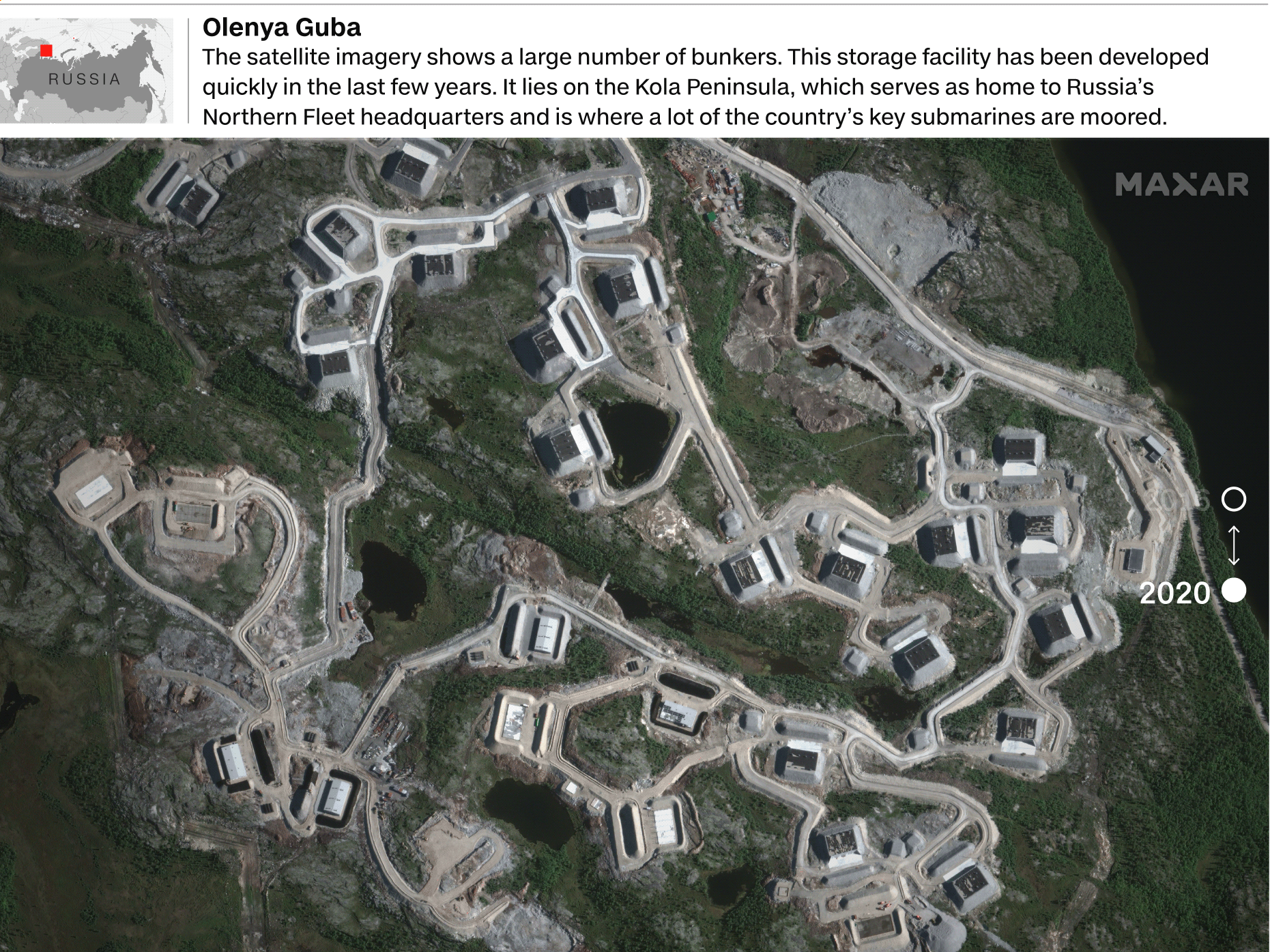
Satellite images provided to CNN by space technology company Maxar detail a stark and continuous build-up of Russian military bases and hardware on the country's Arctic coastline, together with underground storage facilities likely for the Poseidon and other new high-tech weapons.
The Russian hardware in the High North area includes bombers and MiG31BM jets, and new radar systems close to the coast of Alaska.
The Russian build-up has been matched by NATO and US troop and equipment movements.
American B-1 Lancer bombers stationed in Norway's Ørland air base have recently completed missions in the eastern Barents Sea, for example.
The US military's stealth Seawolf submarine was acknowledged by US officials in August as being in the area.
A senior State Department official told CNN: "There's clearly a military challenge from the Russians in the Arctic," including their refitting of old Cold War bases and build-up of new facilities on the Kola Peninsula near the city of Murmansk.
"That has implications for the United States and its allies, not least because it creates the capacity to project power up to the North Atlantic," the official said.
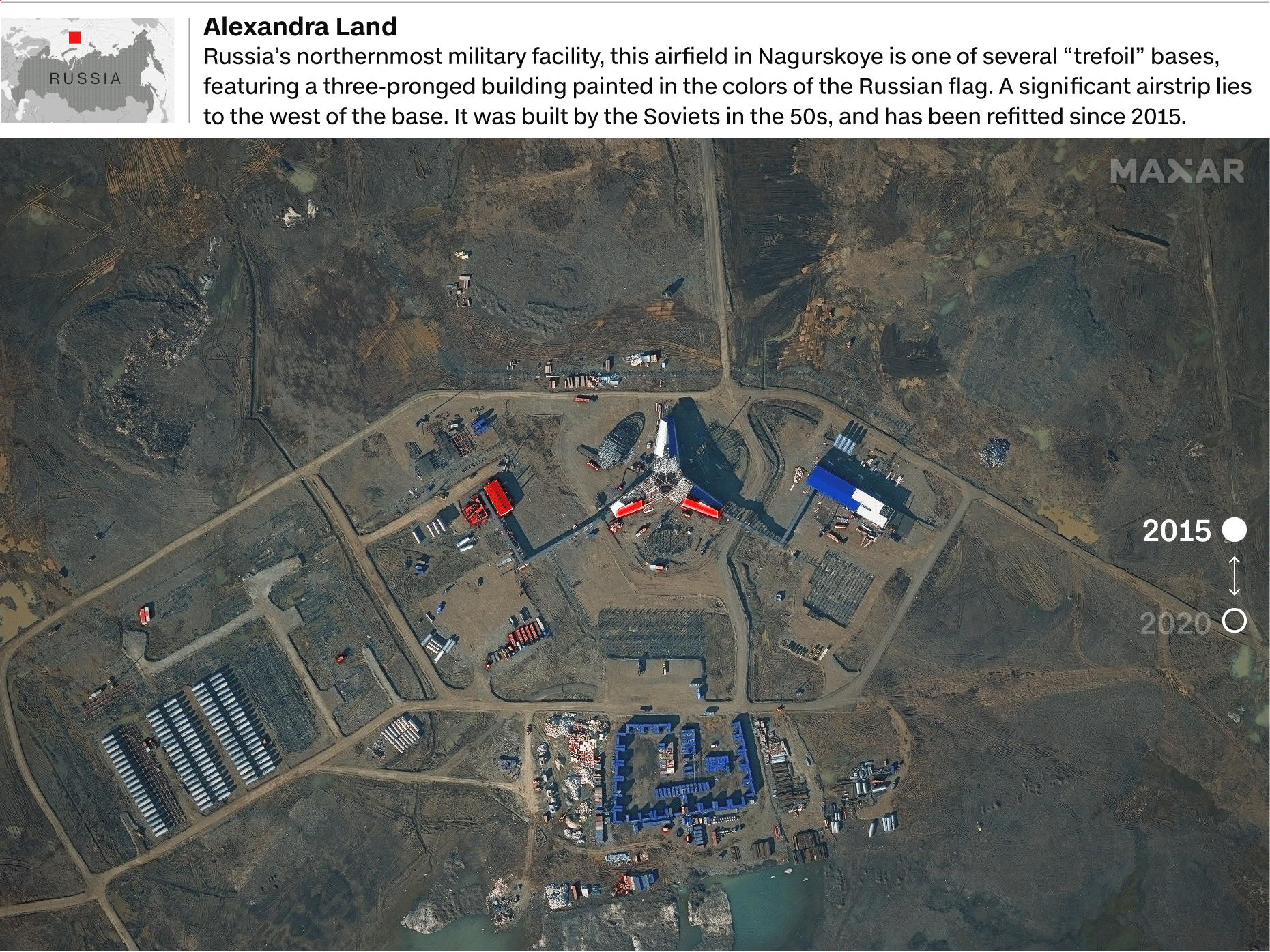
Correction: A previous version of this graphic displayed an image from 2016 instead of 2020.
This has been fixed.

Source: Satellite image ©2021 Maxar Technologies, Center for Strategic and International Studies (CSIS).
Graphic: Henrik Pettersson, CNN

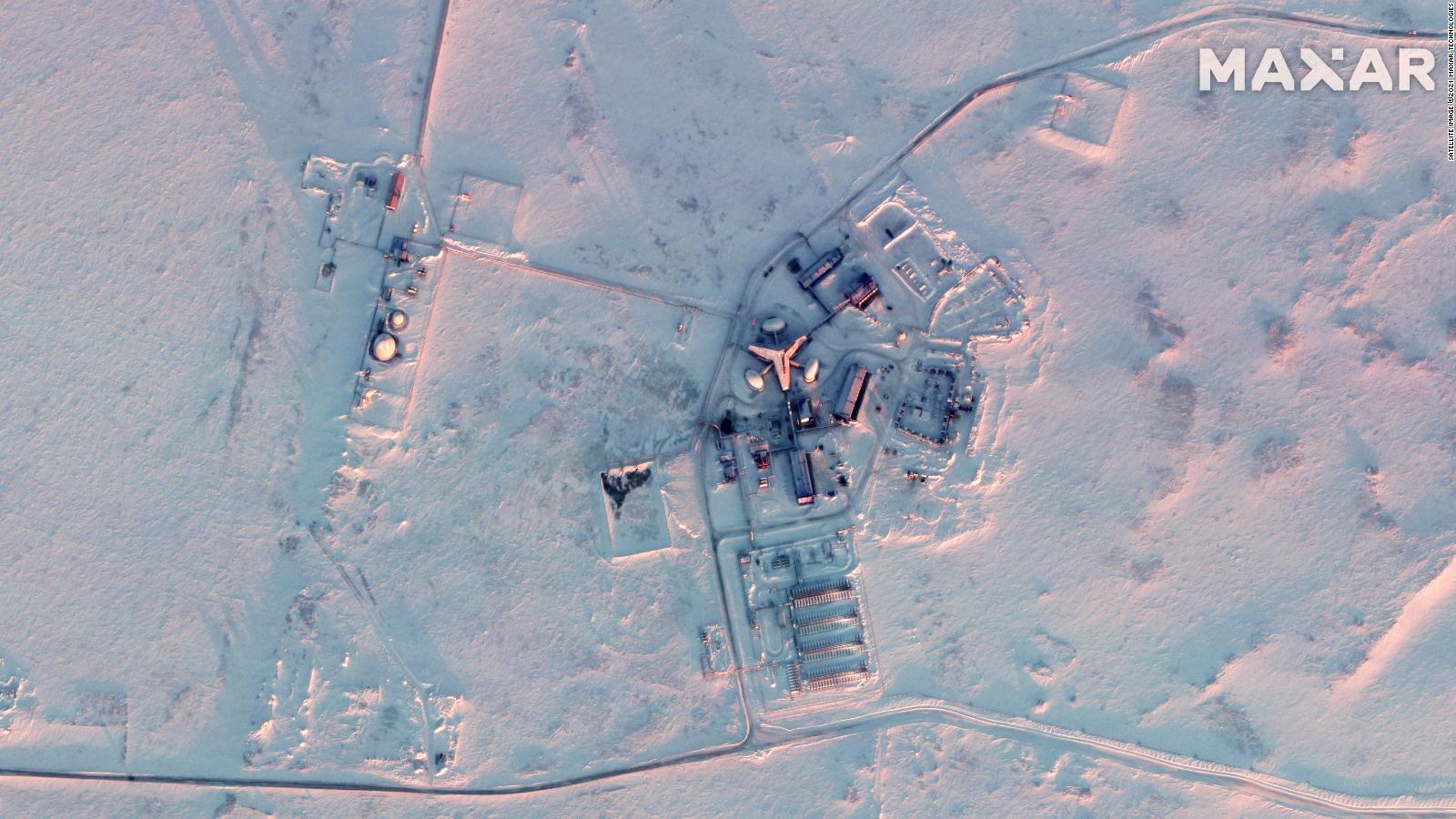
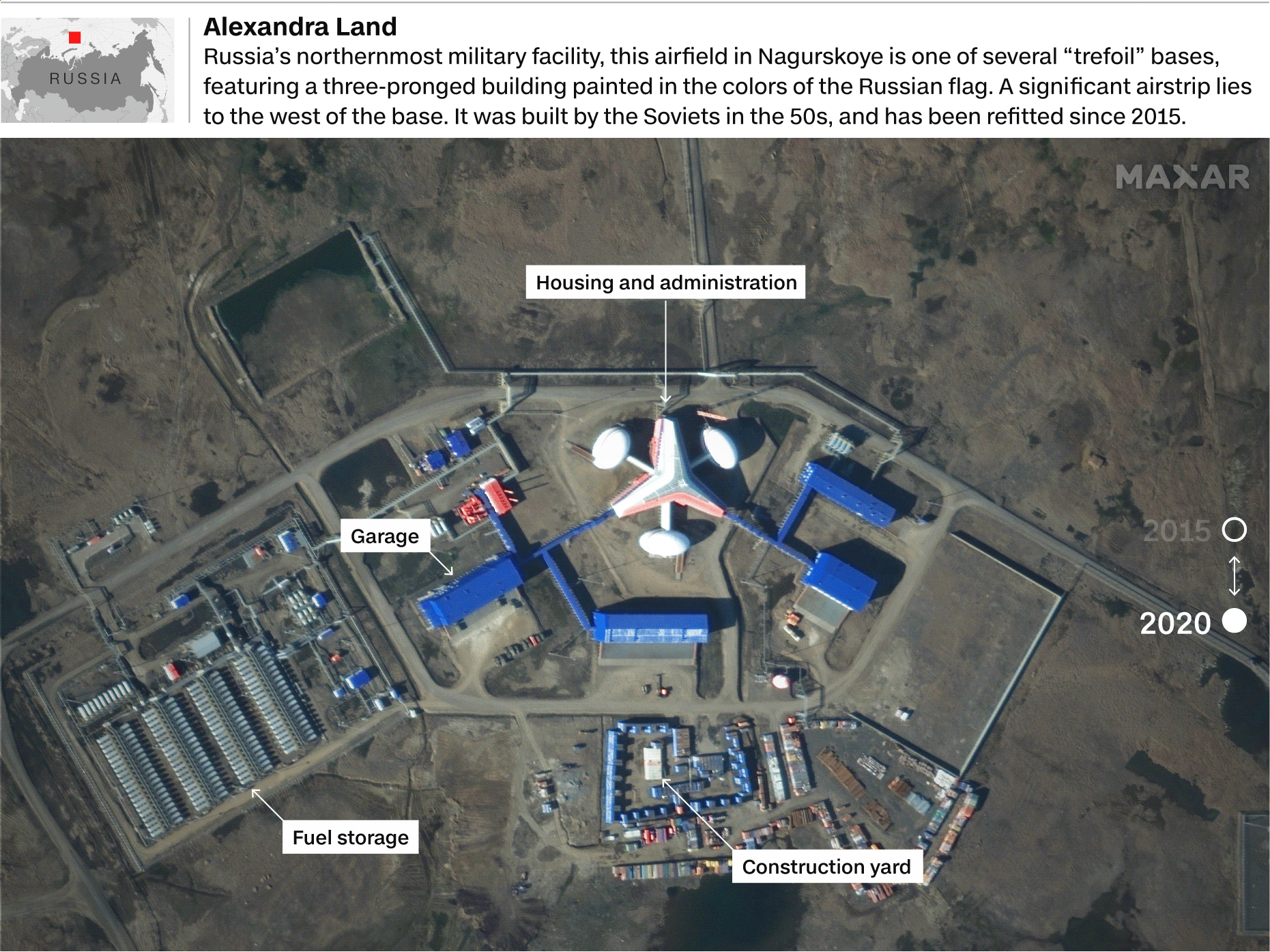
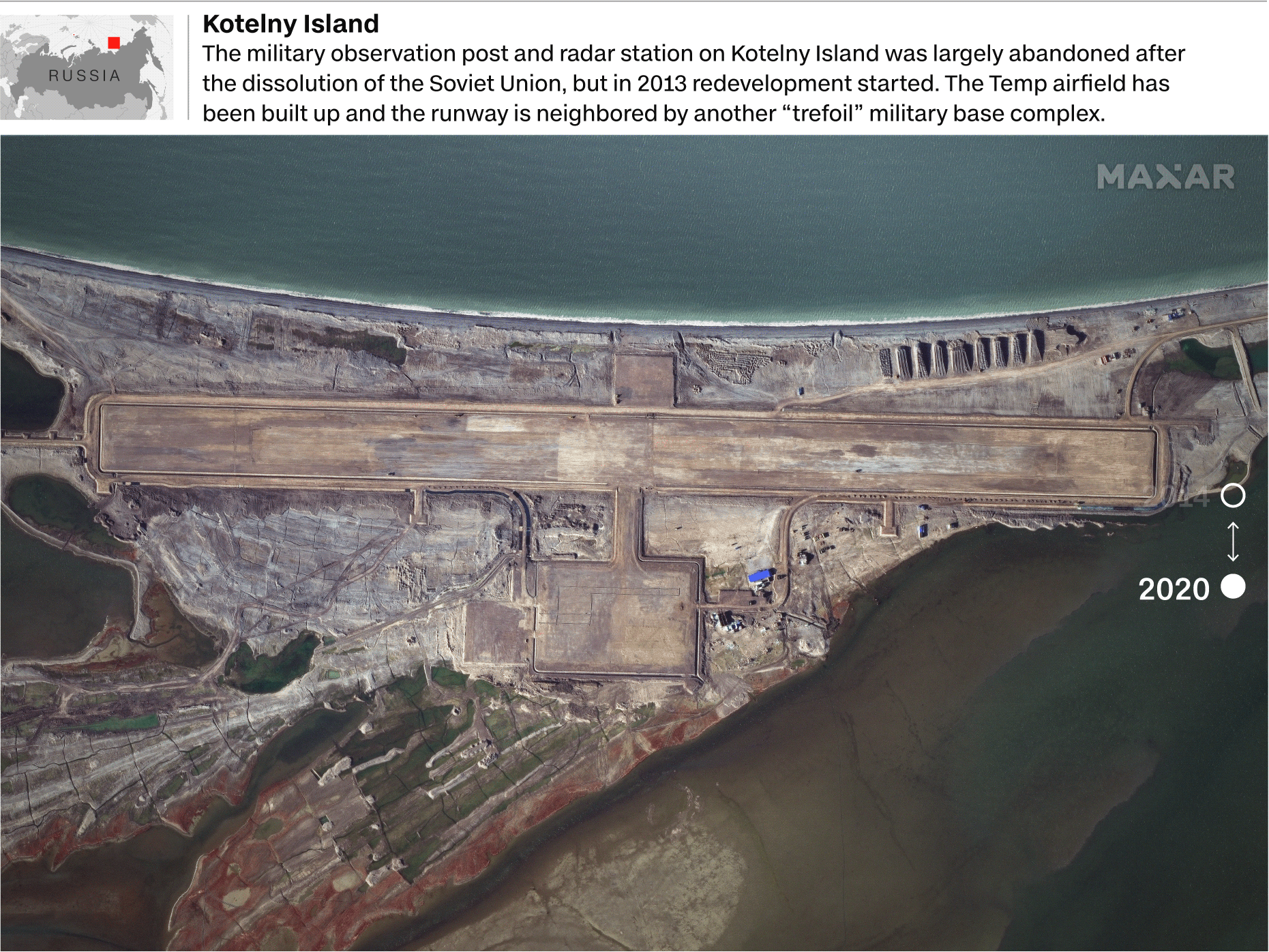
The satellite images show the slow and methodical strengthening of airfields and "trefoil" bases -- with a shamrock-like design, daubed in the red, white and blue of the Russian flag -- at several locations along Russia's Arctic coast over the past five years.
The bases are inside Russian territory and part of a legitimate defense of its borders and coastline.
US officials have voiced concern, however, that the forces might be used to establish de facto control over areas of the Arctic that are further afield, and soon to be ice-free.
"Russia is refurbishing Soviet-era airfields and radar installations, constructing new ports and search-and-rescue centers, and building up its fleet of nuclear- and conventionally-powered icebreakers," Lt.
Col. Thomas Campbell, a Pentagon spokesman, told CNN.


The 50 Let Pobedy (50 years of victory) icebreaker moving through the Arctic ice, said to be in January this year, in a first transit of the eastern seas in deep winter.
Credit: Rosatom State Nuclear Energy Corporation
 
"It is also expanding its network of air and coastal defense missile systems, thus strengthening its anti-access and area-denial capabilities over key portions of the Arctic," he added.
Campbell also noted the recent creation of a Quick Reaction Alert force at two Arctic airfields -- Rogachevo and Anadyr -- and the trial of one at Nagurskoye airfield last year.
Satellite imagery from March 16 shows probable MiG31BMs at Nagurskoye for what is thought to be the first time, bringing a new capability of Russian stealth air power to the far north.
High-tech weapons are also being regularly tested in the Arctic area, according to Russian officials quoted in state media and Western officials.
Campbell added that in November, Russia claimed the successful test of the 'Tsirkon' anti-ship hypersonic cruise missile.

The Tsirkon and the Poseidon are part of a new generation of weapons pledged by Putin in 2018 as strategic game changers in a fast-changing world.
At the time US officials scorned the new weapons as technically far-fetched and improbable, yet they appear to be nearing fruition.
The Norwegian intelligence chief Stensønes told CNN the Tsirkon as a "new technology, with hypersonic speeds, which makes it hard to defend against."
On Thursday, Russian state news agency TASS cited a source in the military industrial complex as saying there had been another successful test of the Tsirkon from the Admiral Gorshkov warship, saying all four test rockets had hit their target, and that another more advanced level of tests would begin in May or June.
The climate emergency has removed many of Russia's natural defenses to its north, such as walls of sheet ice, at an unanticipated rate.
"The melt is moving faster than scientists predicted or thought possible several years ago," said the senior State Department official.
"It's going to be a dramatic transformation in the decades ahead in terms of physical access."

Source: Satellite image ©2021 Maxar Technologies, Center for Strategic and International Studies (CSIS).
Graphic: Henrik Pettersson, CNN

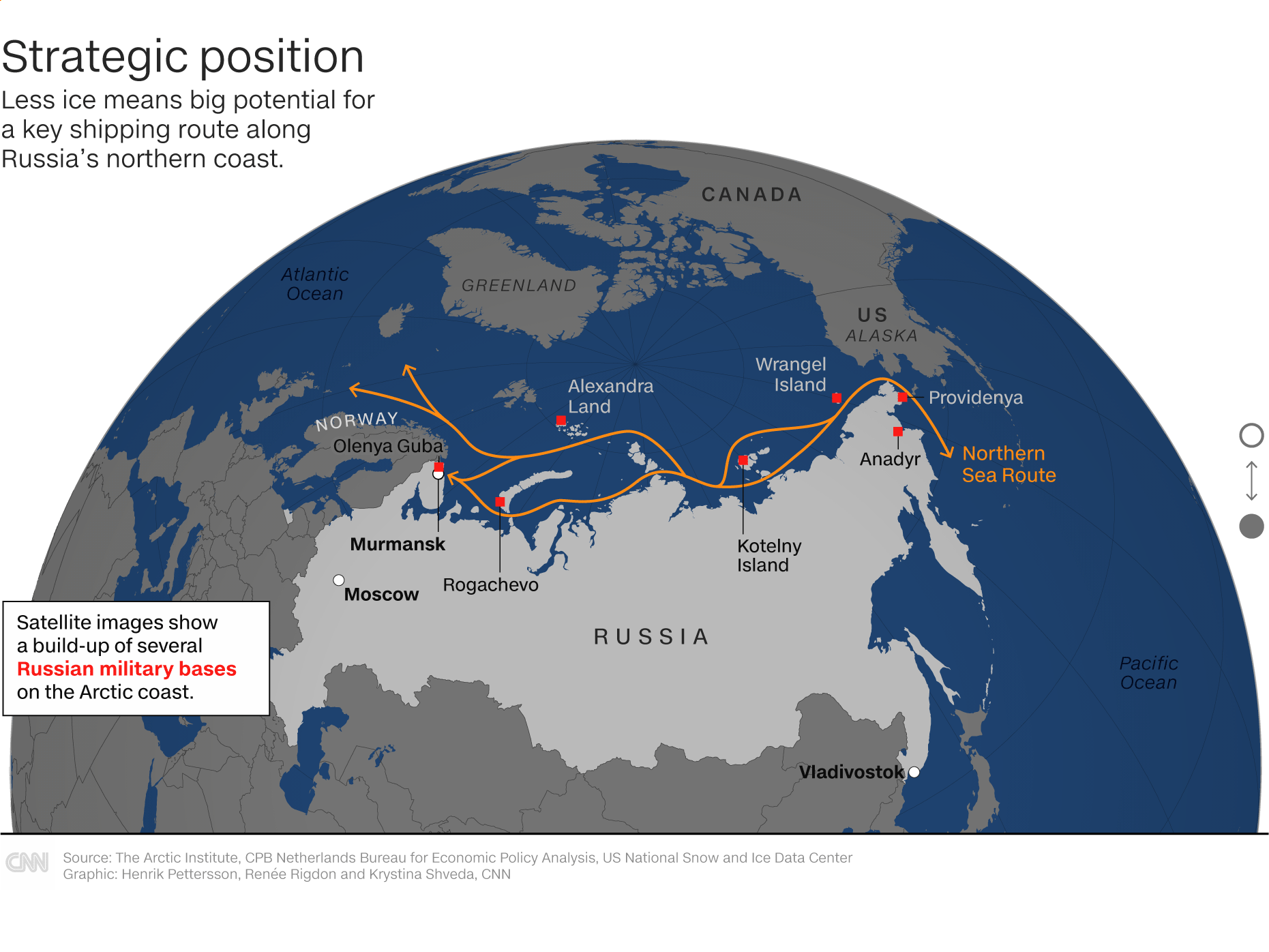
US officials also expressed concern at Moscow's apparent bid to influence the "Northern Sea Route" -- a shipping lane that runs from between Norway and Alaska, along Russia's northern coast, across to the North Atlantic.
The 'NSR' potentially halves the time it currently takes shipping containers to reach Europe from Asia via the Suez Canal.
Russia's Rosatom state nuclear company released elaborately produced drone video this February of the 'Christophe de Margerie' tanker completing an eastern route across the Arctic in winter for the first time, accompanied by the '50 Let Pobedy' nuclear icebreaker for its journey in three of the six Arctic seas.
Campbell said Russia sought to exploit the NSR as a "major international shipping lane," yet voiced concern at the rules Moscow was seeking to impose on vessels using the route.
"Russian laws governing NSR transits exceed Russia's authority under international law," the Pentagon spokesman said.

"They require any vessel transiting the NSR through international waters to have a Russian pilot onboard to guide the vessel.
Russia is also attempting to require foreign vessels to obtain permission before entering the NSR."
The senior State Department official added: "The Russian assertions about the Northern Sea Route is most certainly an effort to lay down some rules of the road, get some de facto acquiescence on the part of the international community, and then claim this is the way things are supposed to work."


Elizabeth Buchanan, lecturer of Strategic Studies at Deakin University, Australia, said that "basic geography affords Russia the NSR which is increasingly seeing thinner ice for more of the year making it commercially viable to use as a transport artery.
This might yet transform global shipping, and with it the movements of 90+% of all goods globally."
The State Department official believes the Russians are mostly interested in exporting hydrocarbons -- essential to the country's economy -- along the route, but also in the resources being uncovered by the fast melt.
The flexing of their military muscles in the north -- key to Moscow's nuclear defense strategy, and also mostly on Russian coastal territory -- could be a bid to impose their writ on the wider area, the official said.

"When the Russians are testing weapons, jamming GPS signals, closing off airspace or sea space for exercises, or flying bombers over the Arctic along the airspace of allies and partners, they are always trying to send a message," the official added.

Russia insists motives are peaceful and economic

Russia's foreign ministry declined to comment, yet Moscow has long maintained its goals in the Arctic are economic and peaceful.

A March 2020 document by Kremlin policymakers presented Russia's key goals in an area behind 20% of its exports and 10% of its GDP.
The strategy focuses on ensuring Russia's territorial integrity and regional peace.
It also expresses the need to guarantee high living standards and economic growth in the region, as well as developing a resource base and the NSR as "a globally competitive national transport corridor."
Putin regularly extols the importance of Russia's technological superiority in the Arctic.
In November, during the unveiling of a new icebreaker in St. Petersburg, the Russian President said: "It is well-known that we have a unique icebreaker fleet that holds a leading position in the development and study of Arctic territories.
We must reaffirm this superiority constantly, every day."
Putin said of a submarine exercise last week in which three submarines surfaced at the same time in the polar ice: "The Arctic expedition ... has no analogues in the Soviet and the modern history of Russia."
Among these new weapons is the Poseidon 2M39.
The plans for this torpedo were initially revealed in an apparently purposeful brandishing of a document discussing its capabilities by a Russian general in 2015.
It was subsequently partially dismissed by analysts as a 'paper tiger' weapon, meant to terrify with its apocalyptic destructive powers that appear to slip around current treaty requirements, but not to be successfully deployed.


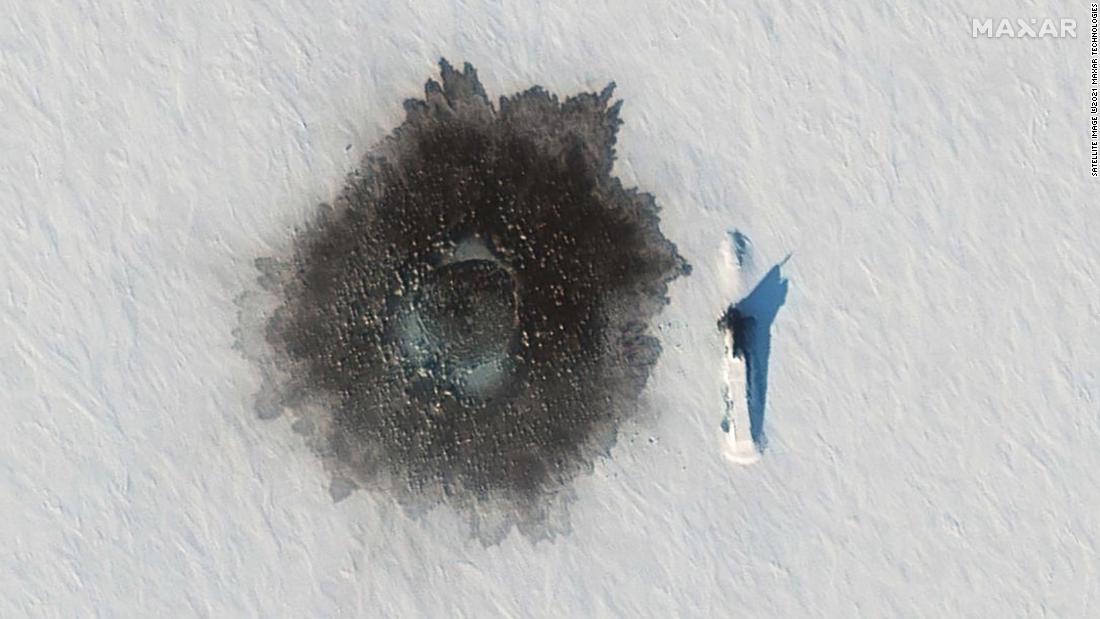
A Russian Delta IV submarine photographed on top of ice near Alexandra Island on March 27, during an exercise, with a likely hole blown in the ice to its left from underwater demolition.
 
Yet a series of developments in the Arctic -- including, according to Russian media reports, the testing of up to three Russian submarines designed to carry the stealth weapon, which has been suggested to be 20 meters long -- have now led analysts to consider the project real and active.

Russia's state news agency, RIA Novosti, cited a "source" on Monday saying that tests for the Belgorod submarine, especially developed to be armed with the Poseidon torpedo, would be completed in September.
Manash Pratim Boruah, a submarine expert at Jane's Fighting Ships, said: "The reality of the weapon is clear.
You can absolutely see development around the torpedo, which is happening.
There is a very good probability that the Poseidon will be tested, and then there is a danger of it polluting a lot.
Even without a warhead, but definitely with just a nuclear reactor inside."
Boruah said some of the specifications for the torpedo leaked by the Russians were optimistic and doubted it could reach a speed of 100 knots (around 115 miles per hour) with a 100MW nuclear reactor.
He added that at such a speed, it would probably be detected quite easily as it would create a large acoustic signature.
"Even if you tone it down from the speculation, it is still quite dangerous," he said.
 
Source: Satellite image ©2021 Maxar Technologies, Center for Strategic and International Studies (CSIS).
Graphic: Henrik Pettersson, CNN
 
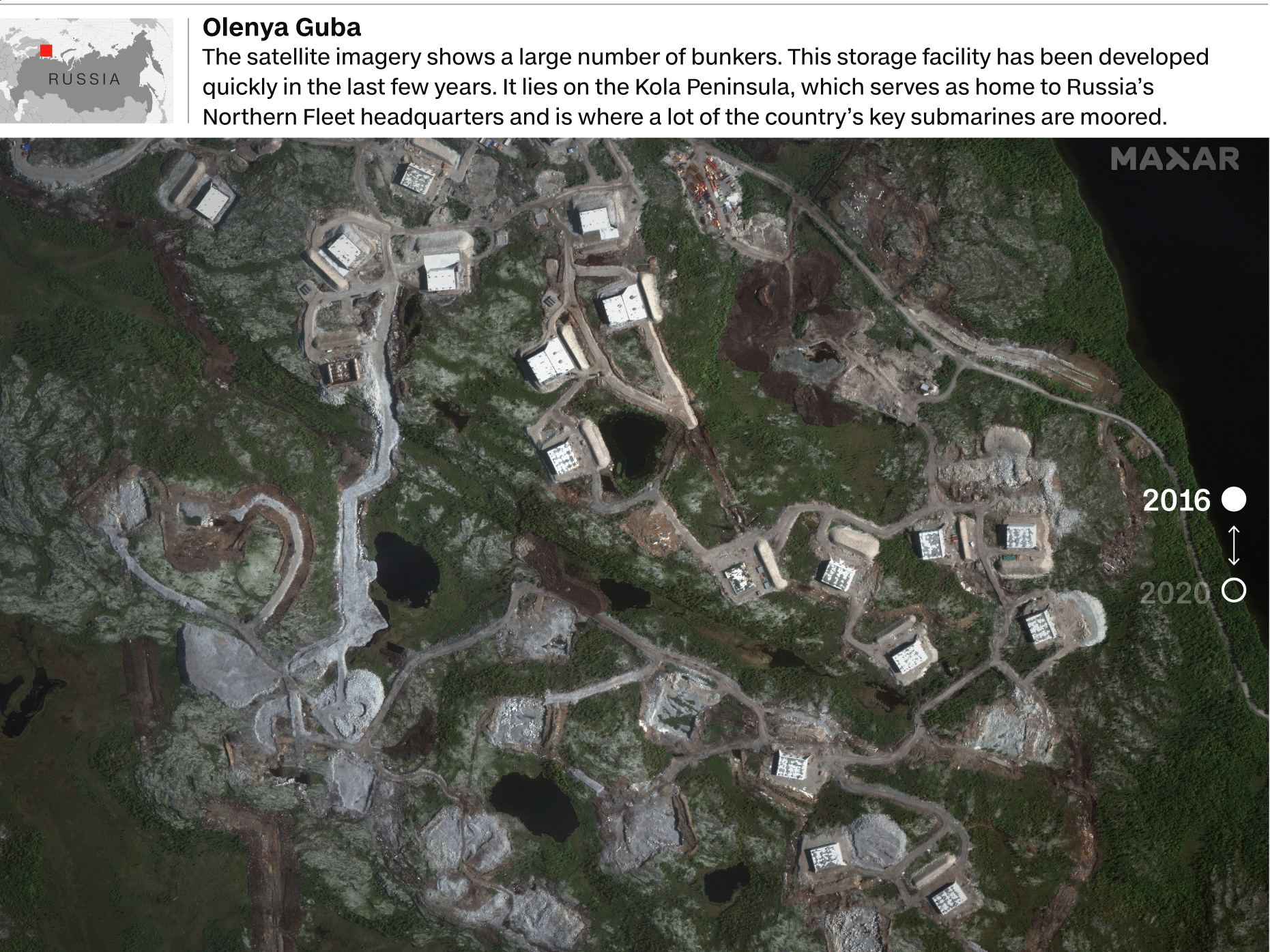
Boruah added that the construction of storage bays for the Poseidon, probably around Olenya Guba on the Kola Peninsula, were meant to be complete next year.
He also expressed concerns about the Tsirkon hyper-sonic missile that Russia says it has tested twice already, which at speeds of 6 to 7 Mach would "definitely cause a lot of damage without a particularly having big warhead itself."
Katarzyna Zysk, professor of international relations at the state-run Norwegian Institute for Defence Studies, said the Poseidon was "getting quite real," given the level of infrastructure development and testing of submarines to carry the torpedo.

"It is absolutely a project that will be used to scare, as a negotiation card in the future, perhaps in arms control talks," Zysk said.
"But in order to do so, it has to be credible.
This seems to be real."
Stensønes also raised the concern that testing such nuclear weapons could have serious environmental consequences.
"We are ecologically worried.
This is not only a theoretical thing: in fact, we have seen serious accidents in the last few years," he said, referring to the testing of the Burevestnik missile which was reported to have caused a fatal nuclear accident in 2019.
"The potential of a nuclear contamination is absolutely there."
 
Links :

Thursday, April 8, 2021

USS Johnston: Sub dives to deepest-known shipwreck

World’s deepest-known shipwreck finally seen.
 
From BBC by Rebecca Morelle

The USS Johnston has been relocated, surveyed and filmed at a depth of 6,456m in the Philippine Sea

A submersible has dived to the world’s deepest-known shipwreck.

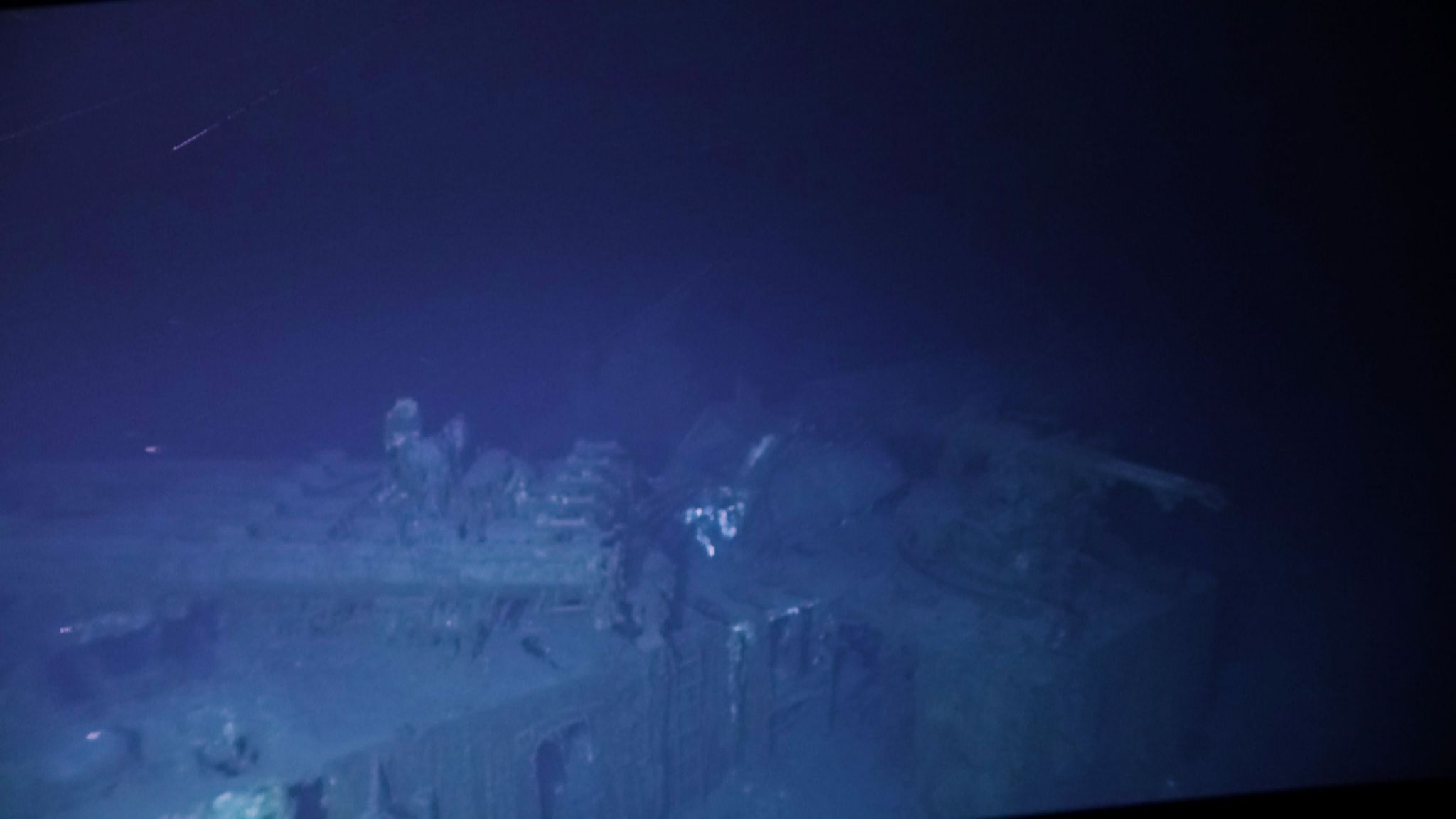
The vessel reached the USS Johnston, which lies 6.5km (4 miles) beneath the waves in the Philippine Sea in the Pacific Ocean.

Explorers spent several hours surveying and filming the wreck over a series of dives.

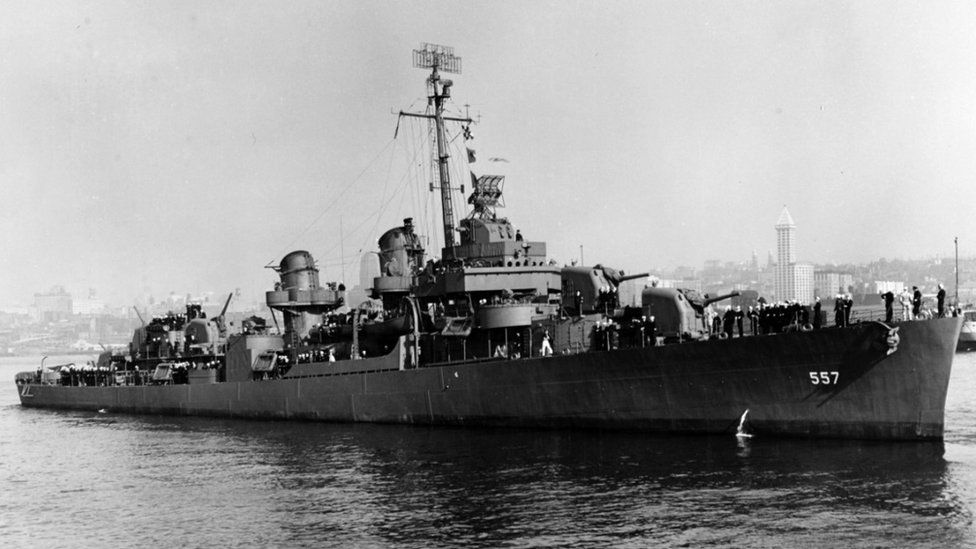
The 115m-long US Navy destroyer sank during the Battle off Samar in 1944 after a fierce battle with a large fleet of Japanese warships.

Victor Vescovo, who led the expedition and piloted the sub, said: “The wreck is so deep so there's very little oxygen down there, and while there is a little bit of contamination from marine life, it's remarkably well intact except for the damage it took from the furious fight.”

 
The destroyer was in good condition apart from the damage it sustained from the battle

The remains of the USS Johnston were first discovered in 2019, and parts of the destroyer were filmed with a remotely operated vehicle (ROV).

But a large part of the wreckage lay deeper than the ROV was able to reach, so for this expedition a submersible called the DSV Limiting Factor was deployed.

Only 141 of the USS Johnston's 327 crew survived the battle

The vessel has a 9cm-thick (3.5in) titanium pressure hull that two people can fit inside, and it is able to descend to any depth.
Previously it has explored the deepest place in the ocean, the Mariana Trench, which lies almost 11km down, as well as the Titanic.

It took several dives to relocate the wreck of the USS Johnston, but then Victor Vescovo, along with engineer Shane Eigler on one dive and naval historian Parks Stephenson on another, were able to spend time surveying and filming the destroyer.


Samar island, Philippines with the GeoGarage platform (NGA nuatical raster chart)
 
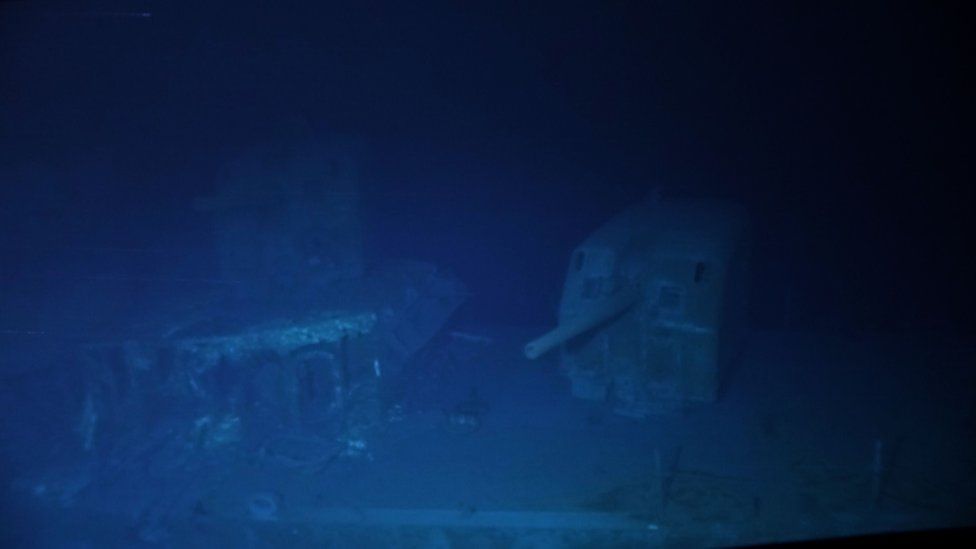
Mr Vescovo said that the hull number – 557 – was clearly visible on both sides of its bow, and two full gun turrets were also intact.
“The gun turrets are right where they're supposed to be, they're even pointing in the correct direction that we believe that they should have been, as they were continuing to fire until the ship went down,” he explained.
“And we saw the twin torpedo racks in the middle of the ship that were completely empty because they shot all the torpedoes at the Japanese.”

Image copyright Victor Vescovo /Caladan Oceanic
The team saw two forward gun mounts during the dive

The team is now working with naval historians in the hope of shedding more light on the World War Two battle.

The relatively small USS Johnston was heavily outnumbered by the Japanese fleet, which included Japan’s largest battleship, but was awarded for its courage under heavy fire
Of the crew of 327, only 141 survived the battle.
No human remains or clothing were found during the expedition, and the team laid wreaths before and after the dives.

 
Links :