Tuesday, May 31, 2011

Whale hunting : tradition versus animal conservation

Whale Hunting from bobby gunawan

Some people understand the seas in a way modern science cannot comprehend.
Yet this understanding has stemmed from extreme isolation and the ability of communities to exist on even the smallest land masses and to harvest bounty that can be seen below the waves or beyond the horizon.

On the
island of Lembata in Indonesia the fishermen of Lamalera continue to hunt 75ft sperm whales by leaping from their boats onto the whale's back armed only with a harpoon.
It's fraught with danger, a real Moby Dick scenario, but a single whale provides for the whole village.

A speck in the Pacific Ocean, Anuta is less than half a mile wide and over 70 miles from its nearest neighbour.
Fish and yams make up the people's diet, but once or twice a year when the trade winds change direction they sail across treacherous seas to reach the rocky island of
Fatutaka, where hundreds of sea birds are harvested.
Special, sacred outriggers are used for this journey, and the birds are captured using a traditional long pole and noose.
For the fishermen isolated in this ocean the risk to life and limb is very real.

Links :
  • DailyMail : The stone-age whale hunters who kill with their bare hands

Monday, May 30, 2011

Bubbling sea signals severe coral damage this century


AIMS scientist Dr Katharina Fabricius has led two research expeditions to study natural carbon dioxide seeps in Milne Bay Province, Papua New Guinea - the only presently known cool, carbon dioxide seep site in tropical waters containing coral reef ecosystems.
The study has given scientists unprecedented insights into what coral reefs would look like if greenhouse gas emissions and resulting ocean acidification continues to increase at present rates.

From BBC

Findings from a
"natural laboratory" in seas off Papua New Guinea suggest that acidifying oceans will severely hit coral reefs by the end of the century.

Carbon dioxide bubbles into the water from the slopes of a dormant volcano here, making it slightly more acidic.
Coral is badly affected, not growing at all in the most CO2-rich zone.

Writing in journal Nature Climate Change, the scientists say this "
lab" mimics conditions that will be widespread if CO2 emissions continue. (see AIMS media release)

The oceans absorb some of the carbon dioxide that human activities are putting into the atmosphere.
This is turning seawater around the world slightly more acidic - or slightly less alkaline.
This reduces the capacity of corals and other marine animals to form hard structures such as shells.
Projections of rising greenhouse gas emissions suggest the process will go further, and accelerate.


  • the oceans are thought to have absorbed about half of the extra CO2 put into the atmosphere in the industrial age
  • this has lowered its pH by 0.1
  • pH is the measure of acidity and alkalinity
  • the vast majority of liquids lie between pH 0 (very acidic) and pH 14 (very alkaline); 7 is neutral
  • seawater is mildly alkaline with a "natural" pH of about 8.2
  • the IPCC forecasts that ocean pH will fall by "between 0.14 and 0.35 units over the 21st Century, adding to the present decrease of 0.1 units since pre-industrial times"
"This is the most realistic experiment done to date on this issue," said Chris Langdon, a coral specialist from the Rosenstiel School of Marine and Atmospheric Science in Miami, US.
"So I don't have any qualms about believing that what we found will apply in other parts of the world."

The water becomes progressively more acidic closer to the vents that are bubbling CO2.
This allows the researchers to study the impacts on coral at different levels of acidity.

Seawater has an average pH of about 8.1; this is already about 0.1 lower than before the industrial age and the large-scale human emissions of greenhouse gases associated with it.
The Intergovernmental Panel on Climate Change (IPCC) projects that by the end of the century, emissions may have risen so much that pH may fall to 7.8.
In the Papua New Guinea site, few types of coral grew at pH7.8.

Reefs still formed, but were dominated by one particular type, the
Porites, which form massive shapes largely devoid of the branches and fronds that characterise reefs rich in species.
"We saw only a few speces of coral, and none of the structually complex ones that provide a lot of cover for fish," Professor Langdon told BBC News..

"The much simpler forms support many fewer species, and theory suggests they create an environment that would be very vulnerable to other stresses."

In an even more acid part of the study site, with a pH of 7.7, the scientists report that "reef development ceased".
Here, seagrasses dominate the floor - but they lack the hard-shelled snails that normally live on their fronds.

This is the second published study of a "natural lab" for ocean acidification.

The first, from a site in Mediterranean, found snails with their shells disintegrating; but the PNG site offers a snapshot of the future that might be more applicable to the world's tropical coral hotspots.
"The results are complex, but their implications chilling," commented
Alex Rogers from the University of Oxford, who was not part of the study team.
"Some may see this as a comforting study in that coral cover is maintained, but this is a false perception; the levels of seawater pH associated with a 4C warming completely change the face of reefs.
"We will see the collapse of many reefs long before the end of the century."

The scientific team behind the new research, drawn from Australia, Germany and the US, suggests that the picture from PNG may underplay the threat.
Reefs in the acidic zones of the study site receive regular doses of larvae floating in from nearby healthy corals, replenishing damaged stocks.

This would not be the case if low pH levels pertained throughout the oceans.

In addition, corals at the site are only minimally affected by other threats; there is little fishing, local pollution, or disease.
By contrast, a
major survey published earlier this year found that three-quarters of the world's reefs were at risk - 95% in southeast Asia - with exploitative and destructive fishing being the biggest immediate threat.

Links :
  • TheGuardian : Ocean acidification is latest manifestation of global warming
  • Physorg : Ocean acidification will likely reduce diversity, resiliency in coral reef ecosystems: new study

Sunday, May 29, 2011

Ocean life captured series stunning pictures

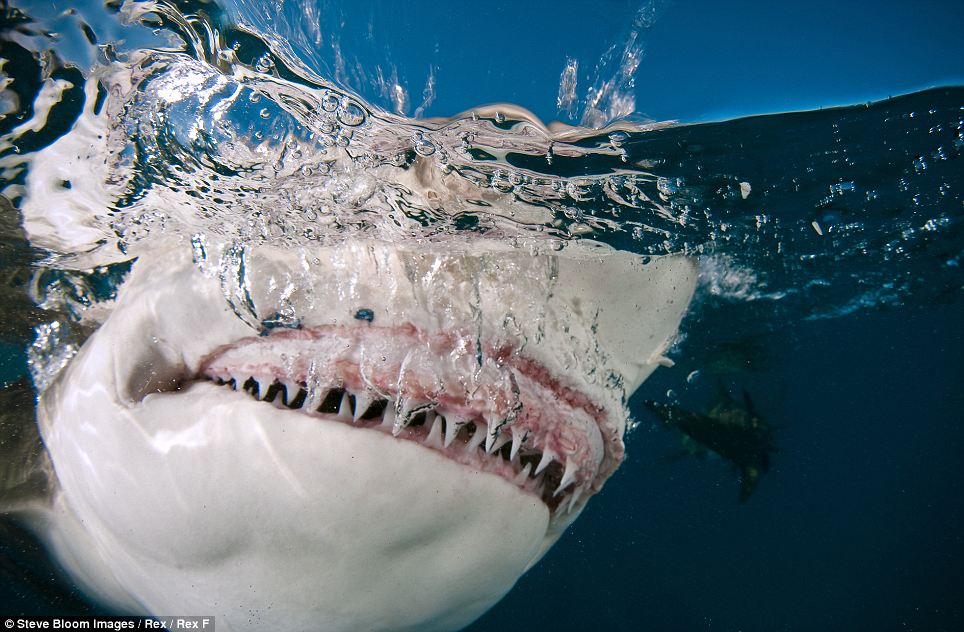
A lemon shark snapping at the surface of the water in the Bahamas

From TheDailyMail

Our oceans are thriving with a veritable cornucopia of life - much of which is rarely, if ever, seen.
It is believed that between 50 and 80 per cent of all life on earth is found hidden under the surface of these bodies of water.
Our oceans contain 99 per cent of the living space on the planet and less than 10 per cent of this vast expanse has been explored by humans.


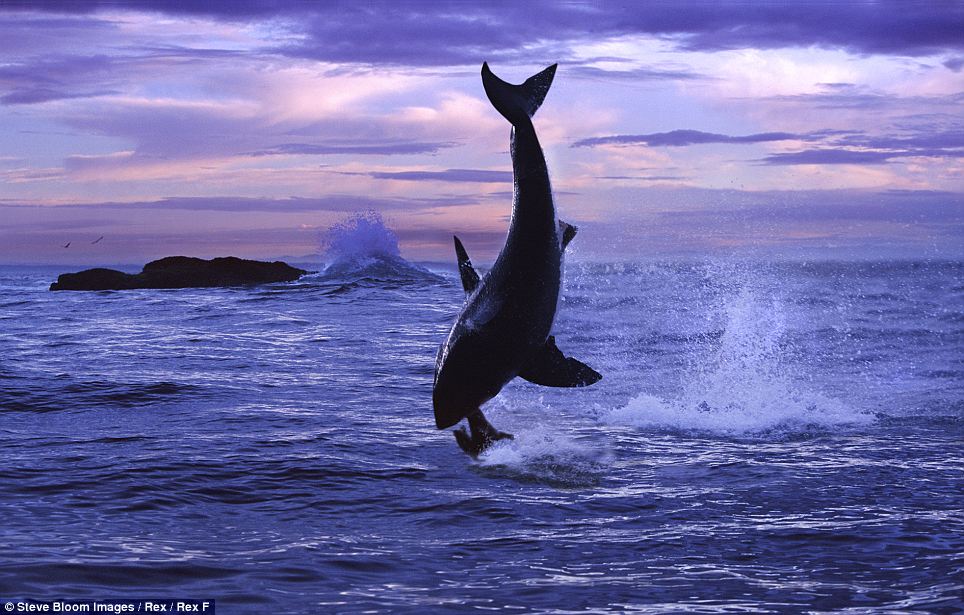
A great white shark hunting seal in South Africa

'Into the Deep', presented by Steve Bloom Images, celebrates the startling variety of life found in the world's oceans and sheds some light on the weird and wonderful creatures who thrive in this mysterious abyss (see gallery).

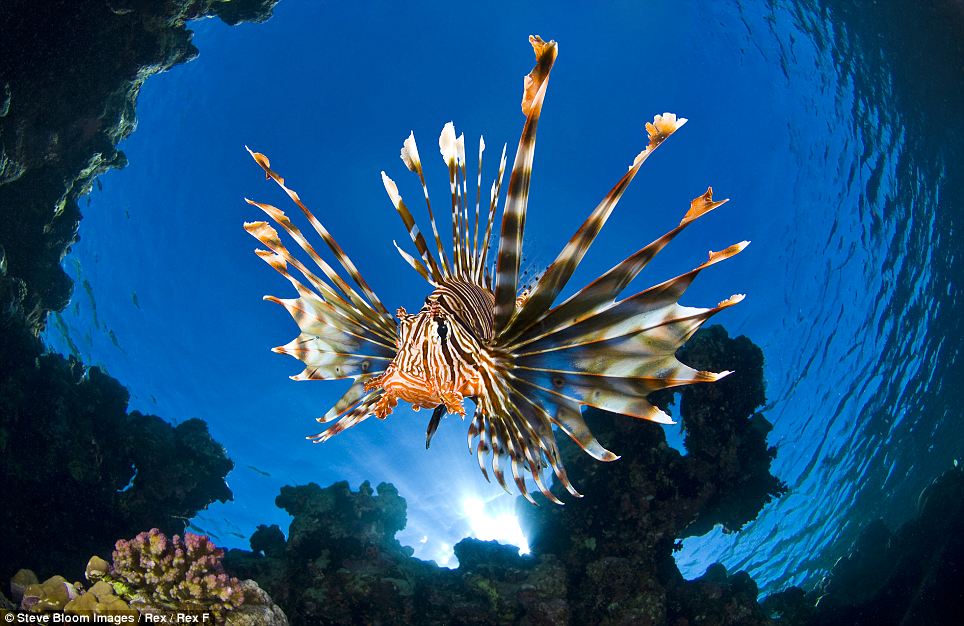
A lionfish (Pterois volitans) gently coasting along in Egypt's Red Sea

Everything from the denizens of the deep who never see light of day, to the strange sealife that populates the wider ocean is seen in this serie of pictures.
The images start at the surface of the ocean and travel downwards - capturing what goes on beneath the waves and away from our view.

Links :

Saturday, May 28, 2011

Jellyfish lake, Palau

JELLYFISH LAKE, PALAU from Sarosh Jacob

Jellyfish Lake is located on Eli Malk island in the Republic of Palau.
>>> geolocalization with the Marine GeoGararage <<<


Twelve thousand years ago these jellyfish became trapped in a natural basin on the island when the ocean receded.
With no predators amongst them for thousands of years, they evolved into a new species that lost most of their stinging ability as they no longer had to protect themselves.
They are pretty much harmless to humans although some people with very sensitive skin may get a minor irritation from them.

These fascinating creatures survive by sharing a symbiotic relationship with algae that live inside of them.
At night, the jellyfish go down to the depths of the lake where the algae feed on nutrients.
During the day, the jellyfish come back to the surface and follow the sun across the lake in a massive migration.
The algae convert the energy of the sun via photosynthesis into a sugar that feeds the jellyfish.

It is not possible to scuba dive in this lake because the nutrient rich layer at around 50 feet and below contains hydrogen sulphide which is highly toxic to humans.
If a scuba diver was to swim in that layer, the toxins would enter the body through the skin and that exposure could be fatal.
Snorkeling however, is perfectly safe and if you ever find yourself in Palau one day, you should make your way to this special place.
The experience of swimming through millions of jellyfish is quite surreal and Palau is the only place in the world where you can do just that!

Friday, May 27, 2011

The man who swims with coelacanths


From Arkive

From Wired

More than seven decades later, the words have the same urgency as when they rolled off
Marjorie Courtinay-Latimer’s telegraph machine and into history:
MOST IMPORTANT PRESERVE SKELETON AND GILLS = FISH DESCRIBED.

Courtinay-Latimer was the young curator of a natural history museum on South Africa’s east coast.
The message came from
J.L.B. Smith, an icthyologist to whom she’d turned when, shortly before Christmas in 1938, local fishermen brought her a fish unlike any they’d ever seen.

Caught at a depth of 240 feet, it was five feet long, covered in bony scales and had fins reminiscent of legs.
Courtinay-Latimer immediately sent a sketch to Smith, who thought it looked like a
coelacanth.
There was just one catch:
Coelacanths were extinct, and had been for 70 million years.

The sketch sent by Marjorie Courtinay-Latimer to J.L.B. Smith.
South African Institute for Aquatic Biodiversity


Smith’s famous cable came too late, as Courtinay-Latimer didn’t have an aquarium large enough to preserve the fish.
But even as they despaired, it was just weeks before another arrived.
Far from being extinct,
coelacanths were actually caught with some regularity by native fishermen of the Comoros Islands, on whose rocky undersea slopes they’d lived since swimming with dinosaurs.

The coelacanths of the Comoros Islands, along with
another population discovered in Indonesia, are now celebrities of the animal kingdom, and nobody has spent more time with them than Hans Fricke.
In 1986, the German explorer and then-freelance photographer convinced a magazine editor to send him and a submarine to the Comoros.
Since then he’s led more than 400 dives, helping to produce much of what is now known about coelacanths.

After the publication of his latest work, published in Marine Biology and entitled “The population biology of the
living coelacanth studied over 21 years,” Wired.com talked to Fricke about his time with the mysterious, magnificent creatures.

Wired.com: How did your interest in coelacanths begin?
Hans Fricke: When I was young, I read the book by J.L.B. Smith, Old Four Legs.
I was a keen skin diver, because I was 11, and I said, ‘Good friend, this fish you will see once in your life.’
In 1975, I joined an expedition of the Royal Society to Aldabra Atoll, and then I went to the Comoros, where I did some very stupid, very daring scuba dives to down over 300 feet.
But I found nothing.
I said to my wife, “Next time I come here, I’m coming with a submarine.”
I said it as a bit of a joke, but the next time I came to the Comoros, in 1986, I came with a submarine.

Wired.com: Can you describe that first submersible?
Fricke: It was made by two Czechoslovakian engineers in Switzerland.
We made the first trials in Lake Constance, then I smuggled the submersible over the Swiss-German border, because I would have had to pay customs.
It was covered in a sheet and looked like an American Sherman tank.
The border policeman asked me, “Friend, what is below this sheet?” I said, “A submarine.”
He said, “No.” I said, “Yes it is. I was in the lake diving,” and told him some fish stories.
He found it really interesting, and forgot to ask the crucial question: if I’d paid customs.

Wired.com: When did you first find a coelacanth?
Fricke: We tried hard to find the fish, but we didn’t look carefully enough, we didn’t know about its behavior.
The fish are nocturnal, and hide during the day.
I had to fly back home to Munich, and two of my friends continued for five more days.
They found it.
Of course my friends immediately called my family.
I had a stopover in Paris, called my family, and my little son said, “How is the fish?” And I said, “Which fish?”
He said, “The coelacanth!”
This was a great moment.
I had tears in my eyes.
I went back a couple weeks later, and on the first dive we found them

Wired.com: What is it like to see one?
Fricke: You immediately grasp that something is fishy with this fish.
It is not a normal fish.
Their movements are extremely slow; it has something like a mute character.
I had the feeling I had an amphibian in front of me, because of the movements of the fins.
I discovered a very funny, tetrapod-like movement of the fins, a kind of cross-step that they do.
If you were to cut a coelacanth across the middle, you’d see that it’s almost an ellipse.
If one make a downbeat with its right pectoral, the beast turns.
To counter this, it has to make a counter-downbeat on the far left side.
This produces the tetrapodic cross-step.
It’s a normal thing for an animal on land, but we’re talking about a fish.
This could be a pre-adaptation for the step to land.
They move so slowly.
J.L.B. Smith said this gives you impression they crawl on their fins at the bottom of the sea, but they don’t.
They don’t even touch with their fins.

Wired.com: If they move so slowly, how do they capture prey?
Fricke: They have a giant electroreceptor in their head, called the rostral organ.
They perceive the electric field which a swimming object in salt water produces.
Lava fields have reduced magnetic anomalies, and if you swim as a fish in this field, of course you produce in your own body an electric field which you could measure.
It is very likely the fish orientates himself via detecting magnetic anomalies in seawater.
It’s amazing — it’s a landscape like Hell, like the lava fields in Hawaii, and they go into this field and orient themselves precisely and fast.

Wired.com: How do juveniles find homes?
Fricke: We never found a juvenile.
We are very puzzled by the fact that we see only sub-adults.
That means they must live somewhere else, and we don’t know where.
We had once a pregnant female radio-marked with a pinger, and she did something extraordinary: She went down to 2,300 feet and remained for the day at that depth.
Something must have happened with her.
I believe she gave birth, but I could not follow her and see if her abdomen was still swollen and prove it.
But it makes sense that they live down there.
If a juvenile swam in front of an adult, they’d eat it.
‘They need about 12 grams of food a day. This is probably the secret of their evolutionary success.’

Wired.com: It takes three years for an embryo to develop. Why so long?
Fricke: They have the slowest metabolic rate known among vertebrates.
We made a calculation that a coelacanth needs, for its resting metabolism, 3.8 milliliters of oxygen per kilogram per hour.
A tuna needs 400 milliliters.
Because coelacanths are always burning at a low metabolic flame, they are able to live in low-energy areas, where there isn’t much food.
The lava fields are a low-product habitat.
They need about 12 grams of food a day.
This is probably the secret of their evolutionary success.
They live where hyperactive fish cannot survive.

Wired.com: Is climate change going to be a problem?
Fricke:With each water temperature increase of 10 degrees Fahrenheit, metabolic requirements are doubled, so they have to live under a special temperature regimen.
They live in areas with a temperature of 59 to 64 degrees Fahrenheit.
It’s there that their hemoglobin has the best capacity for oxygen.
They can’t live anywhere else.
They also need caves.
If there are no caves, the fish can’t survive.

We did a study with [Microsoft co-founder]
Paul Allen’s fantastic equipment, which let us dive very deep.
And the sad story in the Comoros is, the volcano is eroded below 650 feet.
There’s no place to hide there.
In 1991, when there was an El NiƱo happening, we found 40 percent fewer coelacanths in our area.
At 720 feet, it was 77 degrees Fahrenheit.
The fish would be in respirational stress.
With climate change, if the water temperature increases, they would have to go deeper, but there are no caves.
And this would be the end of the Comoros population.

Links :