
The Blue Heron, a research vessel operated by the University of Minnesota Duluth's Large Lakes Observatory.
Courtesy of UMD's Large Lakes Observatory
Courtesy of UMD's Large Lakes Observatory
From MPR news by Dan Kraker
Scientists at the University of Minnesota Duluth's Large Lakes Observatory have discovered a new microorganism in an unexpected place—hiding in the oily recesses of a Great Lakes research vessel.
The researchers made the discovery last fall, after crew members aboard the R/V Blue Heron noticed a strange knocking sound coming from the ship’s propeller system while on a research expedition on Lake Erie.
They hauled the ship out of the water at the Great Lakes Shipyard in Cleveland.
That’s when the Large Lakes Observatory’s Marine Superintendent Doug Ricketts saw a black, tar-like goop oozing out of the ship’s rudder shaft.
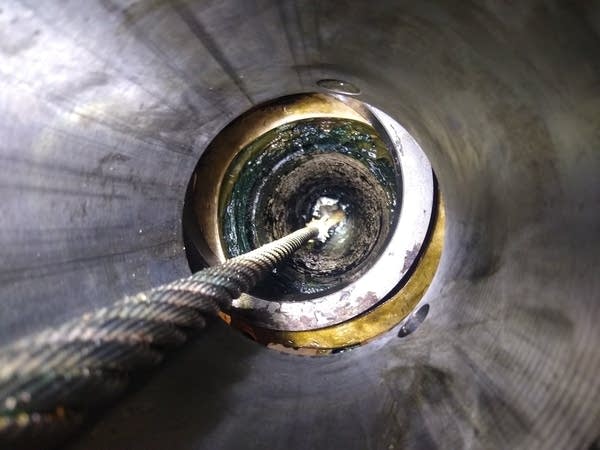
Scientists at the University of Minnesota Duluth's Large Lakes Observatory discovered novel new microbes hiding in the warm, oxygen-free environment of the rudder shaft housing of the research vessel the Blue Heron.
Courtesy of UMD's Large Lakes Observatory
Courtesy of UMD's Large Lakes Observatory
He had never seen the stuff before, and thought it was odd.
So he filled a red plastic cup full of the substance, and gave it to UMD professor Cody Shiek, a biologist who focuses on microbial ecology.
Shiek decided to sample it.
"I was completely like, we're not going to get anything off of this,” he remembers thinking.
“But surprisingly, we found DNA and it wasn’t too destroyed, nor was the biomass too low."
After sequencing the DNA and comparing it with global databases, the team confirmed they had discovered an entirely new organism, a microbial species that appeared to thrive in the warm, oily, oxygen-free environment within the ship’s rudder shaft.
Shiek and his team temporarily dubbed the substance “ShipGoo001.”
"And we don't know exactly what ShipGoo001 is good for right now,” said Catherine O'Reilly, director of the Large Lakes Observatory.
“But there's a good chance that we'll learn more about it, and it might turn out to have applications to things that we care about as a society."
For example, some organisms in the goo appear to be methane producers, O’Reilly said, potentially useful for biofuel production.
This isn’t the first time Shiek has discovered a new organism.
Far from it.
On research trips on Lake Superior aboard the Blue Heron, he said it’s common to find new species, especially in the sediment of the lake
“When we go out into the environment, we're constantly finding new organisms, and that's just because things are very under sampled,” Shiek said.
What’s different and exciting about the ship goo is that they were not looking for these organisms.
It was an accidental discovery.
“We weren’t supposed to probably see this,” he said.
Shiek has studied microbes living in extreme environments from Lake Superior, to deep ocean hydrothermal vents and hot springs.
This discovery highlights how much remains unknown, even in familiar, built-up environments like ships.
“I think it tells us we can discover new things everywhere. We don't have to go to Mars necessarily to find brand new things right under our noses,” O’Reilly said.
She added that it’s important to allow scientists to pursue new things without necessarily having a goal in mind.
“This shows us how how important it is to be creative as a scientist, to be open minded, to take advantage of opportunities that come to you and just explore what's right in front of you, because you really don't know what you're going to find.”
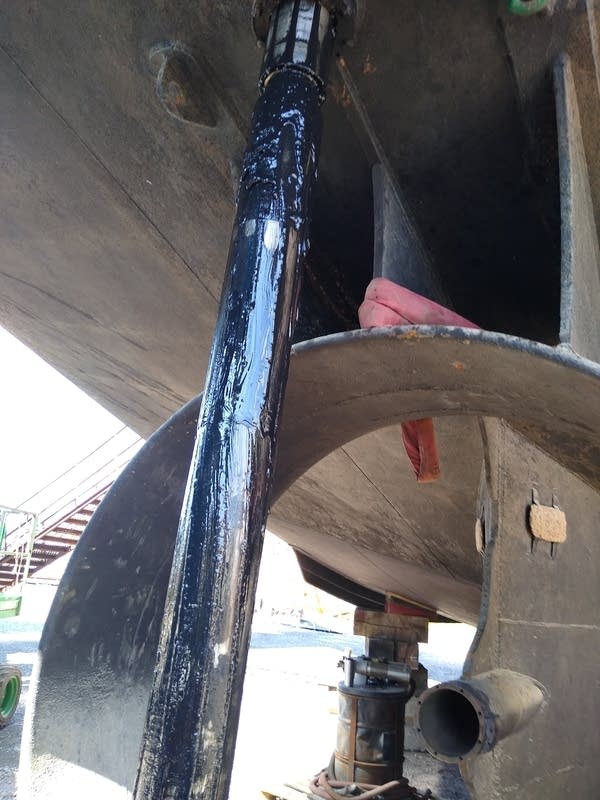
Researchers at the University of Minnesota Duluth's Large Lakes Observatory discovered new microorganisms dubbed "ShipGoo001" in a black tar-like substance on the rudder shaft of the research vessel the Blue Heron.
Courtesy of UMD's Large Lakes Observatory
Courtesy of UMD's Large Lakes Observatory
A mystery that Shiek is still trying to answer is determining where the organisms originate.
He speculates they may have been dormant in the oil used to grease the rudder, waiting until conditions were right for growth.
While ShipGoo001 is new to science, similar species have been found in tar pits and petroleum wells around the world.
Shiek said the next step in the research is to try to decipher the metabolic processes of the microbes.
“Does it eat oil? Does it breathe in metal, like iron? And so that's where we're at right now.
Thinking about how these organisms are surviving, or maybe even just thriving, in this built environment that we very rarely think about.”
And soon, the substance will receive a new scientific name.
Participants in the Large Lakes Observatory’s Freshwater Discovery Day aboard the Blue Heron on July 30 will have a chance to join Shiek in coming up with an official name for what remains, for now, ShipGoo001.
Links :

No comments:
Post a Comment