
Captain Park Sang-hyun of the HMM Emerald explains navigation equipment monitors on the bridge. [KO SUK-HYUN]
From Korea JoongAng Daily by Ko Suk-Hyun
A 24-hour AI autonomous navigation system is beginning to take a more active role on the bridge of a large container ship sailing the Pacific, with its operators saying it can help plot routes, guide the vessel’s speed and improve collision avoidance.
HMM has been testing the solution on the 13,000-twenty-foot-equivalentunit (TEU) HMM Emerald and plans to expand its application across its fleet.
HMM has been testing the solution on the 13,000-twenty-foot-equivalentunit (TEU) HMM Emerald and plans to expand its application across its fleet.
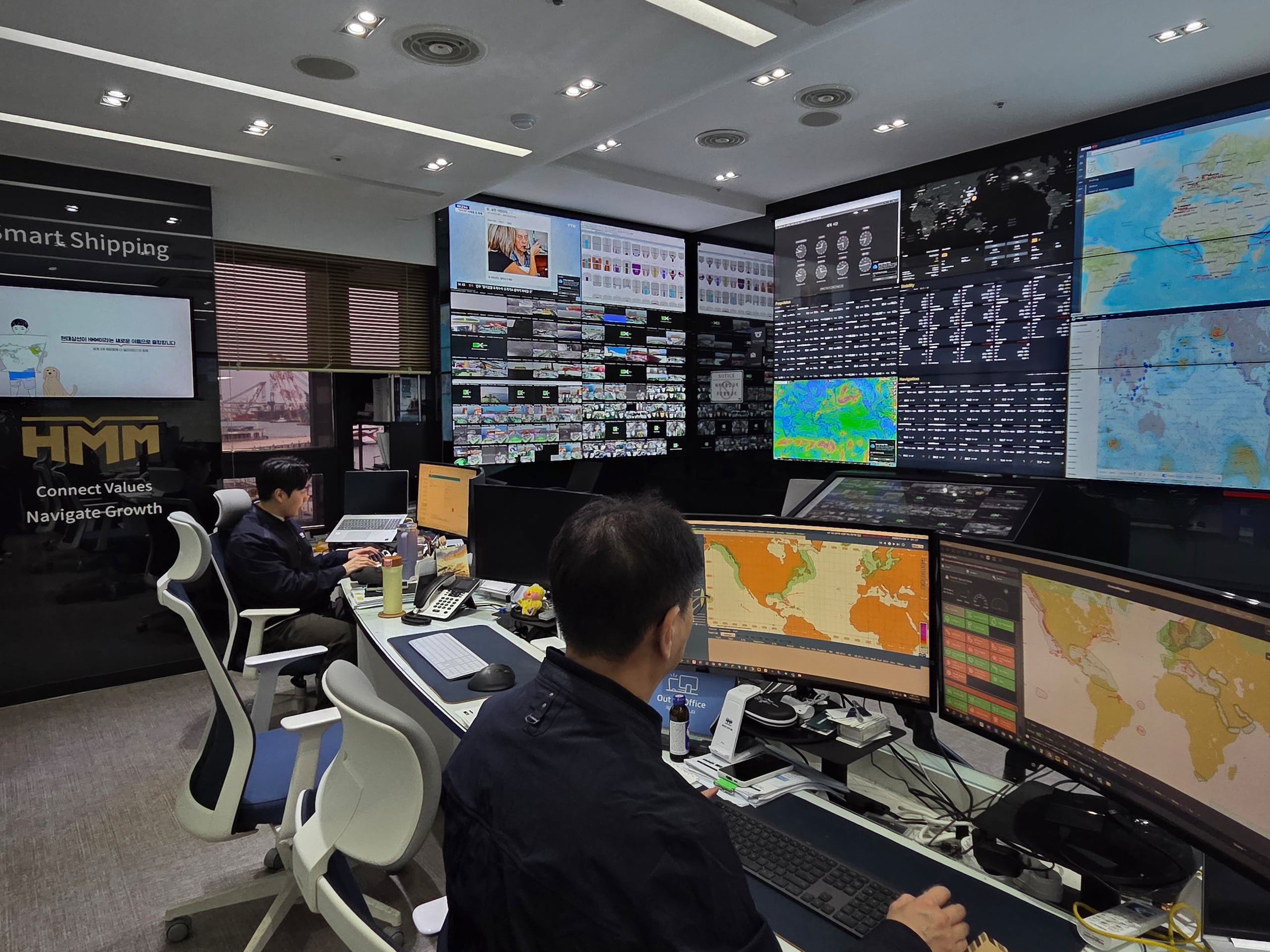
HMM's ship comprehensive situation room. /Courtesy of Han Ye-na
“It feels like we’ve gained one more savvy navigator for the long ocean-crossing voyage,” said Park Sang-hyun, the captain of the HMM Emerald, referring to the Hyundai Intelligent Navigation Assistant System (HiNAS), an AI-powered autonomous navigation solution, on Feb. 26.
Park, with 23 years at sea and nine years as a captain under his belt, said the system has proven its worth.
The 13,000-TEU container ship has been undergoing trial operations since November 2024 as the first HMM vessel to adopt HiNAS.
Park, with 23 years at sea and nine years as a captain under his belt, said the system has proven its worth.
The 13,000-TEU container ship has been undergoing trial operations since November 2024 as the first HMM vessel to adopt HiNAS.
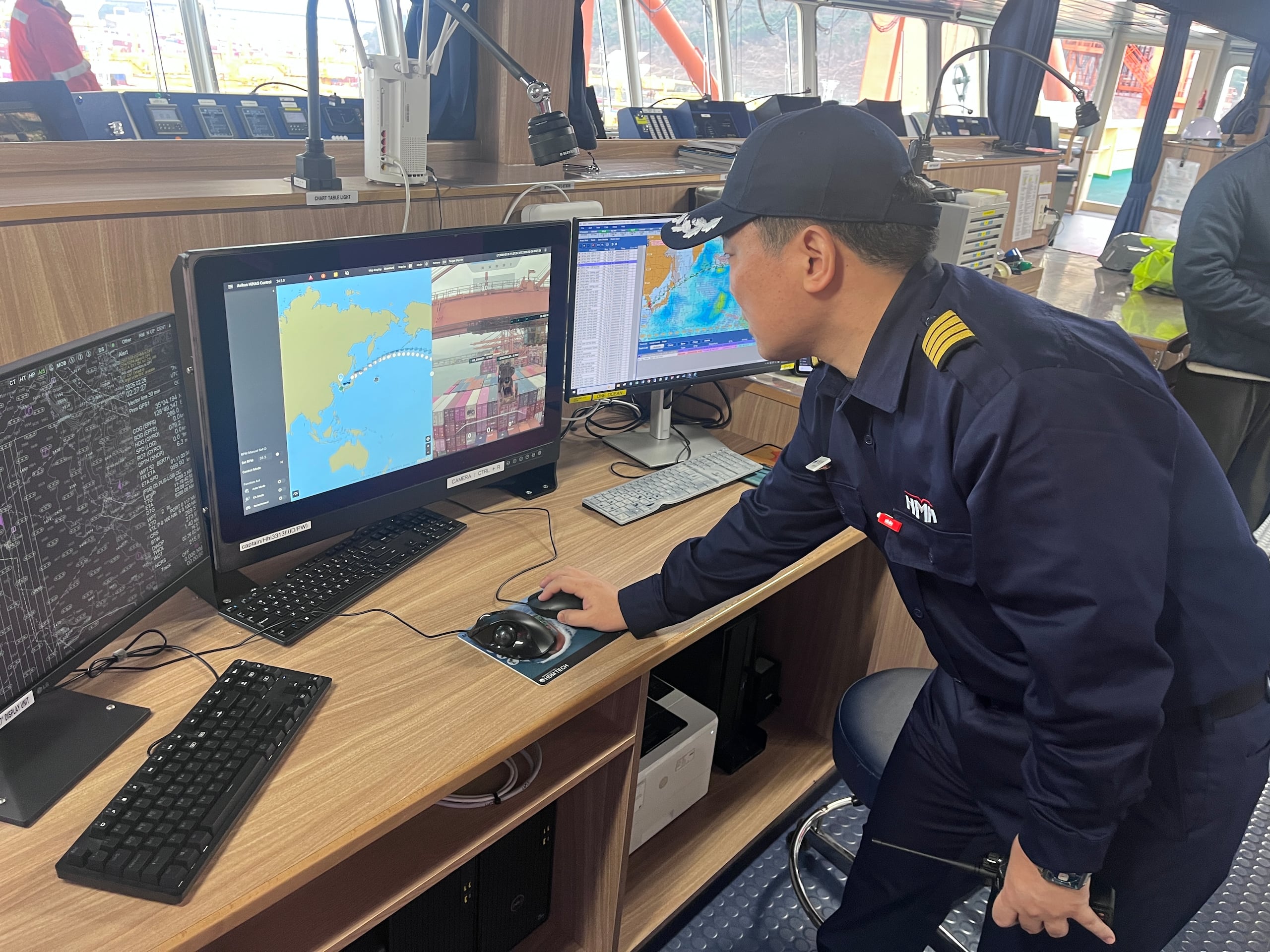
Captain Park Sang-hyun looks at the Avikus system in the bridge of the Emerald.
Courtesy of Han Ye-na
The system was developed by Avikus, an autonomous navigation firm under HD Hyundai Group, and has supported the ship on trips totaling 100,000 nautical miles (109,700 miles).
HMM plans to introduce HiNAS to 40 vessels by the end of this year.
The HMM Emerald, which operates an eight-week round trip between Busan and Los Angeles on a U.S. West Coast route, measures 335 meters (1,100 feet) long, 51 meters wide and 66 meters high, roughly comparable to a 10-story apartment building.
A total of 23 people are on board, including Korean deck and engine officers and Filipino crew members.
Stepping onto the ship, which had arrived at Busan Port overnight, the heavy smell of fuel lingered in the sea wind.
Stepping onto the ship, which had arrived at Busan Port overnight, the heavy smell of fuel lingered in the sea wind.
The highest point on board, the compass deck, was packed with observation equipment, such as radar detectors.

The Hyundai Intelligent Navigation Assistant System camera unit is located on the HMM Emerald’s topmost deck.
[KO SUK-HYUN]
There, the HiNAS navigation camera unit, a box-shaped device about
31 to 33 centimeters (12 to 13 inches) by 24 centimeters, is
installed.
“Six cameras — three optical and three infrared — serve as the ship’s eyes both day and night,” said Kim Hyeon-jae, a lead at Avikus.
“Using data [from the cameras], the AI keeps the vessel on its planned track and maintains its speed according to preset conditions.”
The collected data is transmitted via cables to the bridge, where the helm, charts and communications equipment are located.
The collected data is transmitted via cables to the bridge, where the helm, charts and communications equipment are located.
On a large monitor in the chart room, a video feed of real-time conditions in front of the ship appears alongside information regarding the route, speed, water depth, rudder angle and nearby vessels.

HMM’s container ship, the HMM Emerald, is berthed at Pier 4 of Busan New Port on Feb. 26.
[KO SUK-HYUN]
Jeon Tae-young, the HMM Emerald’s second officer, said HiNAS’s capabilities go beyond what earlier autopilots could do.
“The autopilot functions on existing ships largely focus on [the vessel’s direction],” Jeon said. “HiNAS can set an optimal route on its own and sail based on that route.”
“If the navigator inputs the desired arrival time for a destination, the system automatically calculates guidance for optimal engine revolutions per minute and speed by factoring in realtime weather and routing,” Jeon added.
“The autopilot functions on existing ships largely focus on [the vessel’s direction],” Jeon said. “HiNAS can set an optimal route on its own and sail based on that route.”
“If the navigator inputs the desired arrival time for a destination, the system automatically calculates guidance for optimal engine revolutions per minute and speed by factoring in realtime weather and routing,” Jeon added.
“We’re working with the AI by analyzing a range of navigation data in real time to improve efficiency and keep precisely to the planned track.”
HiNAS also includes a collision avoidance function that detects other vessels and supports evasive maneuvers.
“When another ship enters a set range, [the system] alerts the navigator and, if necessary, can alter course to avoid it and then return to the original route,” Kim said.
HiNAS also includes a collision avoidance function that detects other vessels and supports evasive maneuvers.
“When another ship enters a set range, [the system] alerts the navigator and, if necessary, can alter course to avoid it and then return to the original route,” Kim said.

HMM Emerald second officer Jeon Tae-young uses the Hyundai Intelligent Navigation Assistant System’s “route planning” function to design a route from Busan Port to Los Angeles.
[KO SUK-HYUN]
Jeon said the feature is most useful in open-ocean stretches with little traffic, while manual control remains the norm in congested waters.
Pilot testing post-HiNAS adoption showed annual fuel savings of 2.5 to 4.5 percent, along with accompanying reductions in carbon emissions, according to HMM.
Pilot testing post-HiNAS adoption showed annual fuel savings of 2.5 to 4.5 percent, along with accompanying reductions in carbon emissions, according to HMM.
A large ship’s annual fuel bill typically runs about 10 billion to 20 billion won ($6.8 million to $13.6 million), and Avikus said fuel savings alone could allow the installation cost to be recovered within a year.
Full autonomy, however, remains a distant goal, in part because maritime rules are more complex than those on roads.
Full autonomy, however, remains a distant goal, in part because maritime rules are more complex than those on roads.
“HiNAS corresponds to Level 2 under the International Maritime Organization framework for Maritime Autonomous Surface Ships,” said Kim.
“Watchkeeping by crew remains essential, with collision-avoidance functions requiring a navigator’s judgment. Manual operation is also the default in heavily trafficked waters.”
Even so, the fact that AI has begun to participate in operating large commercial vessels that cross oceans is fueling expectations that autonomous navigation technology could spread across the industry.
“It’s not at the point where AI can stand watch in a navigator’s place,” Park said.
Even so, the fact that AI has begun to participate in operating large commercial vessels that cross oceans is fueling expectations that autonomous navigation technology could spread across the industry.
“It’s not at the point where AI can stand watch in a navigator’s place,” Park said.
“But it lets us focus on judgment and monitoring, which reduces the burden and improves safety. In the future, it could help ease seafarer shortages caused by a shrinking workforce.”
Links :
- Korea JoongAng Daily : HMM ship captain says AI autonomous navigation system has proven its worth
- The Chosun Daily : HMM's 335m Emerald Deploys World's First AI Navigation System
- Splash : HMM rolls out autonomous navigation tech across fleet
- DigitalShip : HMM scales autonomous navigation with Avikus

No comments:
Post a Comment