Saturday, February 14, 2026

Don't pick a jellyfish to be your Valentine -- they have no hearts

Friday, February 13, 2026

Ancient people had nautical tech, know-how to cross hazardous Arctic channel

An exciting discovery has been made at an archaeological site in the Arctic. 
The Calgary Eyeopener's Loren McGinnis speaks with University of Calgary professor Matthew Walls about how this changes what we know about prehistoric people living in the area.

From CBC news by Emily Chung

New archeological evidence for repeat sea journeys and stays at remote islands 

Archeologists have found the remains of an ancient camp on a remote High Arctic island that dates back more than 4,000 years.

They offer surprising new insights about the first people who lived near what is now the Canada-Greenland border and journeyed to take advantage of a rich new ecosystem that formed around the time.

 
Localization of Carey Oer in the GeoGarage platform (DGA nautical raster chart)
 
The Paleo-Inuit archeological site was found in Kitsissut, a rocky cluster of cliff-edged islands between Greenland and Ellesmere Island. 
 
A view of the crossing between Kitsissut and the shores of Avanersuaq in northwest Greenland, with a minimum distance of 53 kilometres. 
UAV image from Isbjørne Island in clear weather looking towards key locations, with beach ridges and Early Paleo-Inuit features in the foreground (figure by authors). 
The archaeological beach ridges where ancient tent rings were found can be seen in the foreground. 
(Walls et al.)
 
Distance of crossings to Kitsissut from key locations, including Nuuliit, the closest Early Paleo-Inuit site
(image source: Copernicus Sentinel-2; figure by authors).
 
As it was thousands of years ago, getting there today by boat is a journey of at least 53 kilometres from the nearest shore in harsh, High Arctic sea conditions.
"It would have been a fairly extraordinary journey for them to get to this location by watercraft," said Matthew Walls, lead author of the new study describing the findings published Monday in the journal Antiquity.

Study co-author Mari Kleist of the University of Greenland studies a Paleo-Inuit tent ring visible in the foreground. (Walls et al.)

Walls estimates that by canoe or kayak, getting to Kitsissut would have taken 12 to 15 hours of difficult paddling — so long that the weather might easily go from calm to stormy en route.
The archeological site contains evidence that many people visited and stayed there repeatedly. 
"It's obviously a place where people are returning over the long term," Walls said.

A photo of the research team. Back row, left to right: Pia Egede (Ilisimatusarfik/University of Greenland), Mari Kleist (Ilisimatusarfik), Pauline Knudsen (Ilisimatusarfik), Qalaseq Sadorana (Qaanaaq), Pivinnguaq Mørch (Ilisimatusarfik), Matthew Walls (University of Calgary). Front row, left to right: Niels Miunge (Qaanaaq), Otto Simigaq (Qaanaaq). (Matthew Walls/University of Calgary)

Max Friesen, a University of Toronto Arctic archeologist who has collaborated with the paper's other authors but was not involved in this research, said the findings suggest the Paleo-Inuit people had much more sophisticated seafaring technology than previously thought.
He said small fragments of their boats have been found, suggesting they had canoe- or kayak-like vessels made of animal skins pulled over a bone or wood frame. But not much more was known.

Friesen, who was Walls's PhD supervisor, said the Paleo-Inuit were found across the High Arctic.
If they had the skills and technology to travel repeatedly to Kitsissut, they likely could also do things like hunt seals or even whales far out in the ocean. 
That means they may have had wider options for what resources they could use and how they could impact ecosystems thousands of years ago.
"It has huge implications across the rest of the Arctic, right?" said Friesen. 
"So that's really exciting, to really add to what we know about the transportation technology."

What the ancient camp looks like


Walls worked with University of Greenland (Ilisimatusarfik) Inuit archeologists Mari Kleist and Pauline Knudsen, and a team that included Inuit from nearby communities to map the archeological site and exposed artifacts between 2017 and 2019.

A set of ridges have been rising out of the ocean over time, springing back from the weight of now-melted glaciers.
On the oldest, highest ridges, farthest inland from the modern coastline, there are least 18 tent rings — circular areas cleared of rocks, with a ring of stones around them. 
Those stones may have held down the edges of the tents, likely sealskin stretched over driftwood frames.

 
The researchers mapped 18 Paleo-Inuit tent rings on the beach ridges in Kitsissut.
(Matthew Walls/University of Calgary)

There was typically a central hearth with the remains of burnt driftwood in the centre, and a line of stones dividing the tent into two "rooms" that could have been used for different activities, such as working with animal skins or making stone tools.

A seabird bone found inside one of the tent rings was sent for radiocarbon dating.
From that analysis, the researchers estimated the age of the site to be between 4,000 to 4,400 years old, a period when the first archeological evidence of people, known as the Paleo-Inuit, are found across the High Arctic.
 
Kitsissut refers to the group of islands and skerries, many of which do not have individual names in Kalallisut. The archaeological features on Isbjørne Island were identified by the authors during a 2019 survey of Kitsissut and include features from the Early Paleo-Inuit and later periods
(image source: Maxar; figure by authors).

Polynya pioneers of many species

It was also around that time that the rich ecosystem was developing in Kitsissut, due to the formation of a rare channel of open water in the sea ice called the Pikialosorsuaq or North Water polynya.
Walls said it's caused by the unique wind, current and geographic conditions in this area.
"It's a really important ecological hotspot," said Walls. 
The open water allows for phytoplankton blooms that support an entire food chain.

 
This map shows Kitsissut's location in the polynya between Ellesmere Island (Canada) and Greenland. (Walls et al.)

The cliffs of Kitsissut are home to nesting colonies of seabirds and the marine mammals such as seals hunt in the surrounding waters, many of which would have first moved there when the polynya opened.

Walls said that's important for how people think about these Arctic ecosystems and their conservation. 
"Indigenous communities are part of their development over the long term, right back to their early formation," he said, supporting the argument for Indigenous stewardship today.

Lesley Howse is director of archeology at the Inuit Heritage Trust, the Inuit organization that co-governs cultural heritage with the Nunavut government, including archeological collections and education, permitting for archaeological projects and requests to work with Inuit belongings.

Howse, who has previously worked with Walls, Kleist and Knudsen but wasn't involved in this study, said archeologists used to think that Paleo-Inuit relied heavily on hunting animals on land.
She's not surprised by evidence that they had such a high level of skill on the sea, given the need to make use of all available resources to survive in such a harsh environment.
"The water is essential to living in the north," she said. 
 
Early Paleo-Inuit features on Isbjørne Island; A) location of site beneath the nesting cliff; B & C) sample of bilobate tent rings with axial features, which bisect the dwelling and include central hearths; D & E) Early Paleo-Inuit tent rings included adjacent dwelling structures or box hearths (figure by authors).
 
"You have to depend and rely on all animals that are there and adapt with the technologies you have. I think this [research] kind of brings this to light."
 
Links :

Thursday, February 12, 2026

The pioneering sailor you’ve probably never heard of: Nicolette Milnes Walker

Nicolette Milnes Walker sailed from Dale to Newport in just over 44 days; she took the Azores route across the Atlantic.
Credit: Nicolette Milnes Walker Credit: Nicolette Milnes Walker

From PBO by Julia Jones
 
In 1971 Nicolette Milnes Walker was the first woman at 28 to sail solo and non-stop from the UK to the USA. Julia Jones charts her trailblazing achievement
 
Ann Davison had crossed single-handed in 1952 in her 24ft wooden yacht Felicity Ann but she’d taken more of a cruise approach, pausing several times along the way. 
It had been a remarkable achievement by a remarkable woman. 

Almost 20 years later, Nicolette Milnes Walker was planning something different. 

Nicolette Milnes Walker enjoyed fixing gear at sea, as it prevented boredom from setting in.
Credit: Getty

Boats and equipment had changed during the boom years of the 1960s. 
Like thousands of other people Nicolette had built a Mirror dinghy from a kit.
She’d been living in a Bristol University student flat and had to get it out through the window. 
By the end of the decade mass production using GRP had revolutionised sailing as a leisure activity. 
There was much more stuff on the market and many more people ready to have a go, even if they didn’t have a big bank balance or generations of sailing experience. 
Practical Boat Owner, founded in 1967, was just the magazine they needed. 

Nicolette Milnes Walker: Spark of an idea 

In January 1971 Nicolette had been to the International Boat Show at Earl’s Court and had become fascinated by the variety of equipment available. 
The year before she’d sailed to the Azores with friends. 
Now she began collecting catalogues, making lists and calculating what she’d need to sail to America alone. 
To begin with it was just a game.
She was good at planning – her current job was as an industrial psychologist devising experiments that helped test how people in high tech jobs might react under stress. 
Gradually her ideas developed from the ‘what if?’ stage to the ‘why not?’ 

Aziz was the 39th Pionier class racer to be built in the UK.
Credit: Nicolette Milnes Walker

There were plenty of negatives.
She wasn’t a hugely experienced sailor. 
She could manage a dinghy but had never handled a yacht on her own, though her trip to the Azores had taught her what an Atlantic gale felt like. 
She wasn’t a good swimmer but swimming alone in the Atlantic wasn’t going to help much anyway. 
She was short sighted, she was female.
Should that stop her? 
Nicolette had a hunch that there were aspects of women’s inherited experience that might potentially make them more resilient than men. 
That was one of the things she wanted to test, with herself as the subject of the experiment. 

Aziz was fitted with Hasler Gibbs self-steering gear.
The boat didn’t have a stern pulpit so a bracket had to be fitted to support the windvane.
Credit: Nicolette Milnes Walker

She wanted to know how she’d react to fear and loneliness: she also wanted the thrill of being first to succeed. 
Imperceptibly she found she’d reached a decision: “I could find no reason for not going. So I decided to go.” 
She resigned from her job and borrowed enough money to buy a small yacht. 
She chose a second hand Pionier, a very early GRP design by EG van der Stadt. Built in 1963 and named Aziz (from its first owner’s polo pony) it would probably be considered unsuitable for single-handed distance cruising today. 
Instead of the traditional long keel, giving good directional stability, Aziz had a fin keel and spade rudder
Later, Nicolette described how difficult it had been to keep Aziz steady under engine, ‘a moment’s inattention and she whips round in a semi-circle’. 
It became ‘quite a laugh’ to dash down to the cabin for a cigarette and matches and get back to the helm before Aziz shot off in the wrong direction. (In 1971 even a doctor’s daughter could smoke without shame!)

Transformative

Under sail, however, Aziz responded well to a Hasler Gibbs servo-pendulum steering system, another 1960s innovation that was transforming life for the single-handed sailor.
Nicolette made clear, practical decisions about what not to take – such as a spinnaker
She’d never used one and guessed that twin headsails, poled out, would be much easier to handle. 
She chose to prepare and set out from a small yachting centre – Dale in Pembrokeshire – rather than the more conventional south coast centres which might be too busy to bother with an enterprise like hers. 
Setting out from Milford Haven also avoided most of the busy Channel shipping. 

Nicolette Milnes Walker decided to leave from Dale in Wales, rather than a South Coast yachting centre. 
Credit: Nicolette Milnes Walker

Once she was away from land, Nicolette remained practical and analytical. She was given a tape recorder into which she spoke each day. 
When she listened to these after the voyage, she realised they were much more revealing than her careful diary entries. 
Her subsequent book, When I Put Out to Sea, reveals that she was hard on herself, getting angry over what she regarded as ‘stupid’ errors. 
She also enjoyed using her initiative to fix her mistakes. 
Later she would joke that she’d almost looked forward to things going wrong at sea because having something to fix relieved the monotony. 


Nicolette Milnes Walker sets off on her Atlantic crossing. It was only the second time she has sailed solo over any distance. 
Credit: Nicolette Milnes Walker

She was also young and fun-loving.
She enjoyed the freedom of summer days without clothes. 
She daubed herself with scent, dressed up and drank brandy for special, solitary celebrations.
(She also used the alcohol to fix her steering compass.) 
All the time she was observing herself as the subject of her own experiment. 
She wondered whether she would lose her voice if she spent time without speaking to people; she noticed she was “thinking very loudly”. 
She endured periods of despair and believed she was facing death. 

Party time


When she arrived safely at Newport in Rhode Island, she changed into a mini-dress and flung herself into celebration. 
Yet it wasn’t long before she was noticing that this also had an effect on her personality. 
It’s probably not surprising that after a period of celebrity –press articles, TV interviews, Women of the Year lunches, Desert Island Discs, an MBE – she decided that it was time for a new challenge… which turned out to be raising twin daughters, Rosalind and Frances. 
When Nicolette decided to retire from the fray, she did so thoroughly, packing away her notes, cuttings, photos and memorabilia and setting herself up not only to make a success of motherhood, but also to be a successful bookseller with her husband, Bruce Coward, at the Harbour Bookshop Dartmouth. 


Being presented with a painting of Aziz by Robin Knox-Johnston. 
Credit: Nicolette Milnes Walker

She never spoke about her achievement and most people have never heard of her. 
Now she is about to be 80 and has been persuaded to unpack some of those packages as a new edition of her book is published. 
She will give a single talk in Dartmouth in aid of the RNLI


When I Put Out to Sea is released on 15 March 2023 

She has written a brief Afterword. “I have often been asked to give a talk about the crossing, but always declined, as I felt that I was no longer that girl who had set out with such excitement to challenge herself. 
“But re-reading this book after very many years makes me realise that I am indeed not that girl, but a new version of her. I have changed my opinions on a number of the views expressed in the book. But I do remember her and I know that her experience gave me the confidence to accept who I am and to be delighted in the life I have. "
“That seems almost as important an achievement as sailing the Atlantic.”

When I Put Out to Sea by Nicolette Milnes Walker is republished by Golden Duck, priced £11.99, www.golden-duck.co.uk and is also available on Amazon Kindle. 

Wednesday, February 11, 2026

Deep-sea mining causes immediate loss of seafloor life


From Earth by Eric Ralls

Far below the ocean surface, the deep seafloor is often described as one of the planet’s least disturbed ecosystems.
That assumption is now being tested.

Companies are preparing to mine mineral-rich nodules scattered across the abyss.
The shift raises urgent questions about how quickly damage could appear once industrial machines begin operating.

A new field experiment offers one of the clearest answers yet.
Researchers found that a single trial of a deep-sea mining collector physically removed more than one-third of the animals and species living directly in its path.

The results show that biological impacts can occur immediately, not only after years of full-scale extraction.

Examining the seafloor test tracks


The damage was documented along fresh tracks carved into the abyssal seafloor during a 2022 trial that removed thousands of tons of mineral-rich nodules from deep Pacific sediments.

By comparing conditions before and after the test, Eva C. D. Stewart and colleagues at the Natural History Museum (NHM) in London directly documented how animal communities thinned and simplified inside those tracks.

The decline appeared within months of the trial, standing out even against the strong natural ups and downs that shape deep-sea life over time.

That contrast between rapid disturbance and slower background change sets the boundary of what the evidence can already show and what the rest of the seafloor response still needs to reveal.

Nodules support seafloor life

Mining companies target polymetallic nodules – rock-like lumps on the seafloor that contain valuable metals such as nickel, cobalt, and copper – because global demand for these materials continues to rise.

Across much of the deep ocean, these nodules sit scattered on soft mud and act as rare patches of hard surface.
Many animals attach to them or use them for feeding, shelter, and breeding.

When mining machines collect the nodules from the seafloor, they remove these living spaces along with the minerals.

Because so many species depend on the nodules themselves, the impact of mining must be measured in terms of habitat loss – not just the amount of metal extracted.

Tracks caused the biggest drop

Inside the fresh tracks, counts of macrofauna – seafloor animals visible without a microscope – fell sharply within two months.
The collector churned the top inch of sediment where most creatures live, and it left a bare lane behind.

With pre-mining sampling in hand, the team reported a 32 percent drop in species richness inside the tracks.

“Finally, we have good data on what the impacts of a modern commercial deep-sea mining machine might be,” said Stewart.
 

Plumes rewired the seafloor community

Far from the tracks, sediment plumes, clouds of stirred-up mud that drift and settle, changed who dominated without lowering animal totals.

The team sampled about 1,300 feet from the lane and saw a thin layer of sediment coating the nodules.

Animal counts stayed steady there, but a few species became more dominant, which reduced overall biodiversity in the plume zone.

Because plumes can spread beyond mined lanes, monitoring has to track community balance, not only head counts, across wide areas.

Natural cycles obscure damage

Animal densities rose and fell across the abyssal plain – a flat deep seafloor covered in fine mud – for two years before mining began.

Changes in surface winds and currents affected how much food reached the bottom, and seafloor communities responded.
These natural swings reduced animal numbers at several sites even before the test, making clean controls essential.

Without repeated sampling, managers could mistake a climate-driven decline for mining damage and draw the wrong boundary for protection.

Across 80 mud cores, the team sorted 4,350 animals and identified 788 species, though diversity remained under-sampled.
Projections suggested that about 15,000 individuals, or 400 cores, would be needed to capture most species.

Researchers tracked species richness – the number of different species per core – which often falls when mining reduces animal communities.

“We have also discovered many new species and shown how the abyssal ecosystem changes naturally over time,” said Stewart.

Mining recovery may take decades

Evidence from past tests suggests recovery will be slow and uneven.
A separate study tracking a 1979 mining test strip still found strong disturbance 44 years later.

Deep-ocean sediments mix slowly, and replacing removed nodules takes far longer than human lifetimes, so communities rebuild at a crawl.

Some small, mobile creatures returned, but many larger animals remained reduced where the seafloor had been scraped.
This history suggests fresh tracks may persist for decades, meaning the early losses measured today could be only the first signal.

Understanding those long-term changes will require stronger monitoring.
Future surveys must include enough sediment cores to capture natural variation, with at least five recommended per site.

Additional cores reduce the chance that a single unusually rich or sparse sample drives the result, especially when animals cluster in patches.

Surveys will also require specialists to identify animals to the species level.
Without that detail, monitoring could miss which species disappear first and fail to detect slower ecological shifts outside mined tracks.

Seafloor evidence fuels mining debate

The International Seabed Authority has signed 15-year exploration contracts with 22 contractors, while industry continues to push for rules governing commercial mining.

Regulators already require baseline surveys and environmental impact plans, and these new results highlight why both must include long-term time-series monitoring.

In the recent trial, Nauru Ocean Resources partnered with Allseas to operate the collector.
The trial demonstrated how mining activity can produce immediate seafloor damage alongside broader, subtler ecological changes that unfold over time.

Until extended follow-up data become available, policymakers will face a difficult decision about how much uncertainty they are willing to accept.

Continued monitoring will determine whether affected communities can recover.
The same rigorous sampling approach could help guide future permitting decisions or justify pauses as governments weigh economic demand against environmental risk.

Links :

Monday, February 9, 2026

Scientists can spy shrimp eggs from space

Brine shrimp, and brine shrimp eggs, are teeny-tiny.
But by analyzing the light they reflect, scientists can now identify aggregations of them from space.
Photo by Kim Taylor/NPL/Minden Pictures
 
From Hakai Mag by Saima Sidik

By analyzing the light it reflects, scientists can say whether that floating blob in a satellite image is made up of plastic, shrimp, seaweed, or something else.

It’s become a bit clichéd to say with surprise that something—a wildfire, the Great Barrier Reef, a ship blocking the Suez Canal—can be seen from space.
But every so often, scientists manage to spot something from space that truly is surprising.
Case in point: University of South Florida optical oceanographer Chuanmin Hu and his colleagues have worked out ways of spotting aggregations of small floating objects, such as shrimp eggs, algae, and herring spawn, from space.
And not only can they find these buoyant masses—they can tell you which is which.

Hu and his team can’t zoom in on a satellite image enough to actually see a shrimp egg in the way that you could look at the picture and say, “That’s a shrimp egg!” So how can they tell the difference?

The key to identifying the objects, says Hu, is that “every floating matter has its fingerprint.”

Different objects, being made of different materials, reflect characteristic wavelengths of light—patterns that scientists can read using multispectral instruments mounted on satellites.
Using these patterns to identify substances is known as spectroscopy.
The technique is common in labs, and scientists in the rapidly evolving field of remote sensing are carrying it over into satellite analysis.

Hu and his team, along with scientists around the world, are building a knowledge base of what different objects and materials look like from space.
That way, when they come across an unfamiliar floating object on a satellite image, they can look to see whether the wavelengths it reflects match up with anything that’s been analyzed before.

Sometimes Hu and his colleagues can only speculate about the identity of floating matter until they have a chance to take a close-up look.
A trip to Utah’s Great Salt Lake, for example, confirmed their suspicion that filamentous white slicks they’d seen on satellite images were massive accumulations of brine shrimp eggs.
Over the past year, Hu’s team has also published a method for identifying herring spawn, and they are attempting to identify sea snot—the disgusting films of phytoplankton mucus that plagued Turkey last summer.

But there’s also a pressing problem that scientists hope remote sensing can address—the vast amounts of plastic that are clogging the oceans.

“The main idea is to create an algorithm that can detect the plastic litter,” says Konstantinos Topouzelis, an environmental scientist at the University of the Aegean in Greece.
“So the cleaning efforts can be guided.”

But identifying plastic from space comes with challenges.
For one, there are many kinds of plastic, and some blend in with the surrounding water.
Plastic also aggregates and disperses quickly.
And while some aggregations are huge, like the Great Pacific Garbage Patch, many are small and difficult to pick out in the images.

For the past few years, Topouzelis and his students have been deploying and analyzing targets, such as shopping bags and fishing nets, made of various plastic materials.
The spectral signatures of these known plastics give researchers a starting point when they’re wondering whether the swirls and swooshes on other satellite images might be plastic.

Oceanographer Katerina Kikaki, at the National Technical University of Athens in Greece, is taking a different approach.
She and her colleagues have scoured through seven years of scientific publications, records from citizen scientists, and media reports to find examples of plastic pollution.
They recently published a database of satellite images that correspond to these known plastic accumulations.
“Our data set can enable the community to explore the spectral behavior of plastic debris,” Kikaki says.

Kikaki’s and Topouzelis’s studies are examples of ground truthing—analyses of known objects that help confirm if remote assessments are accurate.

Having eyes on the ground can really help drive the field forward.
Just looking at satellite observations, “my view is narrowed,” Hu says.
“I may ponder over [a satellite image] for weeks or months.” 
But if a boat captain tweets a picture of sea snot along with some geographical information, that can save Hu a lot of time.

So if you’re on the water, and you stop to appreciate some mysterious slime, put it on social media! 
An optical oceanographer may be staring at a picture of the same region, wondering what’s out there.

How the “Atlantic Grand Canyon” came to exist

 From Nautilus by Jake Currie

New research sheds light on the mysterious underwater structure

On land, most canyons are carved by erosion from rivers over millions of years. 
In the ocean, things are a bit trickier. 
 
Visualization with the GeoGarage platform (UKHO nautical raster chart)
 
Zoom visualization with the GeoGarage platform (UKHO nautical raster chart)
 
Zoom visualization with the GeoGarage platform (STRM bathymetric chart)
 
The King’s Trough Complex, located more than 600 miles off the coast of Portugal, is a massive canyon that includes one of the deepest points in the Atlantic Ocean—and was once a candidate to become

The chain bag dredge is brought back on board.
It can be used to collect specific rock samples from depths of several thousand meters. 
(Image credit: GEOMAR)

But how did it get there? 
 
To find out, geologists from GEOMAR Helmholtz Centre for Ocean Research Kiel in Germany hit the seas in a 300-foot research vessel equipped with high-resolution sonar systems to map the ocean floor and a chain bag dredge to retrieve rock samples. 
After analyzing the chemical composition of the volcanic rocks, the team was able to determine how and when this deep-sea canyon formed. 
They published their findings in Geochemistry, Geophysics, Geosystems (G-Cubed).
 
HIDDEN DEPTHS: This bathymetric map of King’s Trough Complex shows the deep basins at its eastern end, based on new data.
Image courtesy of Geomar. 


“Researchers have long suspected that tectonic processes—that is, movements of the Earth’s crust—played a central role in the formation of the King’s Trough,” study author Antje Dürkefälden explained in a statement
“Our results now explain for the first time why this remarkable structure developed precisely at this location.”

Between 37 and 24 million years ago, a tectonic plate boundary shifted to the area, resulting in the crust fracturing and the seafloor between Europe and Africa opening like a zipper in an east-west direction.
 

(a) Cartoon showing the eastern North Atlantic region at ∼37 Ma after the plate boundary had just jumped to the KTC area resulting in oblique extension beginning at the Peake and Freen Deeps due to the continued anticlockwise rotation of the Iberian/African plate.
(b) After a new plume conduit had branched off toward the south (resulting in the steady build-up of the Azores plateau) and the relocation of the plate boundary to the Azores-Gibraltar Fracture zone, transtension and rifting in the KTC area ceased and the northern plume branch wanes but is still reflected by the 45°N anomaly at the MAR. 
 Credit: Geochemistry, Geophysics, Geosystems (2025). DOI: 10.1029/2025gc012616
 
Prior to the shift, the crust was thickened and heated by an upwelling of molten rock from the mantle, making it particularly fragile.

“This thickened, heated crust may have made the region mechanically weaker, so that the plate boundary preferentially shifted here,” added co-author Jörg Geldmacher. 
“When the plate boundary later moved farther south toward the modern Azores, the formation of the King’s Trough also came to a halt.”

It’s a remarkable example of how activity deep within our planet’s molten mantle can have a dramatic impact on the surface.
 
 Links :

Sunday, February 8, 2026

Women & the wind

Women & the Wind is an independent, self-produced documentary following three women as they cross the North Atlantic aboard a 50-year-old wooden catamaran.
Their voyage follows the journey of plastic pollution across the ocean, exploring the deep and fragile synergy between humanity and nature.

Saturday, February 7, 2026

Creating unsinkable metal

Scientists engineer unsinkable metal tubes The superhydrophobic design could lead to resilient ships, floating platforms, and renewable energy innovations.
More than a century after the Titanic sank, engineers still have hopes of someday creating “unsinkable” ships. In a step toward reaching that lofty goal, researchers at the University of Rochester’s Institute of Optics developed a new process that turns ordinary metal tubes unsinkable —meaning they will stay afloat no matter how long they are forced into water or how heavily they are damaged. 
Chunlei Guo, a professor of optics and physics and senior scientist at URochester’s Laboratory for Laser Energetics, and his team describe their process for creating aluminum tubes with remarkable floating abilities in a study published in Advanced Functional Materials. 
By etching the interior of aluminum tubes, the researchers create micro- and nano-pits on the surface that turns it superhydrophobic, repelling water and staying dry. 
When the treated tube enters water, the superhydrophobic surface traps a stable bubble of air inside the tube and prevents the tube from getting waterlogged and sinking, in a similar way that diving bell spiders trap an air bubble to stay buoyant underwater or fire ants to form floating rafts with their hydrophobic bodies. 
“Importantly, we added a divider to the middle of the tube so that even if you push it vertically into the water, the bubble of air remains trapped inside and the tube retains its floating ability,” says Guo. 
Guo and his lab first demonstrated superhydrophobic floating devices in 2019, featuring two superhydrophobic disks that were sealed together to create their buoyancy. 
But the current tube design simplifies and improves the technology in several key areas. 
The disks that the researchers previously developed could lose their ability to float when turned at extreme angles, but the tubes are resilient against turbulent conditions like those found at sea. 
“We tested them in some really rough environments for weeks at a time and found no degradation to their buoyancy,” says Guo. 
“You can poke big holes in them, and we showed that even if you severely damage the tubes with as many holes as you can punch, they still float.” 
Multiple tubes can be linked together to create rafts that could be the basis for ships, buoys, and floating platforms. 
In lab experiments, the team tested the design using tubes of varying lengths, up to almost half a meter, and Guo says the technology could be easily scaled to the larger sizes needed for load-bearing floating devices. 
The researchers also showed how rafts made from superhydrophobic tubes could be used to harvest water waves to generate electricity, offering a promising renewable energy application.

Friday, February 6, 2026

Russian spy spacecraft have intercepted Europe’s key satellites, officials believe


 Intelsat satellites are among those that have been targeted by Russia © Intelsat
Since 2023, Russian satellites, called Luch‑1 and Luch‑2, have repeatedly moved very close to European commercial and government satellites in GEO orbit.
According to the article, intelligence services believe they are positioning themselves inside the narrow beams connecting ground stations to the satellites so they can capture unencrypted control and communications data.
Many older European satellites do not encrypt command links, so if Russia records these, it could possibly impersonate ground controllers, send false commands, nudge satellites off-position, or potentially cause collisions or deorbiting.
 
From FT by Sam Jones, Peggy Hollinger and Ian Bott
 
Unencrypted European communications are being targeted by Moscow 
 
European security officials believe two Russian space vehicles have intercepted the communications of at least a dozen key satellites over the continent.
Officials believe that the likely interceptions, which have not previously been reported, risk not only compromising sensitive information transmitted by the satellites but could also allow Moscow to manipulate their trajectories or even crash them.
Russian space vehicles have shadowed European satellites more intensively over the past three years, at a time of high tension between the Kremlin and the west following Moscow’s full-scale invasion of Ukraine.

For several years, military and civilian space authorities in the west have been tracking the activities of Luch-1 and Luch-2 — two Russian objects that have carried out repeated suspicious manoeuvres in orbit.
Both vehicles have made risky close approaches to some of Europe’s most important geostationary satellites, which operate high above the Earth and service the continent, including the UK, as well as large parts of Africa and the Middle East.
According to orbital data and ground-based telescopic observations, they have lingered nearby for weeks at a time, particularly over the past three years.

Since its launch in 2023, Luch-2 has approached 17 European satellites.
Both satellites were suspected of “doing sigint [signals intelligence] business”, Major General Michael Traut, head of the German military’s space command, told the FT, referring to the satellites’ practice of staying close to western communications satellites.
A senior European intelligence official said the Luch vehicles were almost certainly intended to position themselves within the narrow cone of data beams transmitted from Earth-based stations to the satellites.
The official expressed concern that sensitive information — notably command data for European satellites — was unencrypted, because many were launched years ago without advanced onboard computers or encryption capabilities.
This leaves them vulnerable to future interference — or even destruction — once hostile actors have recorded their command data.


The manoeuvres in space come as Russia steps up its “hybrid warfare” in Europe, including sabotage operations, such as the severing of subsea internet and power cables.
Intelligence and military officials are increasingly worried that the Kremlin could extend such disruptive activity into space, and is already developing the capability to do so.
While China and the US have developed similar technologies, Russia has one of the most advanced space-spying programmes and has been more aggressive in its use of the vehicles to stalk satellites.
“Satellite networks are an Achilles heel of modern societies.
Whoever attacks them can paralyse entire nations,” German defence minister Boris Pistorius said in a speech last September.
“The Russian activities are a fundamental threat to all of us, especially in space.
A threat we must no longer ignore,” he added.

The European satellites approached by Luch 1 and 2 are primarily used for civilian purposes, such as satellite television, but also carry sensitive government and some military communications.
Luch 1 and Luch 2 were unlikely to have the capability to jam or destroy satellites themselves, the European intelligence official said.
However, they have probably provided Russia with large amounts of data on how such systems could be disrupted, both from the ground and in orbit.
Traut said he presumed the Luch satellites had intercepted the “command link” of the satellites they approached — the channel linking satellites to ground controllers that allows orbital adjustments.
Analysts say that with such information, Russia could mimic ground operators, beaming false commands to satellites to manipulate their thrusters used for minor orbital adjustments.
Those thrusters could also be used to knock satellites out of alignment or even cause them to crash back to Earth or drift into space.
Intelligence gathered by Luch 1 and 2 could also help Russia co-ordinate less overt attacks on western interests.

Monitoring other satellites can reveal who is using them and where — information that could later be exploited for targeted ground-based jamming or hacking operations.
The Luch vehicles were “manoeuvring about and parking themselves close to geostationary satellites, often for many months at a time”, said Belinda Marchand, chief science officer at Slingshot Aerospace, a US-based company that tracks objects in space using ground-based sensors and AI.
She added that Luch 2 was currently “in proximity” to Intelsat 39, a large geostationary satellite that services Europe and Africa.
 
An Ariane rocket carrying an Intelsat satellite lifts off from a space centre in French Guiana © Jody Amiet/AFP/Getty Images
 
Since its launch in 2023, Luch-2 has hovered near at least 17 other geostationary satellites above Europe serving both commercial and government purposes, Slingshot data shows.
“They have visited the same families, the same operators — so you can deduce that they have a specific purpose or interest,” said Norbert Pouzin, senior orbital analyst at Aldoria, a French satellite tracking company that has also shadowed the Luch satellites.
“These are all Nato-based operators.” “Even if they cannot decrypt messages, they can still extract a lot of information . . . they can map how a satellite is being used, work out the location of ground terminals, for example,” he added.
Pouzin also said that Russia now seemed to be ramping up its reconnaissance activity in space, launching two new satellites last year named Cosmos 2589 and Cosmos 2590.
The vehicles appear to have similarly manoeuvrable capabilities to Luch-1 and Luch-2.
Cosmos 2589 was now on its way to the same range as geostationary satellites, which orbit 35,000km above Earth, Pouzin said.
But Luch-1 may no longer be functional.
On January 30, Earth telescopes observed what appeared to be a plume of gas coming from the satellite.
Shortly after, it appeared to at least partially fragment.
“It looks like it began with something to do with the propulsion,” said Marchand, adding that afterwards there “was certainly a fragmentation” and the satellite was “still tumbling”.
 
Links :

Thursday, February 5, 2026

Natalia Molchanova, the enigma of depths

Tribute to the life of Natalia Molchanova - get a glimpse into the life of freediving legend Natalia Molchanova.
Natalia was a freediving world champion and the holder of 42 world records.
She remains the world’s most titled freediver ever, achieving world records in all freediving disciplines.
She won a total of 22 individual gold medals and two team gold medals at Freediving World Championships during her career.
On 25th September 2009, she became the first woman ever to pass 100m (328ft) of depth on a breath-hold in Constant Weight with a freedive to 101m (331ft).
Natalia was the president of the Freediving Federation.
She designed and established its educational program from beginner to instructor level.
Natalia shared her passion and knowledge of freediving both through her courses and with her university students in Moscow.
Today, thousands of freedivers have been trained by the Freediving Federation and several hundred instructors share Natalia’s knowledge with a new generation of freedivers.
In 2015, the presidency was passed to her son Alexey Molchanov, also a freediving world champion and record holder.
Natalia led research in freediver physiology and was interested in relaxation techniques and improving freediving performance and safety.
She was the author of many articles, books, and educational materials on freediving.
Much of her work has been translated into English.
Her love and passion for the sea are also reflected in poems she wrote and a short artistic movie she created, for which she received a number of festival awards.
Natalia’s life was about freediving.
Natalia’s aspiration was always to strive for safe and efficient freediving, and to achieve this through the provision of education and training, and producing the world’s best freediving equipment.

From Pulse

Picture this: recline comfortably, shut your eyes, exhale slowly, and draw in a deep breath, filling your lungs to capacity—then hold that breath.
As seconds trickle by, your focus narrows inward, honing in on your body.
Pressure builds in your chest, and your heartbeat becomes pronounced.
As the urge to inhale intensifies, you face a choice—succumb to immediate panic or delve deeper into a calm state, attempting to steady your heart rate, quiet your mind, and quell restlessness as your body braces for oxygen.

How long can you maintain this breath?
The average adult manages about 30 seconds.
Can you extend it to one minute?
Maybe two?
But can you imagine holding it for nine minutes and two seconds?
Natalia Molchanova achieved this feat, setting the women’s world record in static apnea—holding her breath motionless in a pool—in 2013.
Two years later, Molchanova, hailed by many as the greatest free diver in history, vanished off the coast of Spain during a leisure dive on a sunny August morning.
Her body was never recovered.

Before submerging that day, Molchanova had already secured 41 free diving records across various disciplines.
She could maintain motionless stillness in water, descend over 100 meters on a single breath, and traverse hundreds of feet underwater with or without weights.
Her favorite thrill?
Descending 25 meters and unclipping from an emergency rope line, allowing herself to sink freely.

“Freediving isn’t merely a sport; it’s a path to self-discovery,” Molchanova expressed in a 2014 interview. 
“When we dive, free from thought, we realize our wholeness, our unity with the world. When we think, we create separation. On the surface, thoughts abound, cluttering our minds. Freediving helps reset this.”

Born in 1962, Molchanova initially pursued competitive swimming but paused at 20 to start a family. For two decades, she led a conventional life in Moscow, finding joy in riding scooters around the city until, at 40, she stumbled upon a magazine article about free diving, igniting a passion that catapulted her to the pinnacle of the sport within a decade.

The first 25 meters of a dive pose a challenge as our buoyant bodies resist sinking.
Free divers often use weights to overcome this.
Beyond this depth, however, pressure transforms, causing the body to descend rapidly.
Mastery of this requires disciplined control over panic and the impulse to breathe.

During dives, Molchanova entered a state she termed “attention deconcentration,” akin to meditation.
It involved relinquishing thoughts, turning inward, heightening bodily awareness, and embracing sensation over contemplation.
Chemical shifts in deep dives induce nitrogen narcosis, altering consciousness.
Molchanova’s trained mental state enabled her to navigate this, recognizing when her body had endured enough.

Her accomplishments in diving led her to study physiology, eventually joining the faculty of Moscow’s Russian State University.
Her diving prowess earned her the presidency of the Russian Free Dive Federation.

Yet, Molchanova cared little for accolades or records.
She found solace in the ocean’s depths, where she tested herself, surrendering to pressure, meditation, and an unknown world.
“Compared to the ocean, the pool is like running on a treadmill versus running in the forest,” she remarked.

Her underwater experiences inspired poetry and set records, blending academic prowess with poetic insight.

On August 2, 2015, Molchanova disappeared while diving off Formentera, Spain, with friends.
Despite her unparalleled skill, she never resurfaced.
Efforts to locate her proved futile.
Sara Campbell, a fellow free diver, lamented her loss, describing Molchanova as the greatest the world had seen.

In Molchanova’s own words:
From her poem “The Depth”
I have perceived non-existence The silence of the eternal dark, and the infinity. I went beyond the time, time poured into me And we became immovable. I lost my body in the waves Perceiving vacuum and quiet, Becoming like its blue abyss And touching on the oceanic secret. I’m going inwards recollecting What I am. I am made of light. I peer intensely: The depths reveal a breath I merge with it, And unto the world emerges.

Links :

Wednesday, February 4, 2026

Why are Arctic undersea cables going regional?


From ArticToday by Alexandra Middleton, Bjørn Rønning

Since the late 2000s, several Western countries have attempted to build optical fiber subsea cables across the Arctic Ocean.
Some projects, such as Finland’s Arctic Connect, have been suspended, while others are still years away from completion.

While the Far North Fiber and Polar Connect projects are still on the agenda, the time it will take to secure partnerships, gather findings, and build a commercial case in an unstable geopolitical climate means they are far from being realised.

At the same time, pressing security, militarization and sovereignty concerns are driving the development of regional Arctic undersea cables.
For both Norway and Greenland, recent moves to overhaul digital infrastructure reveal a shift toward digital sovereignty, where state control over Arctic fiber cables is prioritised over commercial profit.

Securing connectivity in Northern Norway


Norway is advancing a government-funded replacement for the ageing Svalbard cable system, linking mainland Bodø, Jan Mayen, and Longyearbyen before the current infrastructure’s technical lifespan ends in 2028. 
A new digital infrastructure project, “Arctic Way,” is set to extend high-speed fiber connectivity deeper into the polar north than ever before. 

Lacking a purely commercial business case, the project is primarily a strategic defense initiative designed to secure Norway’s sovereignty in the High North.
However, limited excess capacity will be released to the market.

The Norwegian Parliament approved the project on March 25, with SubCom contracted for production and laying of the cables, and the Norwegian Armed Forces designated as a primary customer for certain segments

Planned to go live in 2028, the system will span 1,567 miles (2,522 km).
Once completed, it will stand as the world’s northernmost repeated subsea cable system, securing a vital communications lifeline for communities and strategic interests in the High North.

---
Alternative:

Major work began in 2025 with comprehensive route surveys of the seabed, followed by the manufacturing of the specialized cable in 2026.
While crews build the necessary terminal stations on land through early 2027, the critical marine installation is scheduled for May to September 2027 to avoid the worst of the Arctic winter.

Delivered by the American subsea manufacturer SubCom, the Arctic Way is designed as an open cable system — a flexible architecture that allows for easier upgrades as technology evolves.

"Rationale for CPEI priority area Currently, 90% of data traffic between Europe and Asia transits through submarine cables located in the Red Sea, particularly via the Bab el-Mandeb Strait, which represents a single point of failure. 
Consequently, there is an increasing need to develop alternative corridors for
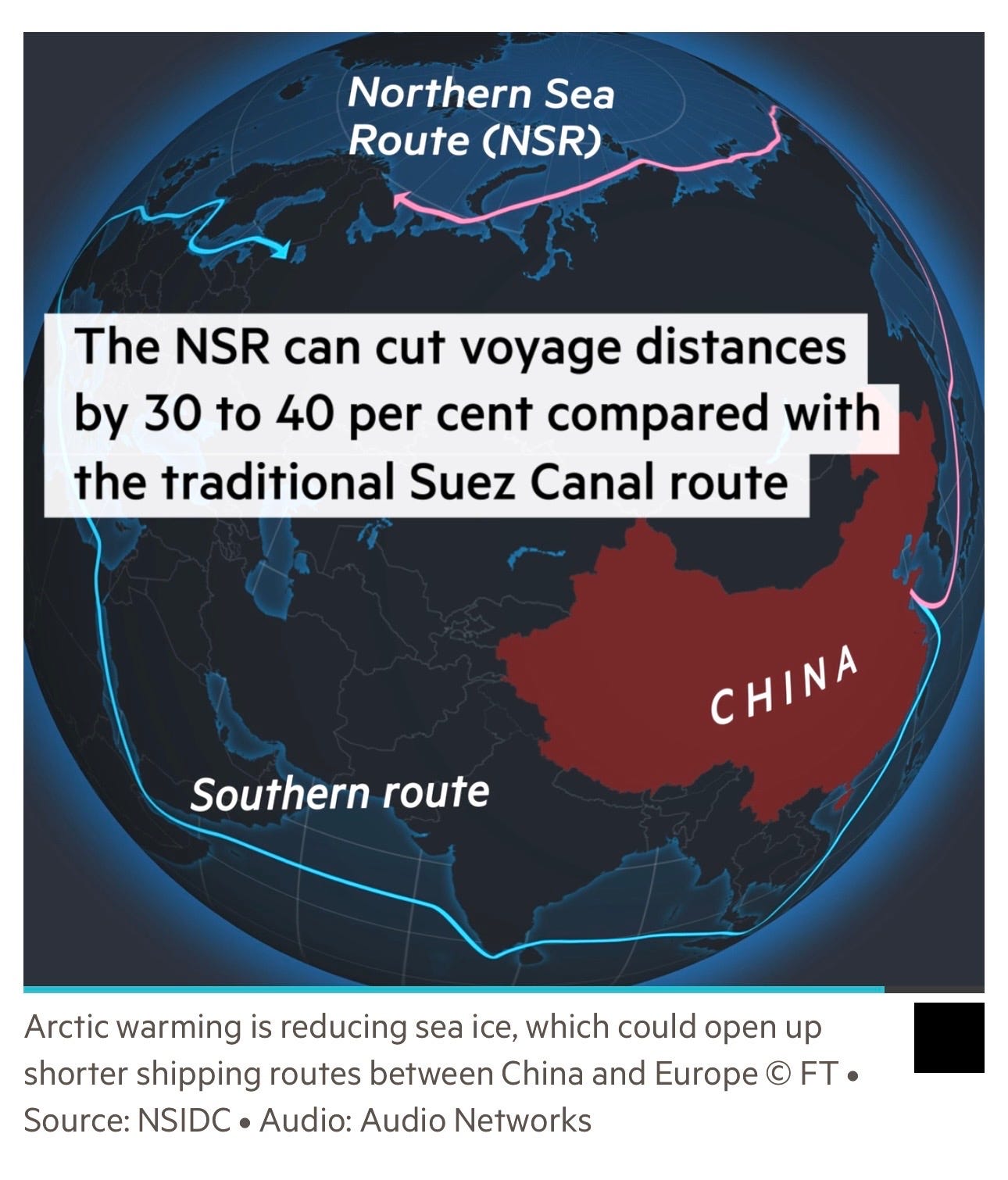
connectivity between Europe and Asia. Given the Arctic region’s strategic importance, a route traversing this area constitutes a viable alternative.
Moreover, this route significantly shortens the distance between Europe and Asia, thereby reducing communication latency across the two regions.
Furthermore, reinforcing connectivity between Greenland and the EU is of increasing geopolitical and economic importance.
Establishing a connection through the West Arctic passage and the Arctic Ocean would create a robust and diversified network ring, removing the single point of failure in the region and therefore improving the resilience of EU infrastructures.
Currently, two potential routes have been identified within the Arctic region.
The first, designated as Area 2a, involves the West Arctic passage, which would connect Germany, Sweden, Norway, Ireland, Denmark, Iceland, Greenland, Canada, the US, Japan and South Korea. 
The second route, Area 2b, is the Polar passage, which would link Scandinavia to Asia via a northern route through the Arctic Ocean north of Greenland.
Both routes, combined with relatively short-range terrestrial connections, would also facilitate Arctic connectivity for countries such as Finland and the Netherlands.
For these reasons, the Arctic region is considered a CPEI priority area (Priority Area 2), which links mainly to CPEI criteria a, c, d and e of Point 26, and CPEI criteria a, b and c of Point 27 of Recommendation 2024/779.
The estimated cost of deploying these two new submarine cables for this priority area is EUR 4 289 million.
In-deployment and planned cables in Priority Area 2
Projects such as Far North Fiber (West Arctic passage, expected to be operational by 2029) and Polar Connect (Polar passage, expected to be operational by 2031) are planned to enhance trans-Arctic connectivity. However, these projects do not fully deliver the strategic redundancy (i.e., ring
network) and direct links needed for EU resilience.
The proposed CPEI priority area (2a and 2b) remains essential to connect Greenland to the EU and provide an alternative route between Europe and Asia through Japan and South Korea, with a possible future extension to the Philippines.
It also offers the opportunity to connect Europe to the West coast of the US and Canada as an alternative route to transatlantic cables.
The Expert Group recommends the deployment of two new submarine cables :
2a) West Arctic passage cable,
2b) Polar passage cable"


Greenland’s push for sovereignty in connectivity


Greenland is developing its telecom landscape through a policy of digital protectionism.
The territory’s state-owned operator, Tusass, has effectively blocked low-earth orbit competitors such as Starlink — a move designed to protect the revenue streams that sustain Greenland’s expensive physical network.

These cables serve as Greenland’s lifeline, and constructing additional ones ensures the country remains connected even if issues arise.
Greenland wants to keep its digital infrastructure under sovereign control rather than relying on foreign companies.

To make this happen, Greenland is mobilising funding from several sources.
Denmark is covering the highest cost through its defense budget, paying for a secure cable link to Europe.
The EU is adding grants to help lay new cables along Greenland’s coast, and Tusass is investing its own funds to bring fiber to towns and build a new data center in Nuuk.

By combining these efforts, Greenland is creating a strong, reliable network that depends on trusted partners, not private tech giants or countries that might pose a risk.
For Greenland, this is about more than fast internet; it is about safety and sovereignty.

The recent rhetoric by U.S. President Donald Trump about acquiring Greenland further strengthens the case for Denmark financing a sovereign data cable for Greenland.
It’s part of a push for more state and military-funded submarine cables in the Arctic.

What lessons does the regional development of these cables teach us at a larger scale, transarctic projects?
The most viable pathway for these projects involves directed state funding, positioned as a strategic measure to safeguard allied interests.

Furthermore, integrating future transarctic projects into existing regional networks is likely to yield significant benefits as it will improve socio-economic opportunities of these remote Arctic places.
 
Links :

Tuesday, February 3, 2026

RIN: GNSS interference is very serious and not improving

Credit: Shutterstock 

From Safety4Sea by The Editorial Team  
… commented Maritime Captain Ivana-Maria Carrioni-Burnett and chair of the RINs Maritime Navigation Group. 

The Royal Institute of Navigation (RIN) has issued a report which exposes the vulnerability of critically important systems such as Global Maritime Distress and Safety Systems (GMDSS) and other SOLAS-mandated equipment that rely on satellite positioning and timing.

According to the “Impacts of GNSS Interference on Maritime Safety” report, intentional interference with GNSS radionavigation broadcasts takes many forms and is now a permanent feature of certain conflict zones and other geographical areas.
 
 
In the context of the report, interference encapsulates jamming (the intentional blocking of the GNSS signals), meaconing (the recording and later rebroadcasting of real signals) and spoofing (the broadcasting of fake signals designed to force a GNSS receiver into calculating an incorrect position, velocity and time).

The RIN Maritime GNSS Interference Working Group has assessed that the impact of GNSS interference on maritime safety, vessel operations, and port security is very serious, with 75% of the respondents to the survey of the opinion that the situation is not improving.

The report has highlighted serious safety concerns and has underlined the fact that these issues are rooted in significant cybersecurity vulnerabilities, and are not just disruptions to navigation

… said Director of the RIN, Dr Ramsey Faragher.

Key areas of concern

The publication demonstrates that the maritime industry has a widespread and deeply-integrated reliance on GNSS that needs to be carefully addressed and managed. 
Areas of urgent concern include:The vulnerabilities of Global Maritime Distress and Safety Systems (GMDSS) and International Convention for the Safety of Life at Sea (SOLAS) mandated equipment that use GNSS as their primary source of position and time.
The serious safety and liability implications associated with operating within areas of known GNSS interference using GMDSS and SOLAS equipment that are expected to fail or malfunction with high probability when in those regions.
The evidence for unnecessary dependencies between GNSS receivers and a variety of electronic systems onboard a modern vessel, many of which do not need to be connected to GNSS data to provide their primary function.
These systems include the RADAR, VHF/MF/HF radios, NAVTEX, ship’s speed log, ship’s clock, and satellite communications systems.
 
Impact on maritime operations Credit: RIN

There are many well documented examples of various systems on a modern digital vessel malfunctioning during or after GNSS interference, including systems which are not primarily navigation systems.
These issues are therefore impacts on end-user equipment of cybersecurity vulnerabilities as well as navigation vulnerabilities, and their assessment and management must be considered within cybersecurity frameworks.

The masters of these vessels are not just dealing with the loss of access to a navigation source, they are dealing with invalid data being processed by a variety of digital systems that are vulnerable to these types of wireless attack.

The corruption of GNSS data can simultaneously compromise the Electronic Chart Display and Information System (ECDIS), Automatic Identification System (AIS), RADAR, and autopilot.
This can lead to a loss of situational awareness and vessel control, increasing the risk of collision or grounding, especially in congested waterways.

Collisions and groundings linked to GNSS interference have included the groundings of the Meghna Princess in December 2024 and the MSC Antonia in May 2025, and the collision between Adalynn and Front Eagle in June 2025.

Retired Commodore James Taylor OBE and fellow of the RIN advised: “Despite measures to improve resistance to jamming, spoofing and other harassment measures, the threat is real and growing.
And this threat is not only to positioning and navigation; it is to every part of every transport and navigation means and to every part of national infrastructure where timing is derived from space-based timing signals.”

Key recommendations

The report’s recommendations include:

#1 Urgent addressing of the vulnerability to GNSS spoofing of SOLAS mandated systems, including GMDSS, EPIRB, AIS-SART, MOB quick-push buttons

These safety systems are mandated by the IMO but are not currently expected to operate as designed when undergoing GNSS spoofing attacks.
This impacts the safety of life at sea and puts both the mariner and rescue services at risk, including delaying assistance and rescue, which has the potential to result in the loss of life or irreparable environmental damage.

Equipment providers are urgently recommended to assess their products against these vulnerabilities and ensure their customers, the marine operator, is made aware of them.

It is further recommended that the IMO, in collaboration with the IEC, look to provide further guidance, policy and regulation on equipment standards to address the issue of GNSS interference.

#2 NAVAREA Coordinators to use the World-Wide Navigational Warning Service to issue Navigational Warnings on the subject of GNSS interference in their areas

The report demonstrates the impact of GNSS interference on safety of life at sea and deems this interference to meet the criteria for “new navigational hazards and failures of important aids to navigation” as well as “significant malfunctioning of radionavigation services and shore-based MSI radio or satellite services”, as determined by the Joint IMO / IHO / WMO Manual on Maritime Safety Information.

#3 Establishment of a real-time, global GNSS monitoring and mapping capability in order to provide timely data to the mariner, which they can use for both passage planning and situational awareness

With the advent of the new S-100 data standards from the IHO, data layers, such as a GNSS interference map, can be overlaid on an electronic chart system or ECDIS.

#4 Adoption of industry-wide improvements to GNSS receiver designs and their validation and testing, especially when to be used in safety critical applications

This will reduce the probability of GNSS receivers succumbing to simple spoofing attacks and will reduce the overall effectiveness of the current GNSS interference techniques in use.

#5 The removal of unnecessary connections to open GNSS signals by hardware manufacturers

This will reduce the number of systems that can be disrupted by processing incorrect timing or positioning data from a spoofed GNSS receiver.

The issue of GNSS interference must be taken seriously.
It cannot be overcome by traditional navigation techniques when GNSS receivers are ‘baked in’ to modern ships’ critical systems, including safety systems.
These are no longer isolated incidents and pose a real risk to life: people, property and the environment. We must do more to safeguard our seas today and the shipping of tomorrow 
 
Links :