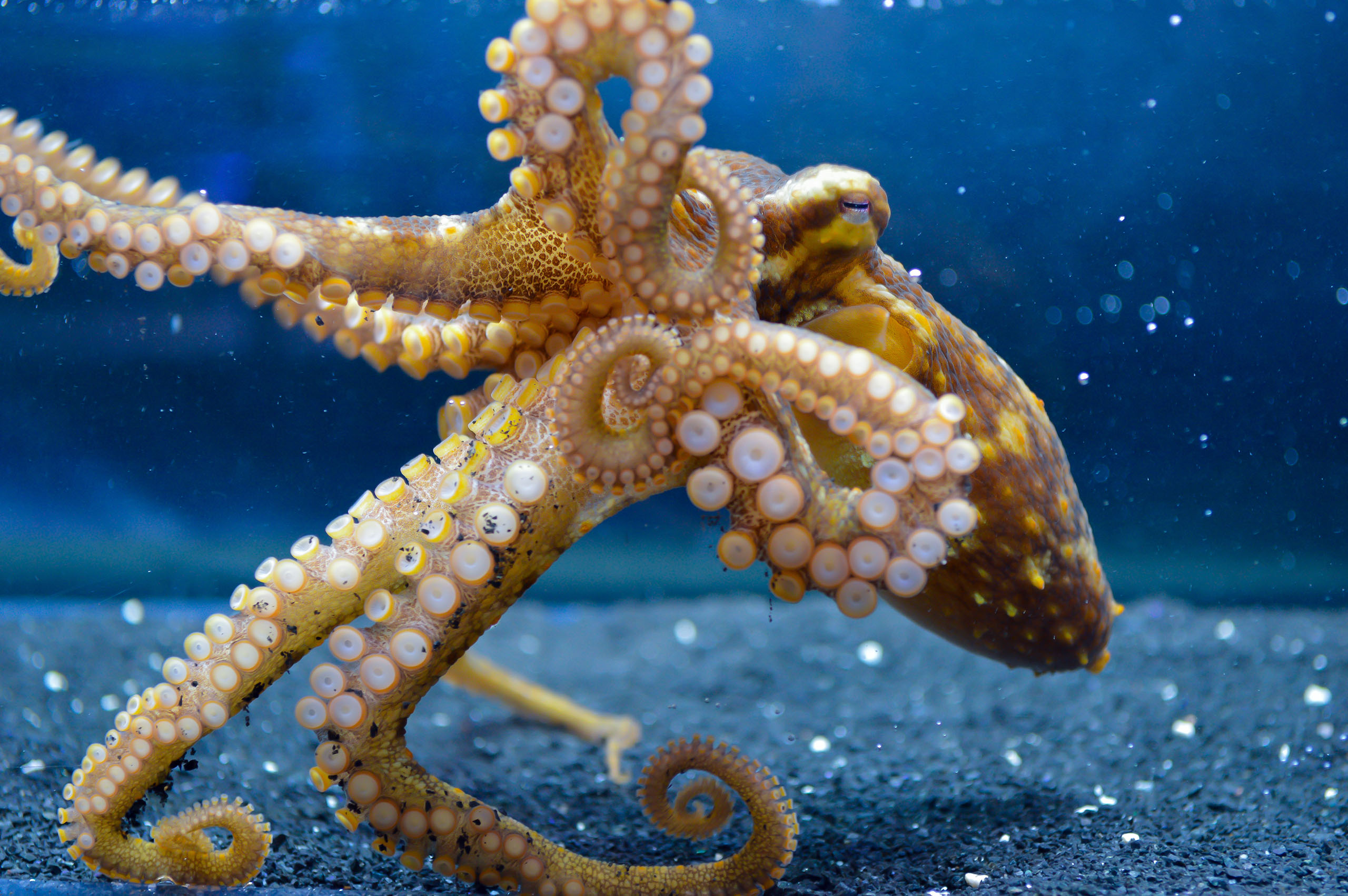
The California two-spot octopus (Octopus bimaculoides).
Photo by Anik Grearson.
Photo by Anik Grearson.
From Mongabay by Pepper St. Clair
Octopus suckers can sense and react to microbiomes in their environment.
Distinct microbial populations on objects relevant to the octopus’s survival, like eggs and prey, inform the animal’s behavior.
Scientists found that in response to different microbial signals, chemotactile receptors trigger reflexive responses in octopus suckers and arms.
From the beginning of life on Earth, microbes, small but influential single-celled organisms, have shaped the environment that animals must adapt to in order to survive.
Distinct microbial populations, known as microbiomes, inhabit nearly every surface on Earth.
Now scientists have found that octopuses can detect signals from the microbiomes they encounter, revealing one of the ways these cephalopods navigate their environment.
Humans can also detect signs of microbial activity, such as when we smell that meat has gone bad or milk has spoiled.
But we can’t sense those microbes by touch.
Octopuses, on the other hand, touch and taste the world with their arms, which collectively have more neurons than their central brain. Those arms are also lined with chemotactile receptors, which enable them to reflexively react to specific chemical signals from microbiomes as they explore their environment, according to research published recently in Cell.
Octopus suckers can sense and react to microbiomes in their environment.
Distinct microbial populations on objects relevant to the octopus’s survival, like eggs and prey, inform the animal’s behavior.
Scientists found that in response to different microbial signals, chemotactile receptors trigger reflexive responses in octopus suckers and arms.
From the beginning of life on Earth, microbes, small but influential single-celled organisms, have shaped the environment that animals must adapt to in order to survive.
Distinct microbial populations, known as microbiomes, inhabit nearly every surface on Earth.
Now scientists have found that octopuses can detect signals from the microbiomes they encounter, revealing one of the ways these cephalopods navigate their environment.
Humans can also detect signs of microbial activity, such as when we smell that meat has gone bad or milk has spoiled.
But we can’t sense those microbes by touch.
Octopuses, on the other hand, touch and taste the world with their arms, which collectively have more neurons than their central brain. Those arms are also lined with chemotactile receptors, which enable them to reflexively react to specific chemical signals from microbiomes as they explore their environment, according to research published recently in Cell.
Microbes have long been known to influence internal animal development, disease, and digestion.
To explore whether the microbiomes in our environment also shape external animal behavior, a team led by biologist Rebecka Sepela, a postdoctoral fellow at Harvard University in Cambridge, Massachusetts, chose as their subject the octopus — an animal that does a lot of exploring by touch.
“There’s a huge interest in this right now.
From human biology to animal biology, from agriculture to medicine,” said Spencer Nyholm, an invertebrate zoologist and microbiologist at the University of Connecticut, who was not involved in the study.
“We are surrounded by microbes, and they’re critically important for our health.”
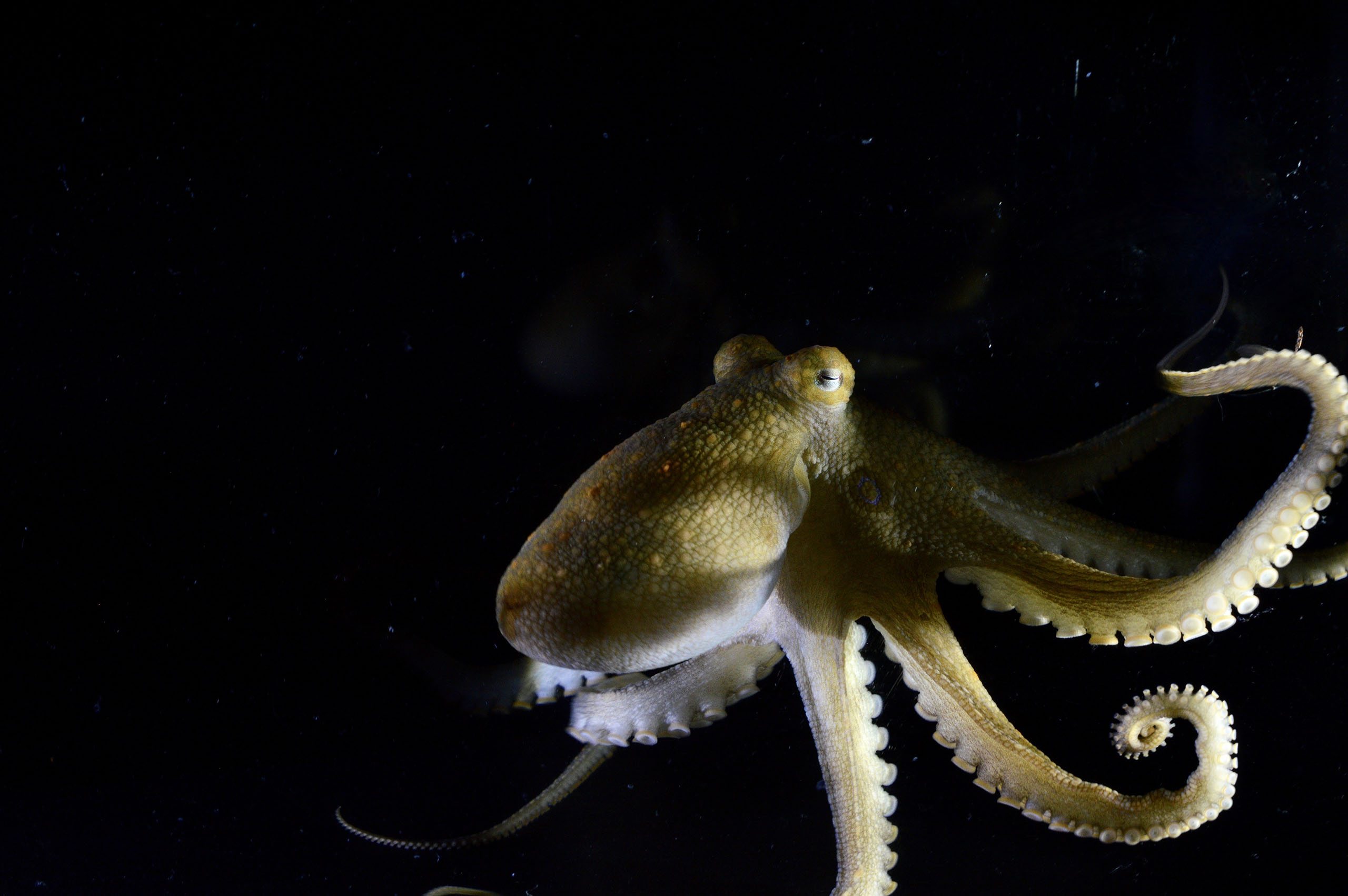
The California two-spot octopus (Octopus bimaculoides).
Photo by Anik Grearson.
Photo by Anik Grearson.
Sepela and her team exposed brooding California two-spot octopuses (Octopus bimaculoides) to microbes found on seafloor surfaces that the animals would likely encounter in their environment.
The scientists made fake octopus eggs out of a nontoxic gel derived from algae and loaded them with a molecule derived from bacteria that the researchers collected from octopus eggs that had been ejected from a clutch.
The octopus mothers rejected those fake eggs much quicker than fake eggs that were not treated with the molecule.
The scientists also isolated a molecule from the microbiome of decaying crabs to see how the octopus would respond to it.
The animals quickly dismissed plastic toy crabs doused in the molecule, exactly as they would react to an actual decaying crab.
When the team gave the octopuses the same plastic crabs without the decaying crab molecule, the octopuses grabbed and held on to them as if they were typical prey.
The results confirm that octopuses can detect and respond to microbial signals, which makes sense given their habitat, Sepela said.
“It’s living on a seafloor world that is completely coated in microbes,” she said.
“Most of the octopus’s body is dedicated towards arms that it uses to taste and touch every surface that it comes into contact with.”
When exposed to the microbial signals, individual octopus suckers reacted reflexively, such as retracting from or adhering to the surface where the molecule was detected.
These reactions were made possible by chemotactile receptors in the cells of octopus suckers that initiate a physiological response when they bind to specific molecules.
One of the receptors the team studied, called CRT1, is “especially sticky,” Sepela said.
“It detects a lot of different molecules.”
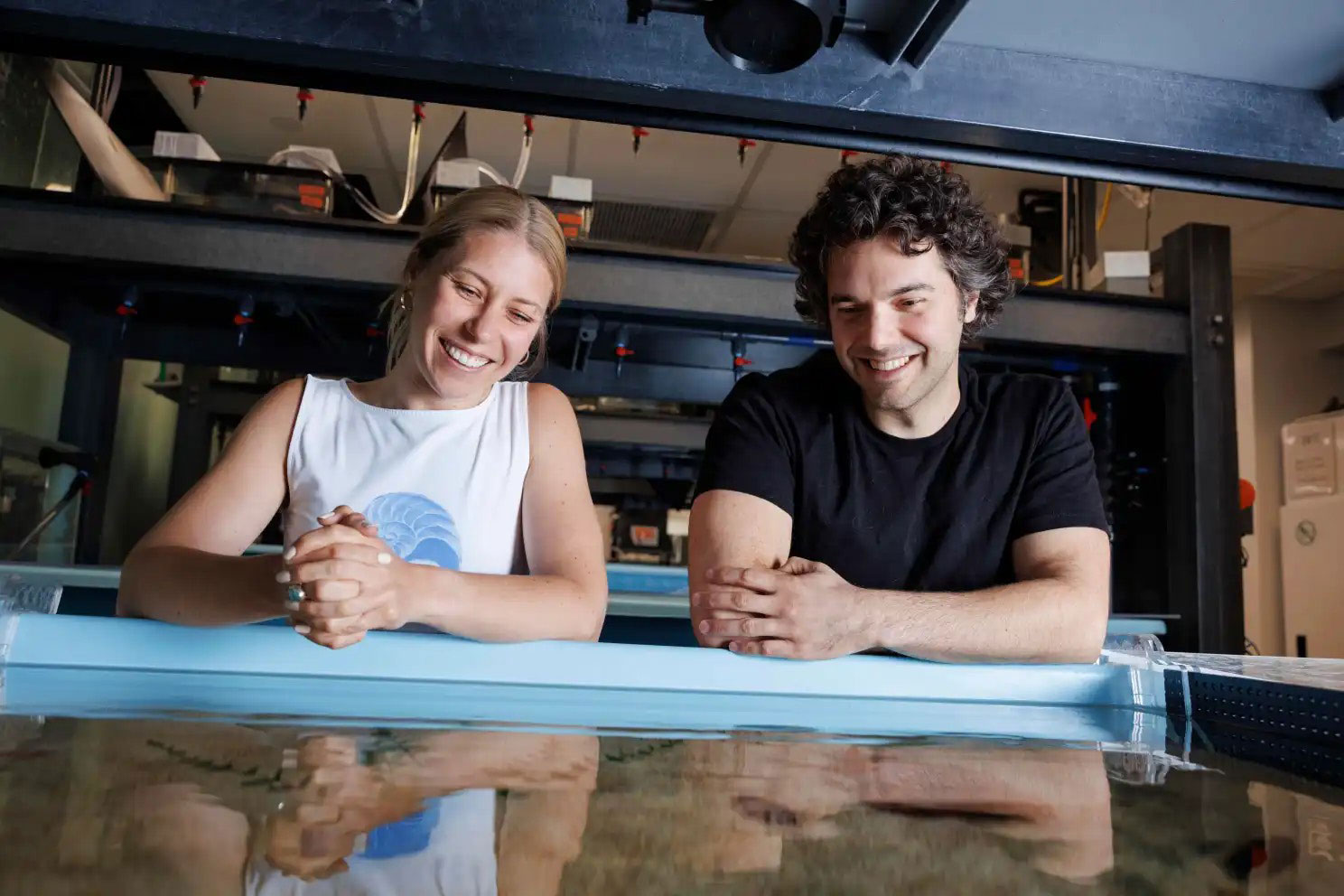 First author Rebecka Sepela and co-author Nicholas Bellono looking at a saltwater tank where octopus behavior is observed.
Photo by Niles Singer.
The findings are impressive but also important, Nyholm said.
The world is “a microbial sea,” and an animal’s ability to understand the microbiomes around it is critical not only for the individual or its species, but for the whole ecosystem, he said.
By studying the octopus’s insight into the microbial world, we can understand how microbes communicate with animal cells, Sepela said.
“I think it’s just really cool to think about how connected we are with a world that we can’t even see.”
Links :
- GeoGarage blog : What do we owe the octopus? / Eight reasons why octopuses are the geniuses of the ocean / World's largest deep-sea octopus nursery discovered / 'A symbol of what humans shouldn't be doing': the new ... / Dance of the Dumbo octopus / Watch baby octopuses hatch from a surprising deep-sea ... / Squid and octopus switch on camouflage / Deep Intellect : inside the mind of the octopus / Giant Pacific octopus babies: thousands of eggs hatch / Evolution of mimicry in octopuses

No comments:
Post a Comment