From Nautilus by Jake Currie
New research sheds light on the mysterious underwater structure
On land, most canyons are carved by erosion from rivers over millions of years.
In the ocean, things are a bit trickier.

Visualization with the GeoGarage platform (UKHO nautical raster chart)

Zoom visualization with the GeoGarage platform (UKHO nautical raster chart)

The King’s Trough Complex, located more than 600 miles off the coast of Portugal, is a massive canyon that includes one of the deepest points in the Atlantic Ocean—and was once a candidate to become
 The chain bag dredge is brought back on board.
It can be used to collect specific rock samples from depths of several thousand meters.
(Image credit: GEOMAR)
But how did it get there?
To find out, geologists from GEOMAR Helmholtz Centre for Ocean Research Kiel in Germany hit the seas in a 300-foot research vessel equipped with high-resolution sonar systems to map the ocean floor and a chain bag dredge to retrieve rock samples.
After analyzing the chemical composition of the volcanic rocks, the team was able to determine how and when this deep-sea canyon formed.
They published their findings in Geochemistry, Geophysics, Geosystems (G-Cubed).
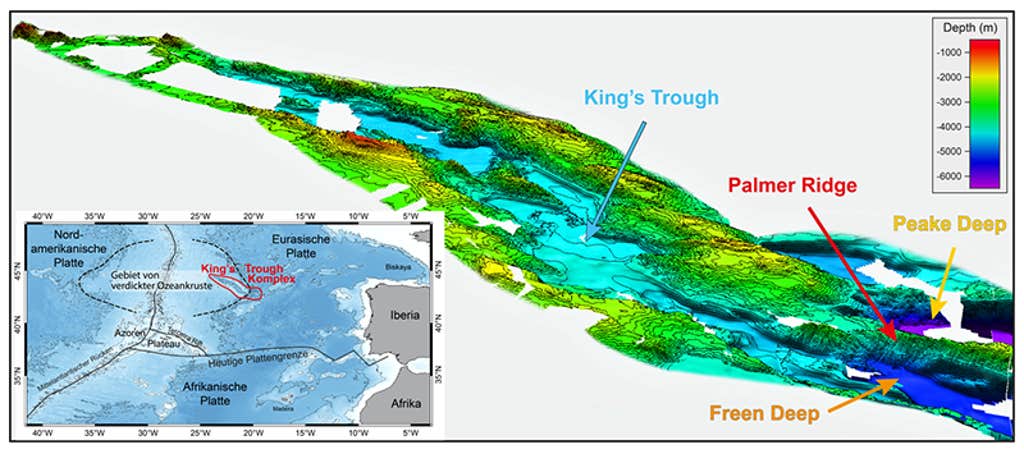 HIDDEN DEPTHS: This bathymetric map of King’s Trough Complex shows the deep basins at its eastern end, based on new data.
Image courtesy of Geomar.

“Researchers have long suspected that tectonic processes—that is, movements of the Earth’s crust—played a central role in the formation of the King’s Trough,” study author Antje Dürkefälden explained in a statement.
“Our results now explain for the first time why this remarkable structure developed precisely at this location.”
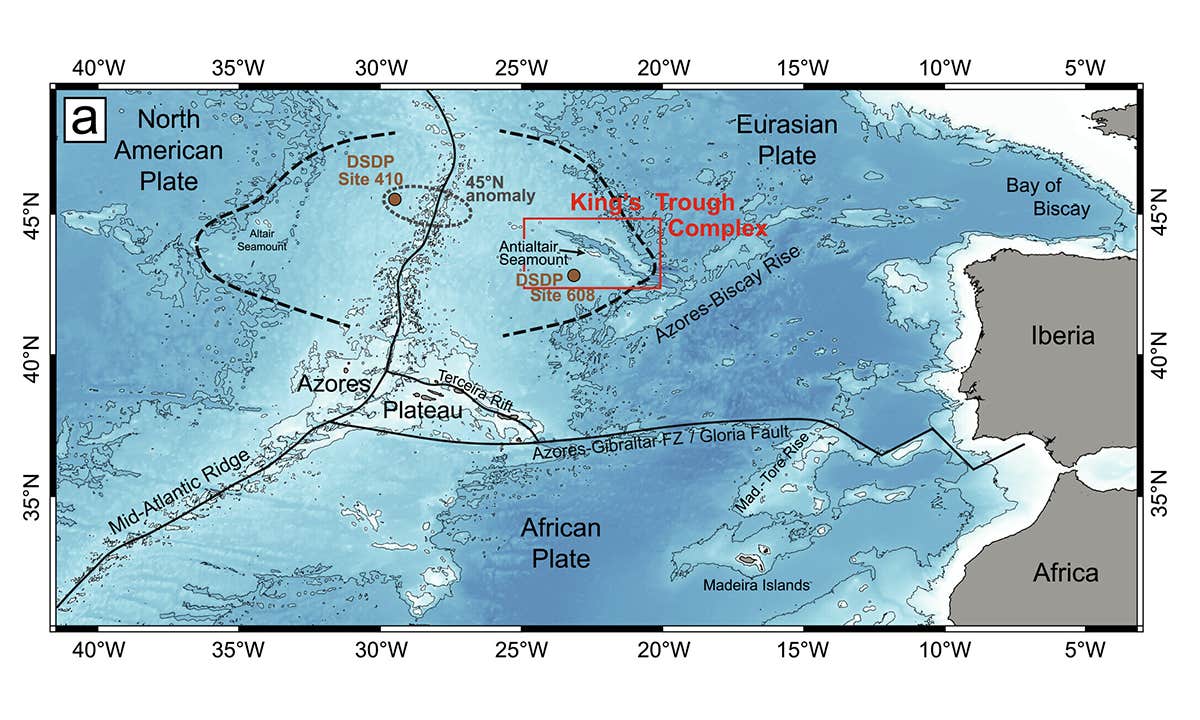
Between 37 and 24 million years ago, a tectonic plate boundary shifted to the area, resulting in the crust fracturing and the seafloor between Europe and Africa opening like a zipper in an east-west direction.
Between 37 and 24 million years ago, a tectonic plate boundary shifted to the area, resulting in the crust fracturing and the seafloor between Europe and Africa opening like a zipper in an east-west direction.

(a) Cartoon showing the eastern North Atlantic region at ∼37 Ma after the plate boundary had just jumped to the KTC area resulting in oblique extension beginning at the Peake and Freen Deeps due to the continued anticlockwise rotation of the Iberian/African plate.
(b) After a new plume conduit had branched off toward the south (resulting in the steady build-up of the Azores plateau) and the relocation of the plate boundary to the Azores-Gibraltar Fracture zone, transtension and rifting in the KTC area ceased and the northern plume branch wanes but is still reflected by the 45°N anomaly at the MAR.
Credit: Geochemistry, Geophysics, Geosystems (2025). DOI: 10.1029/2025gc012616
Prior to the shift, the crust was thickened and heated by an upwelling of molten rock from the mantle, making it particularly fragile.
“This thickened, heated crust may have made the region mechanically weaker, so that the plate boundary preferentially shifted here,” added co-author Jörg Geldmacher.
“This thickened, heated crust may have made the region mechanically weaker, so that the plate boundary preferentially shifted here,” added co-author Jörg Geldmacher.
“When the plate boundary later moved farther south toward the modern Azores, the formation of the King’s Trough also came to a halt.”
It’s a remarkable example of how activity deep within our planet’s molten mantle can have a dramatic impact on the surface.
It’s a remarkable example of how activity deep within our planet’s molten mantle can have a dramatic impact on the surface.
Links :
- AGU : Origin of the King's Trough Complex (North Atlantic): Interplay Between a Transient Plate Boundary and the Early Azores Mantle Plume
- Phys : King's Trough: How a shifting plate boundary and hot mantle material shaped an Atlantic mega-canyon
- Discover : The Atlantic Ocean May Have Its Own Grand Canyon — and It Might Be Even Bigger
- Eureka : The “Grand Canyon” of the Atlantic
- SciTechDaily : Scientists Uncover Unusual Origins of Mysterious Ocean Trench Bigger Than the Grand Canyon
- ECO : The Grand Canyon of the Atlantic

No comments:
Post a Comment