From CBC news by Emily Chung
New archeological evidence for repeat sea journeys and stays at remote islands
Archeologists have found the remains of an ancient camp on a remote High Arctic island that dates back more than 4,000 years.
They offer surprising new insights about the first people who lived near what is now the Canada-Greenland border and journeyed to take advantage of a rich new ecosystem that formed around the time.
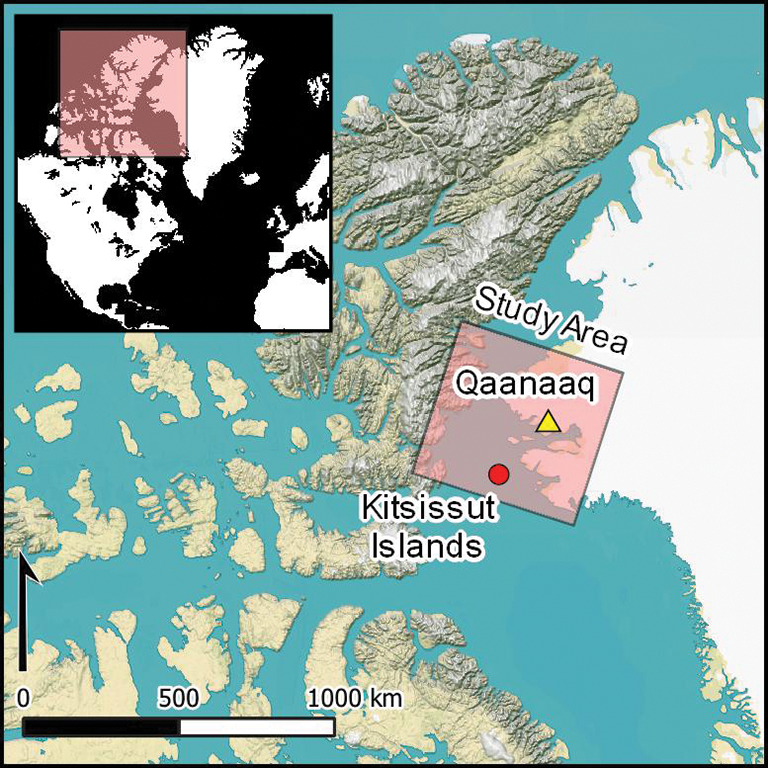

The Paleo-Inuit archeological site was found in Kitsissut, a rocky cluster of cliff-edged islands between Greenland and Ellesmere Island.
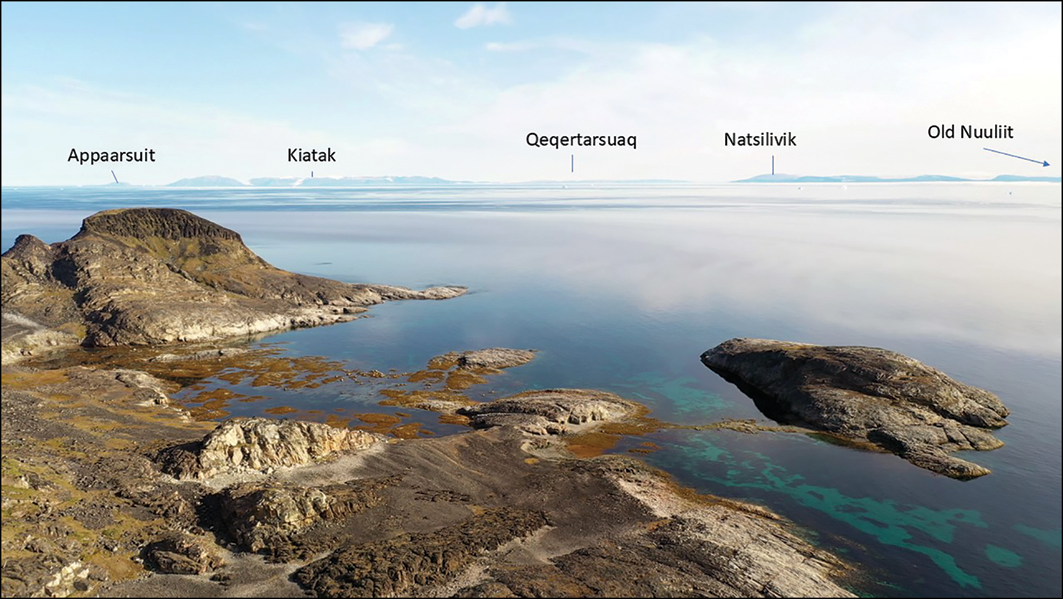
A
view of the crossing between Kitsissut and the shores of Avanersuaq in
northwest Greenland, with a minimum distance of 53 kilometres.
UAV image from Isbjørne Island in clear weather looking towards key locations, with beach ridges and Early Paleo-Inuit features in the foreground (figure by authors).
The archaeological beach ridges where ancient tent rings were found can be seen in the foreground.
(Walls et al.)
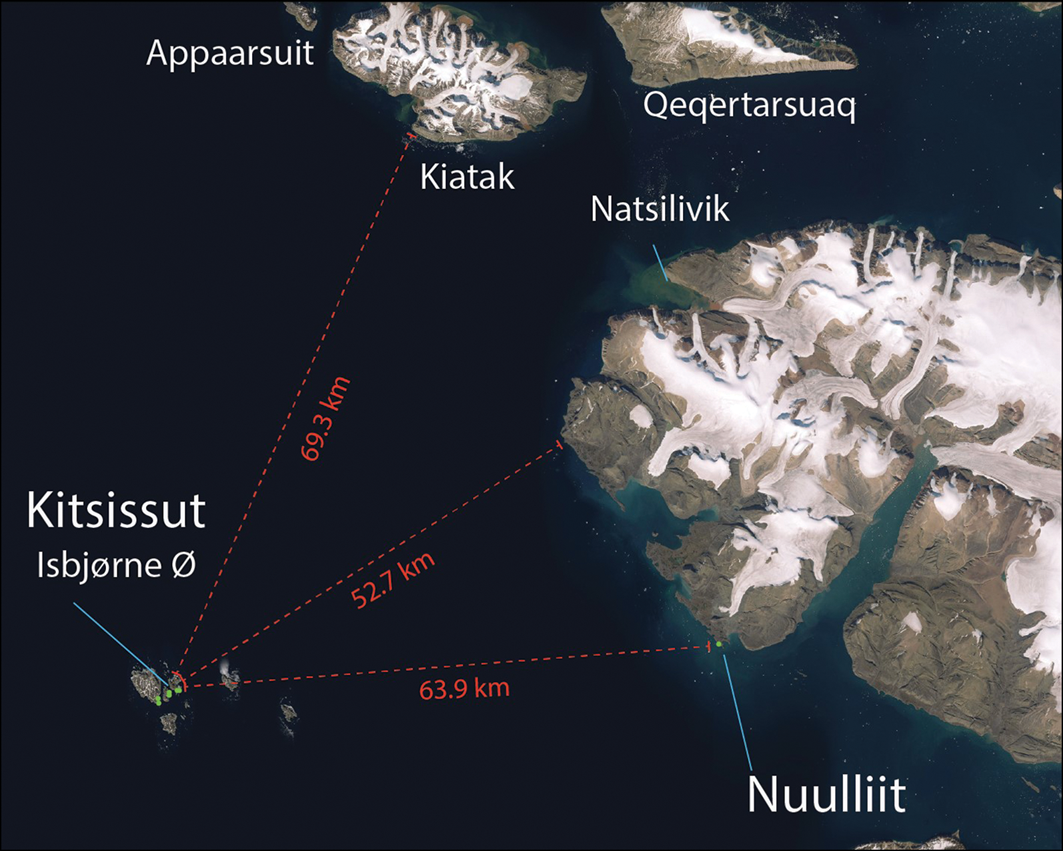
Distance of crossings to Kitsissut from key locations, including
Nuuliit, the closest Early Paleo-Inuit site
(image source: Copernicus
Sentinel-2; figure by authors).
"It would have been a fairly extraordinary journey for them to get to this location by watercraft," said Matthew Walls, lead author of the new study describing the findings published Monday in the journal Antiquity.
 Study co-author Mari Kleist of the University of Greenland studies a Paleo-Inuit tent ring visible in the foreground. (Walls et al.)
Walls estimates that by canoe or kayak, getting to Kitsissut would have taken 12 to 15 hours of difficult paddling — so long that the weather might easily go from calm to stormy en route.
The archeological site contains evidence that many people visited and stayed there repeatedly.
"It's obviously a place where people are returning over the long term," Walls said.
 A photo of the research team. Back row, left to right: Pia Egede (Ilisimatusarfik/University of Greenland), Mari Kleist (Ilisimatusarfik), Pauline Knudsen (Ilisimatusarfik), Qalaseq Sadorana (Qaanaaq), Pivinnguaq Mørch (Ilisimatusarfik), Matthew Walls (University of Calgary). Front row, left to right: Niels Miunge (Qaanaaq), Otto Simigaq (Qaanaaq). (Matthew Walls/University of Calgary)
Max Friesen, a University of Toronto Arctic archeologist who has collaborated with the paper's other authors but was not involved in this research, said the findings suggest the Paleo-Inuit people had much more sophisticated seafaring technology than previously thought.
He said small fragments of their boats have been found, suggesting they had canoe- or kayak-like vessels made of animal skins pulled over a bone or wood frame. But not much more was known.
Friesen, who was Walls's PhD supervisor, said the Paleo-Inuit were found across the High Arctic.
If they had the skills and technology to travel repeatedly to Kitsissut, they likely could also do things like hunt seals or even whales far out in the ocean.
That means they may have had wider options for what resources they could use and how they could impact ecosystems thousands of years ago.
"It has huge implications across the rest of the Arctic, right?" said Friesen.
That means they may have had wider options for what resources they could use and how they could impact ecosystems thousands of years ago.
"It has huge implications across the rest of the Arctic, right?" said Friesen.
"So that's really exciting, to really add to what we know about the transportation technology."
What the ancient camp looks like
Walls worked with University of Greenland (Ilisimatusarfik) Inuit archeologists Mari Kleist and Pauline Knudsen, and a team that included Inuit from nearby communities to map the archeological site and exposed artifacts between 2017 and 2019.
A set of ridges have been rising out of the ocean over time, springing back from the weight of now-melted glaciers.
On the oldest, highest ridges, farthest inland from the modern coastline, there are least 18 tent rings — circular areas cleared of rocks, with a ring of stones around them.
Those stones may have held down the edges of the tents, likely sealskin stretched over driftwood frames.
Those stones may have held down the edges of the tents, likely sealskin stretched over driftwood frames.

The researchers mapped 18 Paleo-Inuit tent rings on the beach ridges in Kitsissut.
(Matthew Walls/University of Calgary)
There was typically a central hearth with the remains of burnt driftwood in the centre, and a line of stones dividing the tent into two "rooms" that could have been used for different activities, such as working with animal skins or making stone tools.
A seabird bone found inside one of the tent rings was sent for radiocarbon dating.
From that analysis, the researchers estimated the age of the site to be between 4,000 to 4,400 years old, a period when the first archeological evidence of people, known as the Paleo-Inuit, are found across the High Arctic.
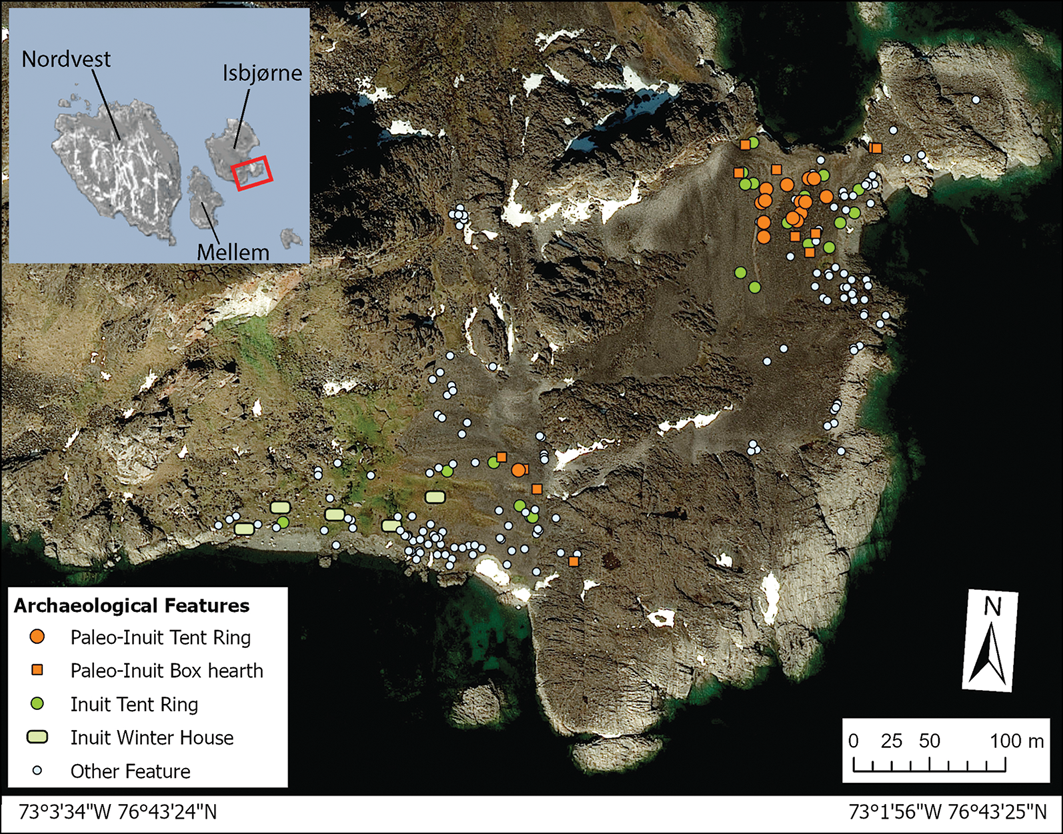
Kitsissut refers to the group of islands and skerries, many of which do
not have individual names in Kalallisut. The archaeological features on
Isbjørne Island were identified by the authors during a 2019 survey of
Kitsissut and include features from the Early Paleo-Inuit and later
periods
(image source: Maxar; figure by authors).
Polynya pioneers of many species
It was also around that time that the rich ecosystem was developing in Kitsissut, due to the formation of a rare channel of open water in the sea ice called the Pikialosorsuaq or North Water polynya.
Walls said it's caused by the unique wind, current and geographic conditions in this area.
"It's a really important ecological hotspot," said Walls.
"It's a really important ecological hotspot," said Walls.
The open water allows for phytoplankton blooms that support an entire food chain.

This map shows Kitsissut's location in the polynya between Ellesmere Island (Canada) and Greenland. (Walls et al.)
The cliffs of Kitsissut are home to nesting colonies of seabirds and the marine mammals such as seals hunt in the surrounding waters, many of which would have first moved there when the polynya opened.
Walls said that's important for how people think about these Arctic ecosystems and their conservation.
"Indigenous communities are part of their development over the long term, right back to their early formation," he said, supporting the argument for Indigenous stewardship today.
Lesley Howse is director of archeology at the Inuit Heritage Trust, the Inuit organization that co-governs cultural heritage with the Nunavut government, including archeological collections and education, permitting for archaeological projects and requests to work with Inuit belongings.
Howse, who has previously worked with Walls, Kleist and Knudsen but wasn't involved in this study, said archeologists used to think that Paleo-Inuit relied heavily on hunting animals on land.
She's not surprised by evidence that they had such a high level of skill on the sea, given the need to make use of all available resources to survive in such a harsh environment.
"The water is essential to living in the north," she said.
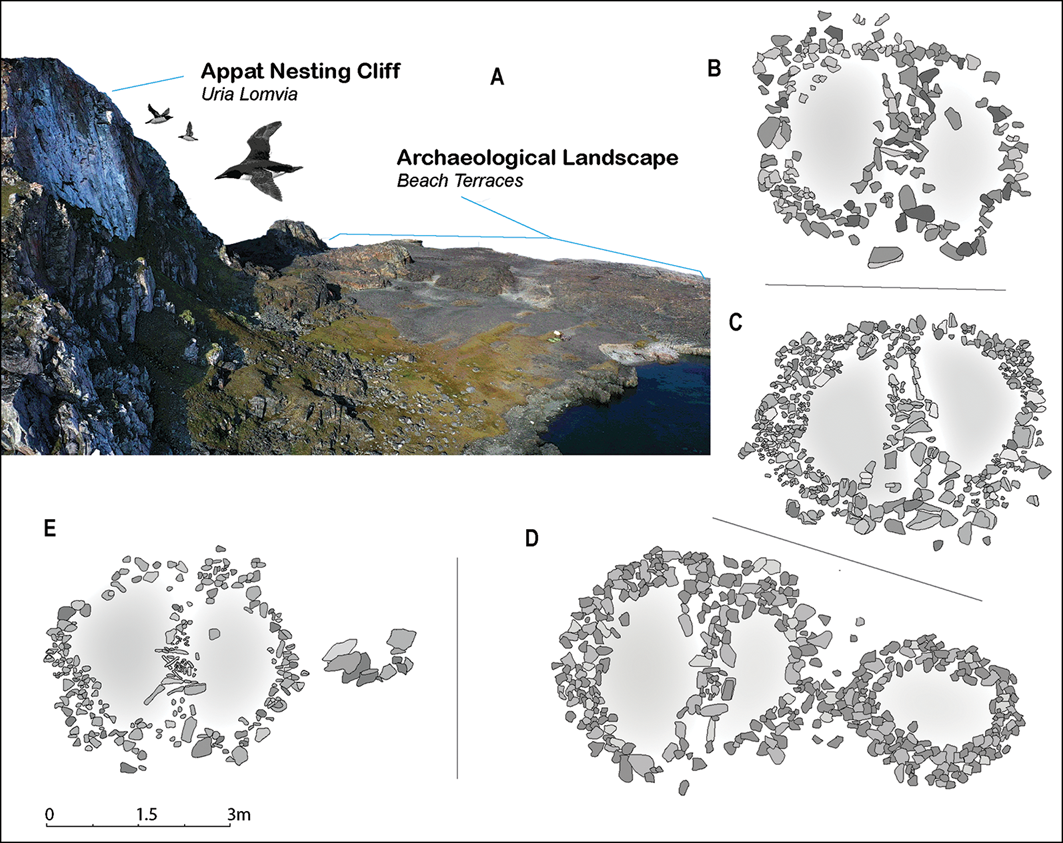
Early Paleo-Inuit features on Isbjørne Island; A) location of site
beneath the nesting cliff; B & C) sample of bilobate tent rings with
axial features, which bisect the dwelling and include central hearths; D
& E) Early Paleo-Inuit tent rings included adjacent dwelling
structures or box hearths (figure by authors).
"You have to depend and rely on all animals that are there and adapt with the technologies you have. I think this [research] kind of brings this to light."
Links :

No comments:
Post a Comment