From Substack by Fererica Maiorano
When the Financial Times dropped its investigation into Mittal Energy’s purchase of Russian crude transported on sanctions-listed vessels, it was framed as another sanctions-evasion story — a billionaire’s refinery caught in the fog of global oil trading.
But if you’re an investor, operator, or founder in the intersection of shipping, energy, and data tech, this episode should read very differently. It’s not just about Russia or sanctions.
It’s a live demonstration of a global infrastructure failure — and the next big data frontier: maritime transparency.
The FT’s reporting found that HPCL-Mittal Energy Limited (HMEL), co-owned by Lakshmi Mittal and Hindustan Petroleum, received roughly $280 million in crude oil shipments this year from Russia’s Arctic port of Murmansk.

That in itself isn’t unusual.
Since 2022, India has become one of the largest buyers of discounted Russian crude.
The problem lies in how the oil got there.
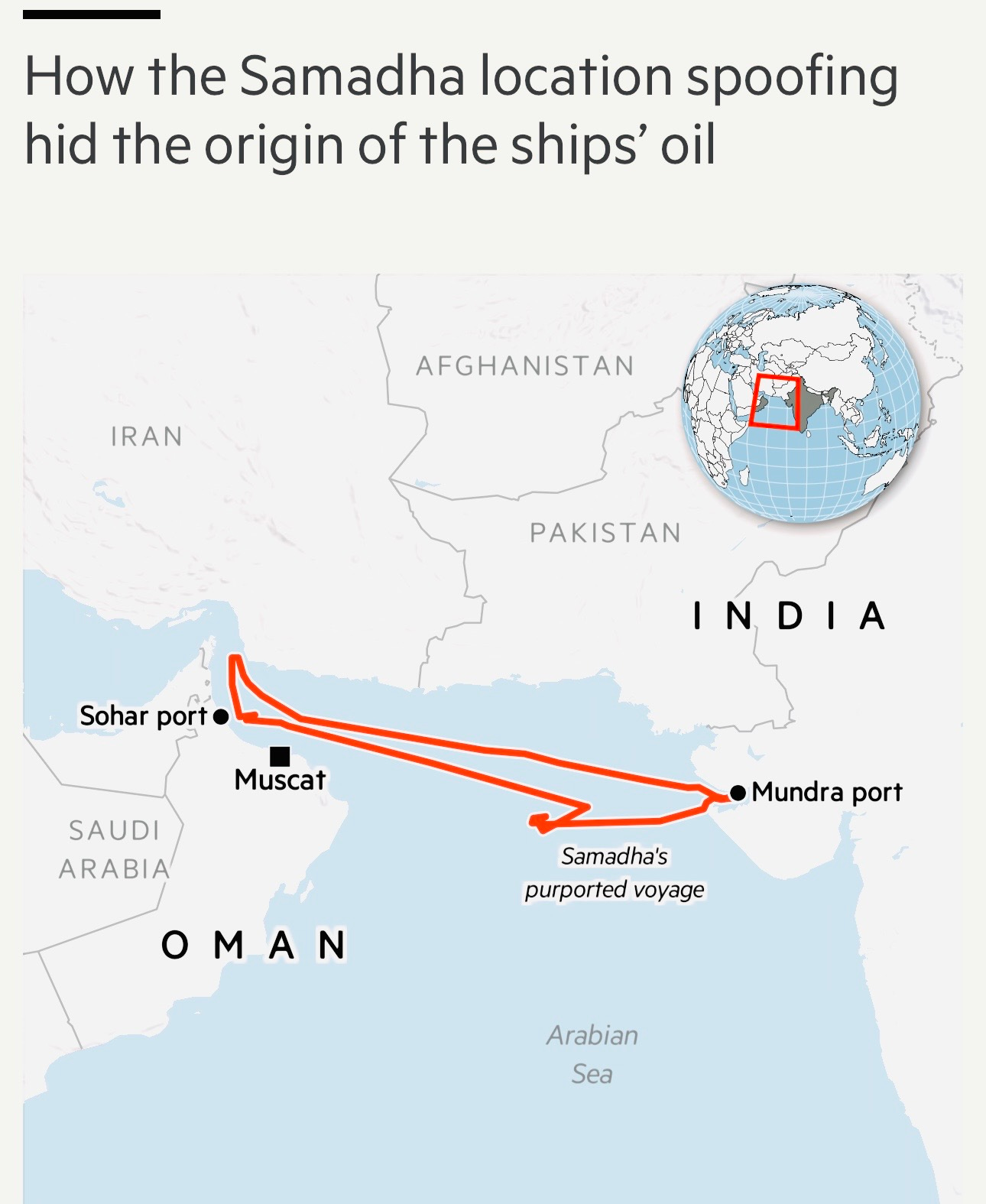
The shipments were transported on US-sanctioned vessels — Belgorod, Dignity, Primorye, and Danshui — that spoofed their AIS transponders, broadcast false locations, and conducted ship-to-ship (STS) transfers in the Gulf of Oman.
A fifth vessel, the Samadha — not initially sanctioned but later blacklisted by the UK — completed the “clean” leg of the trip to India.
This choreography of deception is straight out of the playbook long used by Iranian and Venezuelan operators:
The FT’s reporting found that HPCL-Mittal Energy Limited (HMEL), co-owned by Lakshmi Mittal and Hindustan Petroleum, received roughly $280 million in crude oil shipments this year from Russia’s Arctic port of Murmansk.
That in itself isn’t unusual.
Since 2022, India has become one of the largest buyers of discounted Russian crude.
The problem lies in how the oil got there.
The shipments were transported on US-sanctioned vessels — Belgorod, Dignity, Primorye, and Danshui — that spoofed their AIS transponders, broadcast false locations, and conducted ship-to-ship (STS) transfers in the Gulf of Oman.
A fifth vessel, the Samadha — not initially sanctioned but later blacklisted by the UK — completed the “clean” leg of the trip to India.
This choreography of deception is straight out of the playbook long used by Iranian and Venezuelan operators:
- sanctioned ship goes dark,
- crude is offloaded mid-sea to a non-sanctioned intermediary,
- paperwork is scrubbed,
- cargo arrives looking “legitimate.”
The reality?
The existing compliance stack is blind to real-world spoofing behavior.
The Shadow Fleet Economy
The “dark fleet” — vessels engaged in deceptive shipping practices — now numbers somewhere between 600 and 800 ships, according to Lloyd’s List and Windward.
These tankers operate in a twilight world of flag-hopping, opaque ownership, and synthetic identity data.
The Shadow Fleet Economy
The “dark fleet” — vessels engaged in deceptive shipping practices — now numbers somewhere between 600 and 800 ships, according to Lloyd’s List and Windward.
These tankers operate in a twilight world of flag-hopping, opaque ownership, and synthetic identity data.
Many are registered in Seychelles, Panama, or the Marshall Islands, insured by non-Western providers, and tracked through false AIS signals.
In short: the world’s most critical trade system has a data problem.
For context, 90% of global goods move by sea.
In short: the world’s most critical trade system has a data problem.
For context, 90% of global goods move by sea.
Yet the infrastructure tracking those movements — AIS, registry databases, port logs — was never built to handle intentional deception.
It was designed for collision avoidance, not sanctions enforcement.
The Venture opportunity:
The Venture opportunity:
Building the Maritime Data Stack
If you’re a VC looking for the next big thing, this is it.
The shipping world is quietly going through the same digital transformation the financial markets went through after 2008 — when compliance, fraud analytics, and counterparty risk moved from “legal back-office” to data-native, AI-driven systems.
Here’s what’s being built right now — and where the opportunities lie:
1. Behavioral Vessel Intelligence
Companies like Windward, Spire Global, HawkEye 360, and Maritime AI are using satellite radar (SAR), optical imaging, and RF geolocation to detect ships that are lying about their position. Startups in this space are training models that can flag vessels whose movement patterns are statistically inconsistent with their declared routes — in real time.
2. Sanctions Graph Intelligence
Tools like Altana AI and Palantir’s Foundry are building knowledge graphs that map relationships between shipowners, charterers, and suppliers.
If you’re a VC looking for the next big thing, this is it.
The shipping world is quietly going through the same digital transformation the financial markets went through after 2008 — when compliance, fraud analytics, and counterparty risk moved from “legal back-office” to data-native, AI-driven systems.
Here’s what’s being built right now — and where the opportunities lie:
1. Behavioral Vessel Intelligence
Companies like Windward, Spire Global, HawkEye 360, and Maritime AI are using satellite radar (SAR), optical imaging, and RF geolocation to detect ships that are lying about their position. Startups in this space are training models that can flag vessels whose movement patterns are statistically inconsistent with their declared routes — in real time.
2. Sanctions Graph Intelligence
Tools like Altana AI and Palantir’s Foundry are building knowledge graphs that map relationships between shipowners, charterers, and suppliers.
The future of sanctions compliance is entity linkage, not just list-checking.
A vessel spoofing its transponder is one thing; a corporate entity hiding behind a web of offshore shells is another.
A vessel spoofing its transponder is one thing; a corporate entity hiding behind a web of offshore shells is another.
The intersection of these two data problems is where the next successful ventures will emerge.
3. Trade Finance & Smart Documentation
Right now, bills of lading and shipping manifests are still shockingly manual. Integrating blockchain provenance systems — think CargoX, TradeLens, Dockflow — into trade finance could allow auditors and regulators to verify every link in the logistics chain.
Once regulators (or insurers) start demanding this kind of traceability, the adoption curve will be fast and steep.
4. Geopolitical Risk APIs
Imagine an API that scores every maritime route and cargo chain in terms of sanctions exposure, ESG risk, and data confidence.
3. Trade Finance & Smart Documentation
Right now, bills of lading and shipping manifests are still shockingly manual. Integrating blockchain provenance systems — think CargoX, TradeLens, Dockflow — into trade finance could allow auditors and regulators to verify every link in the logistics chain.
Once regulators (or insurers) start demanding this kind of traceability, the adoption curve will be fast and steep.
4. Geopolitical Risk APIs
Imagine an API that scores every maritime route and cargo chain in terms of sanctions exposure, ESG risk, and data confidence.
That’s what firms like Everstream Analytics and Veridapt are inching toward — and what the next generation of maritime fintechs should be building.
Why VCs should care
Global shipping is a $14 trillion industry — and it’s almost completely under-digitized.
Regulatory pressure is rising, data availability is exploding, and yet, most legacy systems still treat compliance as static record-keeping.
The combination of:
Just as fintechs like Stripe and Plaid turned compliance rails into platforms, maritime AI will turn sanctions intelligence into infrastructure — the invisible layer enabling trade finance, logistics, and ESG reporting.
The Strategic Endgame
This isn’t only about avoiding penalties.
Why VCs should care
Global shipping is a $14 trillion industry — and it’s almost completely under-digitized.
Regulatory pressure is rising, data availability is exploding, and yet, most legacy systems still treat compliance as static record-keeping.
The combination of:
- cheap satellite imagery,
- better ML models, and
- rising sanctions enforcement
Just as fintechs like Stripe and Plaid turned compliance rails into platforms, maritime AI will turn sanctions intelligence into infrastructure — the invisible layer enabling trade finance, logistics, and ESG reporting.
The Strategic Endgame
This isn’t only about avoiding penalties.
In a fragmented, multipolar world, data transparency becomes geopolitical leverage.
Countries like India, China, and Turkey — now key buyers of Russian crude — will increasingly rely on localized compliance ecosystems. The next race is between Western transparency standards and non-aligned trade protocols built around alternative data flows.
For investors, this is the moment to back companies that can sit on top of both — infrastructure players that don’t just monitor sanctions, but build trust networks across opaque markets.
Because if the FT’s Mittal story proves anything, it’s this:
The next supply chain superpower won’t be the company that moves the most oil.
It’ll be the one that knows — with data certainty — where every barrel came from.
This industry has always been foggy, the difference now is that we have the tools to make it transparent — and whoever builds them will define the next decade of trade.
Countries like India, China, and Turkey — now key buyers of Russian crude — will increasingly rely on localized compliance ecosystems. The next race is between Western transparency standards and non-aligned trade protocols built around alternative data flows.
For investors, this is the moment to back companies that can sit on top of both — infrastructure players that don’t just monitor sanctions, but build trust networks across opaque markets.
Because if the FT’s Mittal story proves anything, it’s this:
The next supply chain superpower won’t be the company that moves the most oil.
It’ll be the one that knows — with data certainty — where every barrel came from.
This industry has always been foggy, the difference now is that we have the tools to make it transparent — and whoever builds them will define the next decade of trade.
Links :
- Newsweek : Satellites Capture Iran’s Suspected ‘Shadow Fleet’ in Action
- The Telegraph : Putin’s shadow fleet under threat as Trump tries to ‘terrify’ Russia’s allies
- NPR : How Russia’s shadow fleet is sailing around oil sanctions / How Russia's shadow fleet of oil tankers evades western sanctions
- The Economist : The flashing red threat from Russia's dark fleet
- ENR : Up to 1,400 ships: Russia’s shadow fleet worries the EU
- GeoGarage blog : Shadow tanker fleet: A ticking time bomb waiting to cause ...

No comments:
Post a Comment