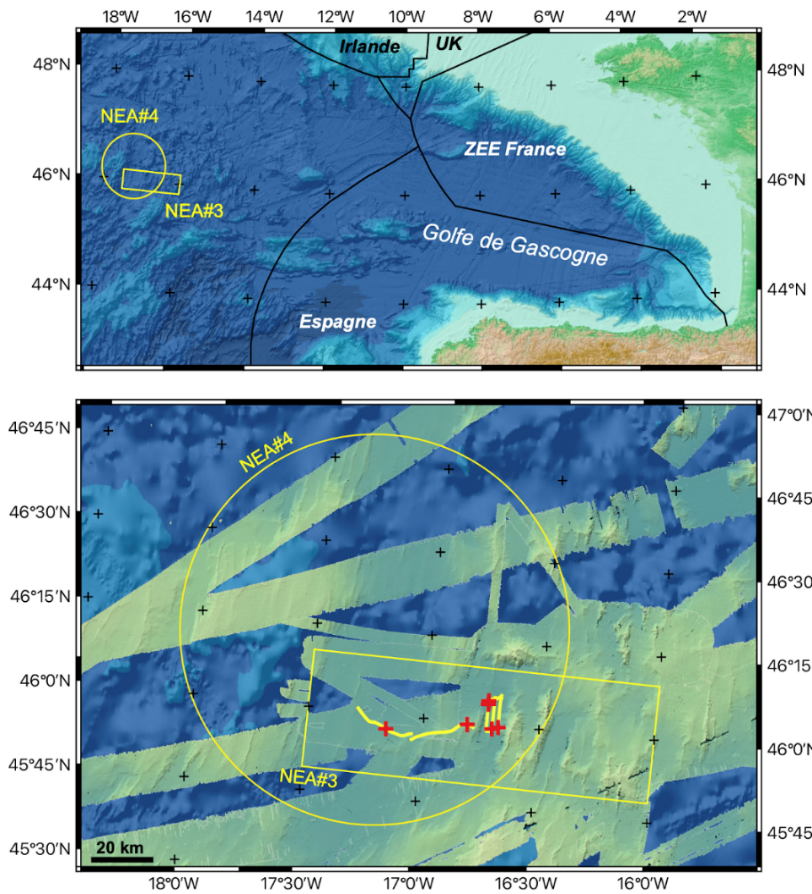
Location of areas in the North-East
Atlantic abyssal plain where radioactive drums (NEA#3 and #4) were
dumped in international waters (top).
The detailed map (bottom) shows
the available bathymetry, as well as the location of the 6 drums (red
crosses) identified by the submersible Epaulard during dives in 1985
(these identifications were made as part of the CEA/IPSN and IFREMER
EPICEA campaign).
Project NODSSUM, 2025
Between 1950 and 1990, over 200,000 barrels of radioactive waste were dumped in the depths of the Northeast Atlantic Ocean.
The first mission of the NODSSUM cruise, taking place from June 15 to July 11 and led by the CNRS, will map the primary sites for submerged barrels and study their interactions with marine biodiversity.
The second mission will target the immediate vicinity of the barrels.
The interdisciplinary NODSSUM mission led by the CNRS in collaboration with a team from Ifremer, the ASNR, and multiple national and international partners will take to the seas on 15th June for one month.
The scientists have planned two cruises, deploying modern tools to map and study the primary sites where numerous barrels of radioactive waste were voluntarily dumped for 40 years at the Abyssal Plains of the Northeast Atlantic.
This first scouting mission is being conducted with the Ulyx robot of the French oceanographic fleet, operated by IFREMER.

Photograph of a barrel of radioactive waste taken by the AUV Epaulard during the Epicea campaign.
© Sibuet et al.
1985
© Sibuet et al.
1985
Between 1946 and 1990, over 200,000 barrels of radioactive waste were dumped by multiple European countries in the international waters of the Abyssal Plains in the Northeast Atlantic Ocean, at a depth of over 4,000 metres.
These barrels contain waste embedded in asphalt or cement.
These barrels contain waste embedded in asphalt or cement.


The Ulyx robot photographed the barrels at a depth of over 4,000 m.
Here we see an abyssal fish and its shadow.
(Photo French oceanographic fleet - Nodssum campaign)
The NODSSUM project, an interdisciplinary cruise including nuclear research, geology, oceanography, biology, and marine chemistry, will map the primary dumping zone and study the behaviour of radionuclides in the deep ocean, in addition to their interactions with marine ecosystems.
For one month, scientists will crisscross the dumping sites of radioactive barrels using high-resolution sonar on board the new autonomous submersible UlyX, which will complete its first scientific dives.
It will navigate at approximately 70 metres above the seafloor to map and identify barrels, and will approach to a distance of 10 metres to photograph them.
This will help identify the sites for initial water, sediment, and faunal samples without approaching the barrels.
For one month, scientists will crisscross the dumping sites of radioactive barrels using high-resolution sonar on board the new autonomous submersible UlyX, which will complete its first scientific dives.
It will navigate at approximately 70 metres above the seafloor to map and identify barrels, and will approach to a distance of 10 metres to photograph them.
This will help identify the sites for initial water, sediment, and faunal samples without approaching the barrels.

For this first interdisciplinary mission, the scientists combine multiple cutting-edge technologies, and plan to take sediment samples on board the ship using corying systems, and water using a rosette sampler.
Currentmeters will be deployed at the seabed to measure the Abyssal Zone’s currents.
The scientists will also install traps for fish and crustaceans to determine the effect of this radioactive waste on marine life and ecosystem dynamics.
On board the ship, the teams will have access to radioactivity measurement instruments for the first assessment, later be refined with more extensive analyses in the laboratory on-land.
To avoid any potential radiological risk, the project includes robust onboard radioprotection measures.
From the moment of their arrival, the samples and instruments will be checked and controlled, implementing appropriate radioprotection measures for sample handling and storage.
This precautionary effort will be applied and adapted throughout the scientists’ activities, including in laboratories back on firm ground.
These measures and samples will help identify the sites to be more closely studied during a second future cruise, whose goal is to target the immediate vicinity of the barrels.
This will be carried out with either a manned submersible, or a remotely operated robots, equipped with mechanical arms to directly observe the barrels and handle sampling nearby.
The interdisciplinary NODSSUM mission is an integral part of the PRIME RADIOCEAN project led by the CNRS, in connection with the NODSSUM project being pursued with the French Oceanographic Fleet.
Notes :
Currentmeters will be deployed at the seabed to measure the Abyssal Zone’s currents.
The scientists will also install traps for fish and crustaceans to determine the effect of this radioactive waste on marine life and ecosystem dynamics.
On board the ship, the teams will have access to radioactivity measurement instruments for the first assessment, later be refined with more extensive analyses in the laboratory on-land.
To avoid any potential radiological risk, the project includes robust onboard radioprotection measures.
From the moment of their arrival, the samples and instruments will be checked and controlled, implementing appropriate radioprotection measures for sample handling and storage.
This precautionary effort will be applied and adapted throughout the scientists’ activities, including in laboratories back on firm ground.
These measures and samples will help identify the sites to be more closely studied during a second future cruise, whose goal is to target the immediate vicinity of the barrels.
This will be carried out with either a manned submersible, or a remotely operated robots, equipped with mechanical arms to directly observe the barrels and handle sampling nearby.
The interdisciplinary NODSSUM mission is an integral part of the PRIME RADIOCEAN project led by the CNRS, in connection with the NODSSUM project being pursued with the French Oceanographic Fleet.
Notes :
- UlyX is the new autonomous underwater vehicle (AUV) of the French Oceanographic Fleet (FOF).
It is an active explorer thanks to its data analytics algorithms, which allow it to change trajectory depending on the signs it detects.
UlyX is powered by batteries that can descend to a depth of more than 6,000 meters.

- A radionuclide is an atom whose nucleus is unstable, and that can potentially transform into another atom by emitting radiation.
Beyond their quantity, they can be present in different forms that are more or less mobile, divided between the water and sediments.
Some radionuclides are produced by humans, such as caesium-137, while others are present naturally, such as potassium-40 and lead-210.
Radionuclides are present everywhere.
In general, exposure to ionizing radiation primarily comes from natural sources (radionuclides from the Earth’s crust, cosmic radiation).
Some radionuclides are produced by humans, such as caesium-137, while others are present naturally, such as potassium-40 and lead-210.
Radionuclides are present everywhere.
In general, exposure to ionizing radiation primarily comes from natural sources (radionuclides from the Earth’s crust, cosmic radiation).
Links :

No comments:
Post a Comment