Monday, June 7, 2010

About the effect of GPS technology on human sense of direction


Can GPS help your brain get lost?

Increasing reliance on global positioning systems could damage our own internal sense of direction and have other unforeseen effects on the brain, neurological research suggests.


From GIS Lounge

As part of a larger article on the real and hypothesized effects of relying on computerized navigation systems on the mind, Alex Hutchinson in the Canadian magazine The Walrus looked at research on spatial cognition.
The ability to navigate successfully can be achieved by either of two different strategies in the brain which Hutchinson explains in Global Impositioning Systems :

Giuseppe Iaria and McGill University researcher Véronique Bohbot demonstrated in a widely cited 2003 study that our mapping strategies fall into two basic categories :
  • one is a spatial strategy that involves learning the relationships between various landmarks — creating a cognitive map in your head, in other words, that shows where the flower shop and other destinations sit on the street grid.
  • the other is a stimulus-response approach that encodes specific routes by memorizing a series of cues, as in: get off the bus when you see the glass skyscraper, then walk toward the big park.
Those that prefer one method over the over is split evenly with half of the population using cognitive mapping, and the other half using stimulus-response.

Women ‘may struggle with maps but are better navigators than men' :
Another recent study by researchers from National Autonomous University of Mexico in Mexico City comparing routing methods by groups of men and women, found that women tend to use landmarking to remember the best routes.
According to the scientists, the study's finding reinforces the idea that male and female navigational skills have evolved differently over time.
The male strategy is the most useful for hunting down prey - a practice which has led modern man to navigate by creating a mental map, then imagining their positions on it.
Women, however, are more likely to recall their routes by using landmarks if they are retracing paths to the most productive patches of plants.
According to researchers, it all goes back to the Pleistocene epoch - which began more than 2.5m years ago - when humans' route finding skills were honed differently for the distinct tasks of hunters and gatherers.
Luis Pacheco-Cobos, who led the research at the National Autonomous University of Mexico in Mexico City, said: "These findings show that women perform better and more readily adopt search strategies appropriate to a gathering lifestyle than men."

Though the data can only be extrapolated so far, Jason Lerch’s mouse studies (research at the mouse imaging centre at Toronto’s Hospital for Sick Children) suggest that human brains begin to reorganize very quickly in response to the way we use them.
The implications of this concern Bohbot.
She fears that overreliance on GPS … will result in our using the spatial capabilities of the hippocampus less, and that it will in turn get smaller.
Other studies have tied atrophy of the hippocampus to increased risk of dementia.
“We can only draw an inference,” Bohbot acknowledges. “But there’s a logical conclusion that people could increase their risk of atrophy if they stop paying attention to where they are and where they go.”

If a few years in a taxi can produce noticeable differences in the organization of the brain (see link below), imagine what a lifetime of roaming the featureless Arctic or sailing between remote Polynesian islands would do. :-)

The area of research that looks at the mind’s ability to map out geography, and the reverse effect of navigation experience on the development of the mind is relatively new.
Cognitive maps are the way the brain forms a virtual representation of the environment and the term was introduced in 1948 by Edward Tolman.
Those individuals that experience no activity in the area of brain responsible for cognitive maps are diagnosed as having “developmental topographical disorientation.”
Giuseppe Iaria, an assistant professor in Cognitive Neuroscience at the University of Calgary and Jason Barton, a professor at the University of British Columbia, recently published their research on this newly named disorder in the journal Neuropsychologia.

If you’ve always suspected that your cognitive mapping skills are shaky, you can take Isaria and Barton’s series of nine tests designed to assess your orientation skills.
The entire test takes about ninety minutes and you are required to do the entire study in one sitting. If you complete the study and supply your email address, the researchers will email you a report on your test results.

Links :
  • ScienceDaily : Getting lost, a newly discovered developmental brain disorder
  • Times : Want to find your way fast ? Follow a girl
  • TheIndependent : Taxi drivers' knowledge helps their brains grow
  • TheWeek : This is your brain on GPS
  • NewScientist : Why humans can’t navigate out of a paper bag
  • NYTimes : Why we can find our way to the moon but get lost in the mall
  • WashingtonPost : Are Google Maps and GPS bad for our brains ?

Sunday, June 6, 2010

Low-lying Pacific islands 'growing not sinking' as sea levels rise


At five metres above sea level, Tuvalu has one of the lowest maximum elevations in the world, making it extremely vulnerable to storms and changes in sea level.

From : DailyMail

Many low-lying islands in the Pacific are growing in size to counter the effects of rising sea levels, according to new research.

Scientists have feared that many of the small islands throughout the South Pacific will eventually disappear under rising sea levels caused by climate change.
But two researchers who measured 27 islands where local sea levels have risen 4.8 inches over the past 60 years, found just four had diminished in size.

The study found that the coral islands are able to respond to changes in weather patterns and climate, with coral debris eroded from encircling reefs pushed up onto the islands' coasts by winds and waves.
Professor Paul Kench of Auckland University's environment school said that the study shows the islands are coping with sea-level change, with higher waves and water depth supplying sand and gravel from coral reefs.

Professor Kench said: 'It has been thought that as the sea level goes up, islands will sit there and drown. But they won't. The sea level will go up and the island will start responding.'
'They're not all growing, they're changing. They've always changed ... but the consistency (with which) some of them have grown is a little surprising,' said.

Tuvalu, a coral island group that climate change campaigners have repeatedly predicted will be drowned by rising seas, has its highest point just 14 feet above sea level.
The research, which appeared in this week's New Scientist, found that seven of Tuvalu's nine islands had grown by more than 3 percent on average over the past 60 years.
In 1972, Cyclone Bebe dumped 346 acres of sediment on the eastern reef of Tuvalu, increasing the area of Funafuti, the main island, by 10 percent.

Another island, Funamanu, gained nearly 30 percent of its previous area.
On World Environment Day in 2008, Kiribati President Anote Tong warned parts of his island nation were already being submerged, forcing some of Kiribati's 94,000 people living in shoreline village communities to be relocated from century-old sites.
Worst case scenarios showed Kiribati would disappear into the sea within a century, he said at the time.

Professor Kench added: 'In other words, they (the islands) are slowly moving ... migrating across their reef platforms.'
'As the sea-level conditions and wave conditions are changing, the islands are adjusting to that.'
But he warned an accelerated rate of sea-level rise could be 'the critical environmental threat to the small island nations,' with 'a very rapid rate of island destruction' possible from a water depth beyond a certain threshold. That threshold currently is unknown.

Australian sea level oceanographer John Hunter said the findings 'are good news and not a surprise.'
'Coral islands can keep up with some sea-level rise, but (there's also) ocean warming ... and ocean acidification ... that are certainly problematic for the corals.
'Sea-level rise can actually make the islands grow - as it apparently is doing,' said Hunter.

Links :

Saturday, June 5, 2010

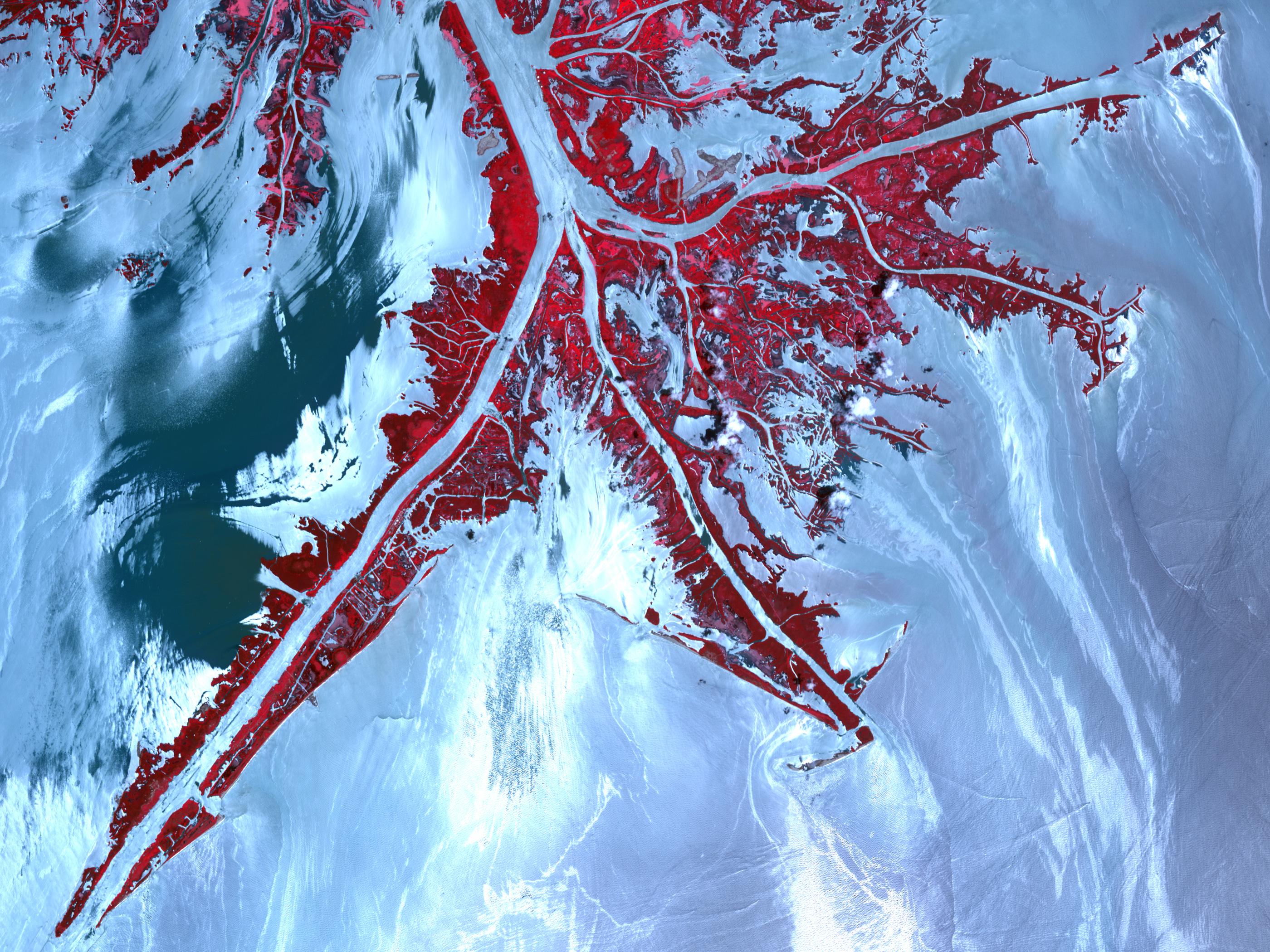
Image of the week : NASA satellite spots oil at Mississippi Delta mouth


From NASA

On May 24, 2010, the Advanced Spaceborne Thermal Emission and Reflection Radiometer (ASTER) instrument on NASA's Terra spacecraft captured this false-color, high-resolution view of the very tip of the Mississippi River delta.
Ribbons and patches of oil that have leaked from the Deepwater Horizon well offshore appear silver against the light blue color of the adjacent water. Vegetation is red.

In the sunglint region of a satellite image--where the mirror-like reflection of the sun gets blurred into a wide, bright strip--any differences in the texture of the water surface are enhanced.
Oil smoothes the water, making it a better "mirror." Oil-covered waters are very bright in this image, but, depending on the viewing conditions (time of day, satellite viewing angle, slick location), oil-covered water may look darker rather than brighter.

The relative brightness of the oil from place to place is not necessarily an indication of the amount of oil present.
Any oil located near the precise spot where the sun's reflection would appear, if the surface of the Gulf were perfectly smooth and calm, is going to look very bright in these images.
The cause of the dark patch of water in the upper left quadrant of the image is unknown.
It may indicate the use of chemical dispersants, skimmers or booms, or it may be the result of natural differences in turbidity, salinity or organic matter in the coastal waters.

Links :

Friday, June 4, 2010

Researchers use low-cost sonar to map stream habitat

From Georgia DNR Department of Natural Ressources -Wildlife Resources Division-

It’s a question every researcher who studies fish or other aquatic life eventually faces:
what exactly is beneath the surface of that murky stream?

Or as DNR aquatic resources biologist Adam Kaeser said, talking about detailed landscape maps, “Once you get to the edge of the water … you come to the edge of the information.”

Not for long.
That lack of information is giving way to advances Kaeser and DNR GIS specialist Thom Litts have made translating imagery from a blue-collar, side-imaging sonar unit into a GIS layer that probes the underwater side of streams.

Kaeser and Litts have published their findings in American Fisheries Society journals (December 2008 and April 2010), trained some 200 people in using the sonar and scaled their methods to suit the most common level of ArcGIS.
They are also providing software tools needed to process the sonar imagery for free.
Results from the habitat mapping initiative offer biologists with limited training a low-cost, relatively fast way to document wood, substrate and other habitat in navigable streams.

“It would be extremely difficult to map large, muddy streams any other way,” Litts said. “I think we’ll see some good things come of this.”

The side-scan sonar method is already being used to explore habitat preferences of state-listed Barbour’s map turtles in southwest Georgia’s Ichawaynochaway Creek, search out spawning sites for the rare robust redhorse in the Ocmulgee River and study habitat relationships between three bass species in the upper Flint River.
For the Auburn University bass study on the Flint, Kaeser and Litts covered nearly 15 miles of river in one day and produced the map in a week.
Traditional methods – measuring habitat along transects and extrapolating findings to the entire area – would have taken several weeks, or longer.

Using side-scan sonar was once the realm of deep-water marine research with tow-behind-the-boat units worth tens of thousands of dollars. But Litts and Kaeser use a Humminbird 900-series Side Imaging system priced at less than $2,000.
They motor along the middle of a stream at 5 mph, taking depth readings and sonar “snapshots” that reach from bank to bank.

Computer programs piece together the digital images, a process Litts wrote tools for and smoothed out the remaining kinks.
It takes time to interpret the imagery, which looks like a moonscape, with boulders as bumps and logs as lines. Accuracy is confirmed through field spot-checks. The images taken by sound instead of light are rich in detail.

“We’re on our third or fourth generation of refinement,” Litts said.

But they are definitely on to something.

Kaeser envisions a biologist on a blackwater stream pulling up the data on his smartphone.
“I think you’re going to see an explosion” in use, Kaeser said.

Links :
  • Poster : mapping habitat in navigable streams using low-cost side scan sonar
  • Other study : mapping the habitats of estuaries in Australia using SSS

Thursday, June 3, 2010

Base jumping combined with free diving

Produced and edited by BLUENERY (c)

Free fall into water of a natural wonder of the world, like a dream :

Freediver champion Guillaume Nery proposed an unique performance at Dean's Blue Hole (Long Island, Bahamas) the deepest blue hole in the world (202 m - 663 ft).
Geolocalization : Marine GeoGarage

Blue Hole is not only the breathtaking location of this artistic concept video, but it is also the site of Guillaume's successful constant weight (CWT) national French record dive to 115m.
In the same competition in Dean's Blue Hole
(April 2010), Herbert Nitsch moved the world CWT record (deepest self-powered freedive of all time) to 124m.

Another impressive feat - the exquisite footage in this video piece was entirely filmed on breath hold by Julie Gautier, who is also herself a French freediving champion.

Apnea is an inner journey, a positive introspection.

Links :

Wednesday, June 2, 2010

Bluefin tuna spawn & oil mixing in Gulf of Mexico now

This shows the track (yellow line) and daily positions (dots) of a giant bluefin tuna electronically tagged off Canada on October 25, 2008 -- which spent the period from March 23-May 24, 2009, in the Gulf of Mexico. The track is overlaid on the area of the Deepwater Horizon oil spill as of May 24, 2010 (black). Peak spawning of bluefin tuna occurs in this area during April and May. (Credit: Tag-A-Giant Foundation and Stanford University)

From : Tag-A-Giant Foundation

Electronic tagging and fisheries catch data have revealed pronounced differences in preferred habitat of Atlantic bluefin tuna and yellowfin tuna in the Gulf of Mexico, despite their close ancestry, according to a new study published today in the peer-reviewed journal PLoS ONE. Bluefin tuna return to the same regions of the Gulf of Mexico during spring months to spawn.
The bluefin are selecting a particular habitat along the slope waters of the Gulf of Mexico, which has unique oceanographic properties that are predictable and can be seen from satellites.
Yellowfin tuna are more widely distributed throughout the warm Gulf waters and occupy the region throughout the year.

"The bluefins' habitat requirements are relatively exact so we can predict with reasonable accuracy where bluefin tuna are likely to be spawning at any given time based on oceanographic data continually being gathered by satellites and weather buoys," said lead author Steven Teo of the University of California at Davis.
"This is in stark contrast to yellowfin tuna, which exhibit much more generalized environmental preferences." The fidelity to breeding areas over time detected in this study is reminiscent of salmon returning to their natal stream to spawn.

Bluefin tuna are among the most valuable fish in global markets. The International Commission for the Conservation of Atlantic Tunas (ICCAT) currently manages the Atlantic bluefin tuna as two distinct populations, with western Atlantic spawners of the Gulf of Mexico forming a distinct population genetically from the eastern spawners of the Mediterranean Sea.
The western Atlantic stock has suffered a significant decline in spawning stock biomass since 1950, and a 20-year rebuilding plan has failed to revive the population or the North American fishery.
The failure of the Gulf of Mexico spawning population to rebuild, as well as the scope of illegal and under-reported catches -- particularly in the Mediterranean Sea -- are of such major concern that the species was recently considered by the United Nations for endangered species listing in March of 2010.

Targeted bluefin fishing has been banned in the Gulf for over twenty years, but bluefin continue to be captured accidentally on pelagic longlines, often resulting in mortality.
The study shows that bluefin tuna are captured in the Gulf of Mexico from January through June each year, and the highest pelagic longline catch rates are in April and May, during the bluefin spawning season.

The authors compared environmental preferences and spatio-temporal distributions of bluefin and yellowfin tuna as revealed by pelagic longline catch rates and scientific tagging cruise conducted by the Stanford University and Monterey Bay Aquarium team coupled with oceanographic data sets.
Drawing on these data, a model was developed to determine the relative probability of catching bluefin and yellowfin tuna at a given place and time. This model showed that there are two major hotspot regions within the Gulf where bycatch occurs -- one in the eastern Gulf of Mexico to the north of the Loop Current, and the other in the western Gulf of Mexico.
Both regions are along the slope where the shallow continental shelf depth changes rapidly to the deep sea. It is within these hotspots that bluefin tuna prefer to spawn in circular, swirling water masses called "cyclonic eddies." These eddies are more productive and slightly cooler than surrounding warm Gulf ocean currents. Yellowfin tuna, however, are much more widely dispersed throughout the Gulf of Mexico throughout the year.

These findings indicate that it would be possible to utilize spatial management techniques to protect western Atlantic bluefin tuna on their breeding grounds in the Gulf of Mexico without compromising the yellowfin tuna fishery, which could be carried out in other areas during the critical bluefin tuna breeding times.

Unfortunately, these findings also give cause for concern in light of the recent Deepwater Horizon oil spill. "Both catch data and electronic tags indicate the Gulf of Mexico along the continental shelf is the preferred habitat of this majestic fish. I think it is amazing how precisely we can predict where the bluefin are.
Unfortunately their spawning habitat overlaps the Deepwater Horizon oil accident site, and the timing of the spill coincides with the time when we expect them to be there spawning" said senior author Dr. Barbara Block of Stanford University.

Links :
  • Nola.com : bluefin tuna particularly vulnerable to Gulf of Mexico oil leak
  • WWF : bluefin tuna in crisis
  • BigMarineFish.com : Atlantic bluefin tuna, severity to decline and its causes
  • BBC News : the bitter battle over bluefin tuna

Tuesday, June 1, 2010

MarineMap a web-based tool for MPAs


How MarineMap facilitates environmental conflict resolution


MarineMap is a web-based decision support tool for open and participatory spatial planning in the marine environment.
MarineMap offers a simple, flexible and powerful means of gathering expertise from resource managers, scientists, stakeholders and public in a process of collaborative decision making.

The MarineMap Consortium brings together personnel and skills from UC Santa Barbara, Ecotrust, and The Nature Conservancy.
They create open-source spatial tools that integrate and illuminate the human dimensions of marine science and policy.

The 1999 Marine Life Protection Act directs the state of California to design and manage a network of Marine Protected Areas (MPAs) in order to, among other things, protect marine life and habitats, marine ecosystems, and marine natural heritage, as well as improve recreational, educational and study opportunities provided by marine ecosystems.
Actually, MarineMap is a mashup of the California coastline and MPAs. The map has a large number of features and manages to include a massive amount of data.

The stated aim of MarineMap is to assist organizations involved in mapping of the oceanographic, biological, geological, chemical, and human dimensions of the ocean and coastal areas. They provide organizations with customized solutions for data storage, data sharing, and web-based mapping.

"Because such a diverse range of organizations and individuals have a stake in marine habitat protection, it is critical that MarineMap be accessible to individuals without technical GIS training.

MarineMap allows residents to define scientifically defensible MPAs in a collaborative manner.
"An absolutely critical component to this project is the ability for users to share their proposed marine protected areas and analyses with other stakeholders. Stakeholders can then collaborate and negotiate to come up with the best scenarios," said Matt Merrifield, GIS Manager for The Nature Conservancy.

Whether a stakeholder is a fisherman, a scientist, or environmental advocate, each needs to be able to draw on a map the location of marine resources to be preserved," said Will McClintock, Marine Map Director at the UCSB Marine Science Institute.

A couple of days ago, the U.S. Institute for Environmental Conflict Resolution awarded MarineMap the “Innovation in Technology and Environmental Conflict Resolution”.


Links :