Jerry Arey, Moses Kayotuk and Larry Arey atop a landed bowhead.
Remembering the Great Bowhead Hunt of 1991
For more than four decades, my work as an Arctic scholar has been animated by a single, foundational truth: the global arena is not merely a collection of Westphalian states competing for structural dominance.
While classical international relations theory fixates on oversimplified structures such as Kenneth Waltz’s classic “three images,” it leaves an analytical void at the foundational level of human organization.
To fill this gap, I have advanced 4th Image Theory.
This framework recognizes that beneath and before the modern state lies a deeper, older reality: the tribal, sub-state, and indigenous polities that have survived millennia of change.
These are not mere domestic minorities; they are enduring sovereign entities whose governance models, land claims, and cultural practices provide a platform for enduring regional stability.
Nowhere is the intersection of state sovereignty and indigenous self-determination more sharply defined — or more routinely misunderstood —than in the deep blue waters of our global commons.
For decades, the international community, led by urban activists far removed from the realities of life on and by the sea, has viewed the harvest of cetaceans through the singular lens of prohibition.
Whaling has been falsely cast as an archaic, ecologically destructive relic of a bygone era.
This view is profoundly flawed.
It ignores both the success of modern conservation and the deep, constitutional evolution of native land claims.
When we look past the emotive rhetoric of anti-whaling campaigns, a startling paradox emerges.
The sustainable management of whaling is not a point of permanent division.
Instead, it offers a powerful framework for bridging the gap between sovereign nation-states and Indigenous peoples, forging a shared, collaborative international order.
Alternative:
To understand how whaling can unite rather than divide, one need only look to the Western Arctic.
In 1982, Canada made the decision to withdraw from the International Whaling Commission (IWC).
This move was not an act of environmental defiance; it was a pragmatic recognition of domestic political realities.
At the time, Ottawa was deep in negotiations over comprehensive land claims agreements with Arctic Indigenous peoples —treaties that would ultimately reshape governance of the Northwest Territories and lead to the creation of Nunavut.
By stepping away from the rigid, often deadlocked dictates of the IWC, Ottawa cleared a path to restore the traditional Inuvialuit and Inuit bowhead whale hunting.
It replaced distant, centralized and neocolonial governance with an innovative domestic model based on co-management.
Through boards composed of both indigenous hunters and federal biologists, decisions on quotas, sustainability, and ecosystem monitoring were co-produced.
Traditional Ecological Knowledge (TEK) was elevated to equal standing with Western empirical science.
The foundational proving ground for this paradigm shift occurred on Sept.
3, 1991, in the waters off Shingle Point.
For over half a century, the Inuvialuit had been denied the right to hunt a bowhead whale (Arviq), a restriction born of global conservation anxieties that completely ignored the ecological balance maintained by the original inhabitants of the coast.

The 1991 hunt was one of many fruits of the historic 1984 Inuvialuit Final Agreement (IFA) — the first Canadian comprehensive land claim settlement north of 60.
This treaty did not merely grant land rights; it erected a revolutionary, constitutionally protected architecture for wildlife co-management.
When the Inuvialuit Game Council and the newly formed Fisheries Joint Management Committee approved a license for a single bowhead, they were putting the constitutional teeth of their land claim to the test.
The hunt itself became a masterclass in cross-generational, cross-cultural collaboration.
Because a full 54 years had passed since the last local bowhead harvest, the Inuvialuit faced a profound rupture in practical whaling knowledge.
To bridge this historical chasm, they looked across the border to their Inupiat kin in Alaska.
Experienced whaling captains from the North Slope traveled to the Mackenzie Delta, bringing with them modern safety protocols, traditional tracking techniques, and specialized harvesting equipment.
This included penthrite projectile bombs designed to ensure a humane, efficient kill.
On Sept. 4, a crew led by Inuvialuit whaling captain Danny A. Gordon successfully landed a 36-foot, 40-ton bowhead whale.
The event was a profound cultural awakening, but its political implications were even greater.
The processing of the whale on the beaches of Shingle Point required the mobilization of whole communities — Aklavik, Inuvik, Tuktoyaktuk —distributing muktuk (skin and blubber) across the region according to ancient laws of sharing that reinforce social cohesion.
For the Canadian state, this was a watershed moment in regulatory flexibility.
Federal fisheries officers worked alongside indigenous hunters — not as adversarial enforcers, but as technical partners.
The 1991 harvest proved to a skeptical international community that an indigenous polity, armed with modern legal authority and rooted in traditional ecological wisdom, could safely manage a protected species without state paternalism.
It transformed the concept of conservation from a top-down mandate into a collaborative, treaty-based partnership between indigenous peoples and the state.
This historical lesson demonstrates that when a nation-state respects the maritime traditions of its Indigenous peoples, it does not weaken its own sovereignty; it actually strengthens the fabric of its domestic peace.
The restoration of the bowhead hunt in the Western Arctic did not spark ecological collapse.
Instead, it revitalized community cohesion, strengthened food security in an economically marginalized region, and integrated indigenous governance directly into the structural machinery of the state.
In recent years, we have seen history repeating itself, with Tokyo’s decision to exit the IWC in 2019, following in Canada’s footsteps so that Japan, too, could resume coastal whaling within its own territorial waters and EEZ.
Japan’s pivot offers a compelling point of alignment with northern Indigenous communities.
Small, historic whaling towns of coastal Japan —such as Taiji, Wada, and Ayukawa — possess a deep maritime heritage that mirrors the subsistence culture of the Inuvialuit.
For coastal communities of both the Arctic and the Pacific, the whale isn’t merely a resource to be extracted; it is an economic anchor, a dietary staple, and the focus of deep cultural veneration.
When modern states like Japan, Iceland and Norway defend their right to utilize abundant marine resources sustainably under international law, they are fighting the exact same battle against eco-colonialism that Indigenous communities have waged for generations.
By reframing the whaling debate around the principles of sustainability, food security, and cultural survival, we create a powerful common denominator: sovereign nations defending their maritime rights and indigenous polities protecting their ancestral subsistence traditions find themselves standing on the same side of the geopolitical ledger.
They are united by a shared commitment to what I call constructive realism—a pragmatism that recognizes that real-world stability requires balancing ecological limits with human survival and cultural continuity.
The international community must stop viewing whaling as a binary conflict between conservationists and exploiters.
Instead, it must be recognized as a sophisticated arena for co-management, where the sovereign rights of coastal states and the inherent rights of First Nations converge.
By honoring Native traditions through robust, collaborative, and scientifically sound frameworks, we do not fracture global unity.
Instead, we ground it in the realities of our shared environment, proving that international relations are at their most resilient when they honor the tribal foundations upon which our world was built.
 “Navigo in mari inesplorati, ma c’è una bussola nel mio cuore che conosce la strada”.…


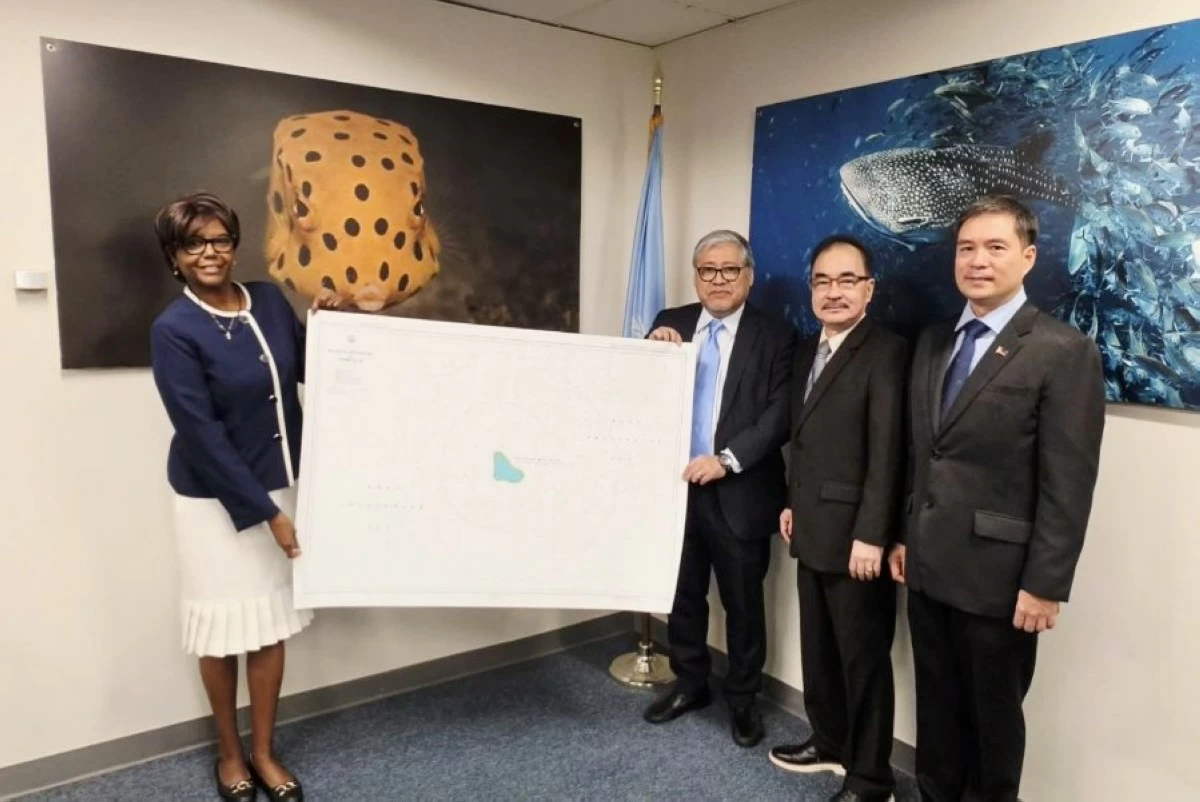 Philippine Ambassador and Permanent Representative of the Philippines to the UN Enrique A. Manalo (center), together with Undersecretary Peter N. Tiangco, NAMRIA Administrator, and Deputy Assistant Secretary Rogelio E. Villanueva Jr., DFA Spokesperson for Maritime Affairs (right and rightmost, respectively), presenting the official copy of NAMRIA Chart No. 1567 titled 'Bajo de Masinloc and Approach' to UN Division for Ocean Affairs and the Law of the Sea represented by Deputy Director Alice Hicuburundi (leftmost). (DFA)


 Matt Rutherford departs Annapolis for Greenland, where he will begin an attempt to become the first person to circumnavigate the Arctic solo and nonstop by sailboat.
 Sailing across an increasingly fragmented Arctic. Photo: Ocean Research Project
 Matt Rutherford preparing to lower a probe into the ice. Photo: Ocean Research Project
 Aerial view of Matt Rutherford on board his 42-foot Valiant Photo: Ocean Research Project