Friday, January 23, 2026

Top 10 deepest parts of the ocean


From Marine Insight by Raunek

The oceans and seas surrounding the continents offer several wonders, many of which humans have yet to discover.

The vast bodies of water that cover over 70% of the planet’s surface, holding around 1.35 billion cubic kilometres of water, have plateaus, valleys, plains, mountains, and trenches.

And interestingly, the underwater formations are enormous compared to those on dry land.

The mountains in the ocean basin are higher than those we see on land; similarly, the plains are flatter, so the ocean trenches are much more profound.

Of all the features that oceans offer, the very depth of these water bodies makes them so enchanting.

Indeed, the ocean is deep, and the average depth of the oceans and seas surrounding the continents is around 3.5km.

The part of the ocean that is deeper than just 200 meters is considered the “deep sea.”
However, some parts of the oceans go up to several kilometres.
 
But what is the deepest part of the ocean exactly?

Scientifically speaking, the deepest part of the ocean refers to the maximum depth of a point that can be accessed or defined.
Every deep part of the ocean is called a deep trench.

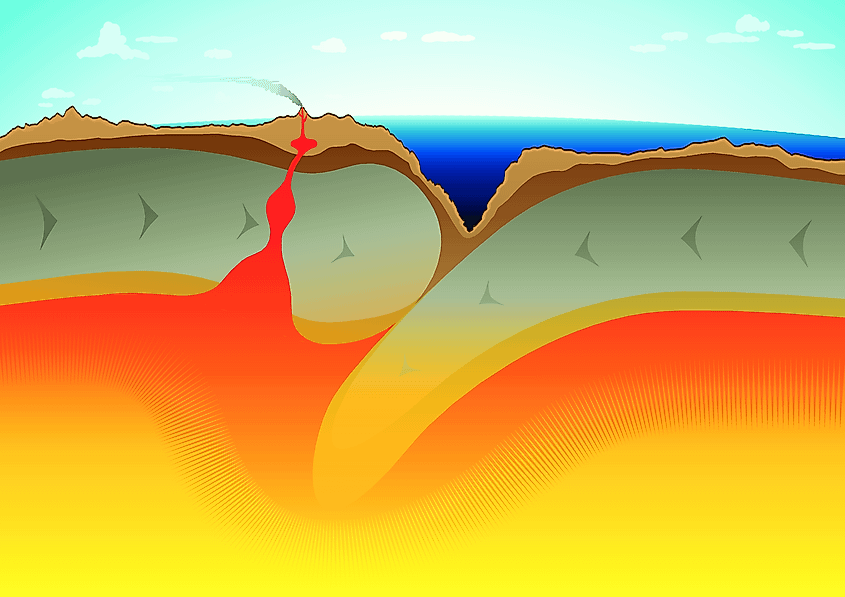
They are known as the hadal zone, and the deepest sea trenches are created by shifting tectonic plates.

Currently, there are 46 hadal habitats across the oceans, and humans know very little about these regions since it’s challenging to study these parts of the oceans.
Here is a list of ten points that mark the deepest points of oceans.

1. Mariana Trench

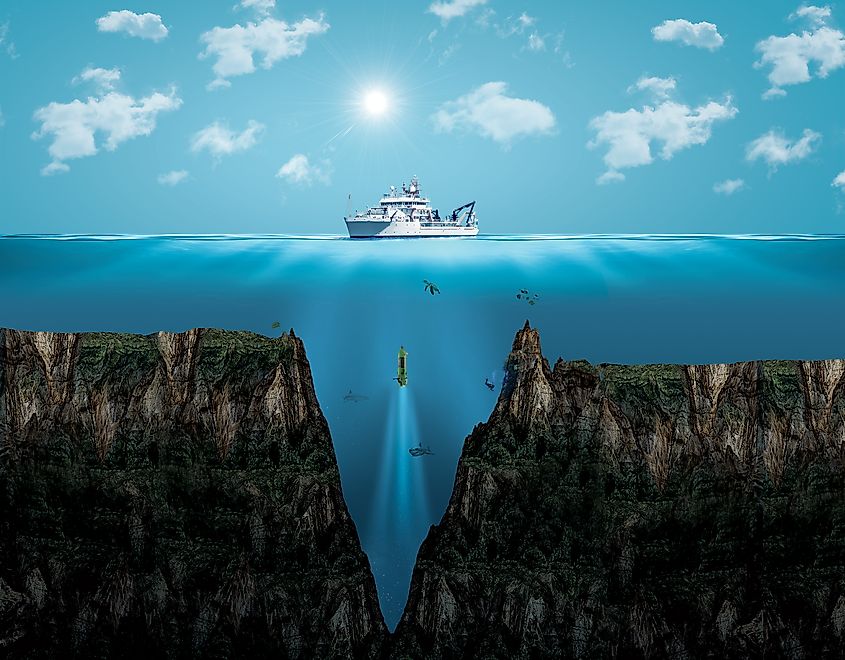
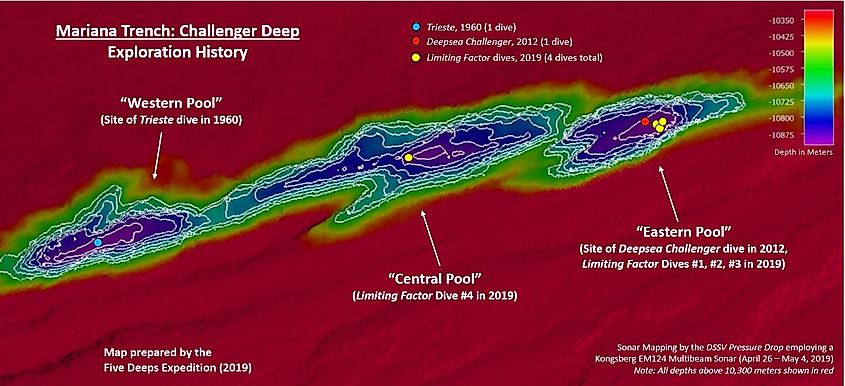
The Marina Trench is the deepest part of the Earth’s surface in the western Pacific Ocean. It contains the Earth’s deepest point, called the Challenger Deep.
While many have reached Mount Everest, just 27 people have descended the Challenger Deep.

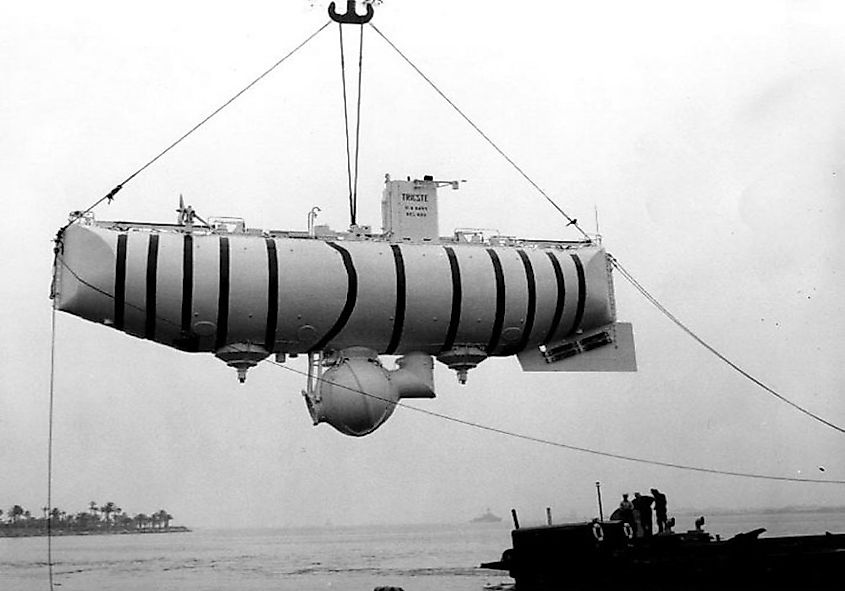
Jacques Piccard and Don Walsh reached a 10,916 m depth in their Trieste bathyscaphe in 1960.
The first unmanned vehicle to reach the Deep was controlled by the Woods Hole Oceanographic Institution’s researchers, reaching up to 10,902 meters.

Appearing as a crescent-shaped scar in the Earth’s crust, the trench measures around 2,550 km long, 69 km wide on average, and has a maximum depth of 10.91 km at the Challenger Deep.
At the same time, some other efforts measured the deepest portion at 11.034 km.
The deep runs several hundred kilometres towards the US island of Guam in the southwest direction.
 
Visualization with the GeoGarage platform (UKHO nautical raster chart)

The deep holes in the Mariana Trench were formed due to the collision of converging plates of the oceanic lithosphere. During the collision, one plate descended into the Earth’s mantle, and the downward flexure formed a trough at the line of contact between the plates.

At the bottom of the Marina Trench, the density of water increases by 4.96% due to the high pressure at the seabed.
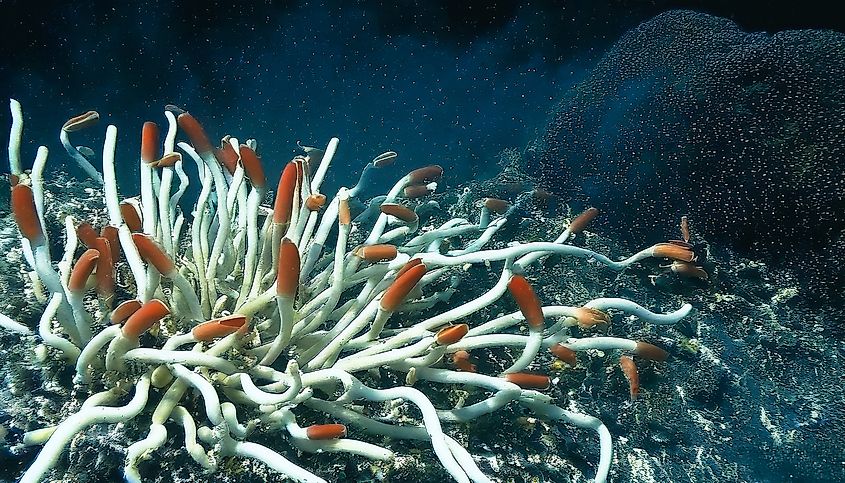
However, the expeditions conducted at various times have observed the presence of large creatures such as flatfish, large shrimp-type amphipods, crustaceans, and even an unknown type of snailfish.
Scientists believe there are many new species in the Mariana Trench awaiting discovery.
 
2. Tonga Trench
 

 Visualization with the GeoGarage platform (UKHO nautical raster chart)
 
Located in the southwest Pacific Ocean and at the northern end of the Kermadec Tonga Subduction Zone, the Tonga Trench lies around 10.882 km below sea level.

The deepest point in the Tonga trench, known as the Horizon Deep, is considered the second deepest point on Earth after the Challenger Deep and the deepest trench in the Southern Hemisphere.

Stretches at a distance of 2,500 km from New Zealand’s North Island northeast to the island of Tonga, the Tonga trench was formed due to the subduction of the Pacific plate by the Tonga plate.

Researchers have also found that these plate movements cause large volcanoes in the Japan and Mariana Trench. According to marine scientists, the sediments of the Horizon Deep house a community of roundworms.

3. Philippine Trench
 
Visualization with the GeoGarage platform (UKHO nautical raster chart)

The third deepest point in the world, the Galathea Depth in the Philippine trench, is 10.54 km below sea level.
Also known as Mindanao Trench, this submarine trench is located in the Philippine Sea and spreads in a length of 1,320km and 30km in width in the east of the Philippines.

Prominent among other trenches in the Philippine Sea, this trench was formed due to a collision between the Eurasian plate and the smaller Philippine plate.
The other significant trenches in the Philippine Sea include Manila Trench, East Luzon Trench, Negros Trench, Sulu Trench, and Cotabato Trench.

It is said that scientists considered the Philippine Trench to be the planet’s deepest point until 1970. Scientists say the Philippine trench was younger than 8-9 million years ago.

4. Kuril- Kamchatka Trench

Another deepest part of the ocean belonging to the Pacific Ocean, this trench lies at a considerable depth of 10.5 km below sea level.
 
Visualization with the GeoGarage platform (UKHO nautical raster chart)
 
Lying close to Kuril Island and off the coast of Kamchatka, this trench is responsible for many ocean bed volcanic activities in the region.

The trench was formed by the subduction zone developed in the late Cretaceous, which created the Kuril Island and Kamchatka volcanic arcs.

5. Kermadec Trench
 
Visualization with the GeoGarage platform (UKHO nautical raster chart)

Another submarine trench lies on the floor of the South Pacific Ocean.
The Kermadec Trench stretches around 1,000 km between the Louisville Seamount Chain and the Hikurangi Plateau.

Formed by the subduction of the Pacific plate under the Indo-Australian Plate, the Kermadec Trench has a maximum depth of 1o.04 km.

Along with the Tonga Trench to the north, the Kermadec Trench creates the 2,000 km-long, near-linear Kermadec-Tonga subduction system.

The trench is also home to various species, including a giant amphipod, which measures approximately 34 cm in length at the bottom.
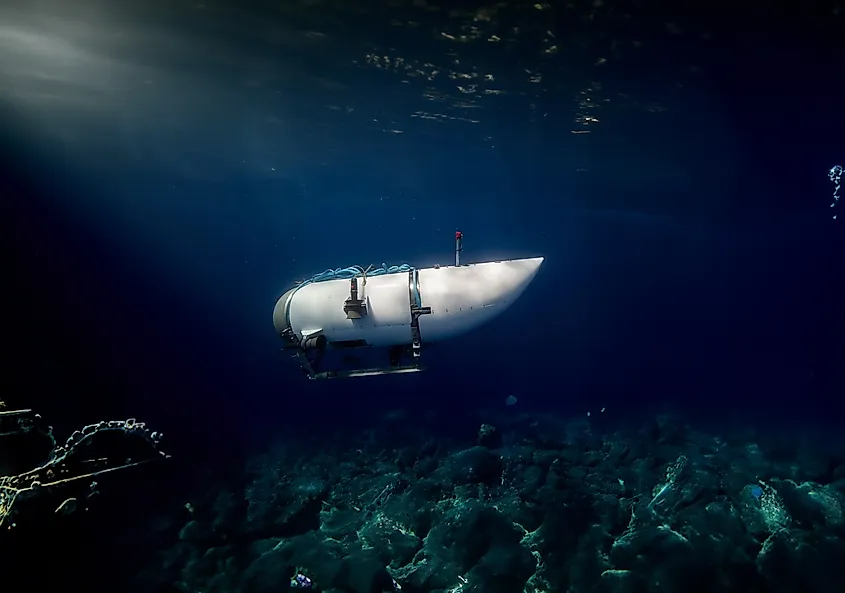
A few years ago, the Kermadec Trench was in the news after the Nereus, an unmanned research submarine, imploded because of the high pressure at a depth of 9,990 meters while exploring the Kermadec Trench.

6. Izu-Ogasawara Trench
 
Visualization with the GeoGarage platform (UKHO nautical raster chart)
 
Located in the western Pacific Ocean, the Izu-Ogasawara Trench has a maximum depth of 9.78km.
Also known as Izu-Bonin Trench, this deep trench stretches from Japan to the northern section of the Mariana Trench and is also an extension of the Japan Trench.
Apart from the Izu-Ogasawara Trench, the western Pacific Ocean houses the Izu Trench and the Bonin Trench.

7. Japan Trench

Visualization with the GeoGarage platform (UKHO nautical raster chart)
 
Another deep submarine trench located east of the Japanese islands, the Japan trench (as shown in the image above), is part of the Pacific Ring of Fire in the northern Pacific Ocean.

With a maximum depth of 9 km, the Japan trench stretches from the Kuril Islands to the Bonin Islands. It also extends the Kuril-Kamchatka Trench and the Izu-Ogasawara Trench to the north and south, respectively.

The trench was formed due to the subduction of the oceanic Pacific plate beneath the continental Okhotsk Plate.
The tsunamis and earthquakes led to the movement of the subduction zone with the Japan Trench.

8. Puerto Rico Trench

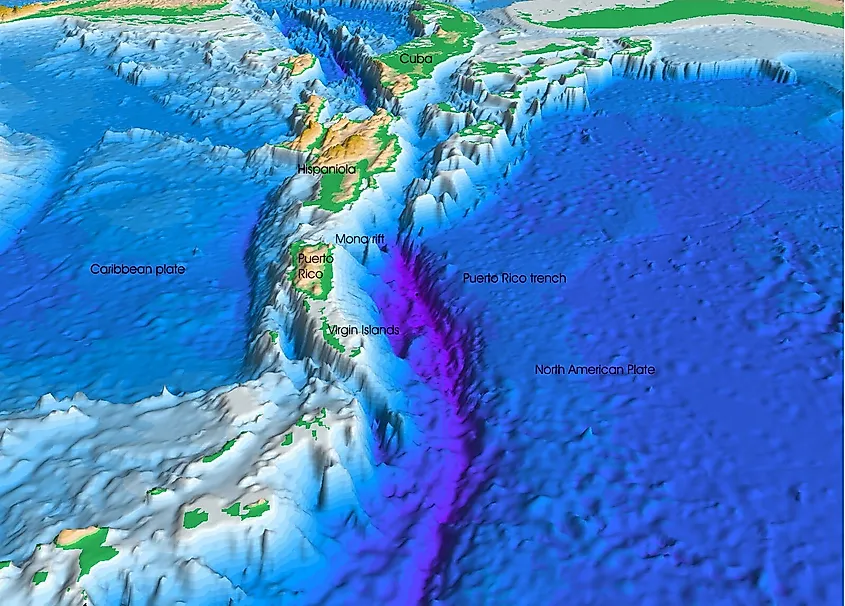
Located between the Caribbean Sea and the Atlantic Ocean, the Puerto Rico trench marks the deepest point in this region and the eighth deepest point found on the Earth’s surface.

It lies at a depth of 8.64 km, is spotted at Milwaukee Deep, and measures a length of over 800 km; this trench has been responsible for many tragic tsunamis and earthquake activities in this region.

Visualization with the GeoGarage platform (UKHO nautical raster chart)

Efforts for a complete mapping of this trench have been ongoing for a long time.
The French bathyscaphe Archimède first attempted to explore the seafloor in 1964, and a robotic vehicle was sent to the trench in 2012 to study its characteristics.

9. South Sandwich Trench

The deepest trench in the Atlantic Ocean after Puerto Rico Trench, South Sandwich Trench, is at a depth of about 8.42 km, described as Meteor Deep, and runs for over 956 km, making it one of the most noticeable trenches in the world.

Located 100 km east of the South Sandwich Islands in the southern Atlantic Ocean, this trench was formed by the subduction of the South American Plate’s southernmost portion beneath the small South Sandwich Plate.
 
Visualization with the GeoGarage platform (UKHO nautical raster chart)
 
This South Sandwich Trench is also associated with an active volcanic arc.

10. Peru–Chile Trench

The Peru–Chile Trench (the Atacama Trench) is located around 160 km off the coast of Peru and Chile in the eastern Pacific Ocean.
The Atacama Trench has a maximum depth of 8.06 km below sea level.
The deepest point of the trench is known as Richards Deep.

Visualization with the GeoGarage platform (UKHO nautical raster chart)

The trench measures around 5,900 km in length and 64 km in mean width, while it covers an area of about 590,000 square kilometres.
The Atacama Trench was formed due to a convergent boundary between the subducting Nazca and the South American Plates.

Links : 


Thursday, January 22, 2026

The future of mine warfare is uncrewed, autonomous, and sensor-Led


From Pulse by Thomas Meurling

Mine Countermeasures (MCM) is entering a new era—one defined not by manned minehunters or clearance divers, but by autonomous sensor systems that keep sailors safely out of the minefield. Against a backdrop of rising geopolitical tension and repeated incidents involving subsea pipelines and communication cables, nations are embracing stand-off, unmanned MCM concepts at unprecedented speed.

Why the USV Matters, But Is Not the Capability

New Mine Counter Measure Concept based on USVs

In this emerging operational model, the USV becomes the vehicle that carries the sensor suite, but not the sensor suite itself. This distinction is far more than academic—it is strategic.

Mines do not react to the design of the vessel. They react to proximity.

Removing humans from that proximity fundamentally reshapes the risk equation of mine warfare. Instead of sending a crewed minehunter into a suspected minefield, commanders now deploy an unmanned surface vehicle towing a sophisticated sonar package, operating autonomously, and maintaining precise navigation without exposing personnel to danger.

The USV provides the platform—speed, towing geometry, stability, and endurance. But the capability is the integrated sensor chain and autonomy stack.
The Modern MCM Mission Chain: Detect, Classify, Neutralize

MCM Flow

The effectiveness of any MCM system depends entirely on the performance of its sensors and data-processing ecosystem.

1. Detection: Seeing the Seafloor in Centimeters

Modern detection relies on:

High-frequency multibeam echosounders (MBES) to create a topography baseline
Synthetic Aperture Sonar (SAS) delivering ultra-sharp seabed imagery (main sensor)
High-SNR acoustic returns for cluttered environments
Wide-area high-coverage geometries enabled by towed bodies or AUVs

Only centimeter-level imagery provides the confidence required to separate a mine from a rock, crate, anchor, or biological clutter.

2. Classification: Turning Raw Data Into Decisions


Classification now depends on:
  • Machine learning
  • Automatic Target Recognition (ATR)
  • On-board and off-board processing pipelines
  • Robust, low-noise navigation
  • High-fidelity metadata and positioning

The shift toward AI-assisted classification dramatically reduces post-mission analysis time and increases throughput—critical in large minefields.

3. Neutralization: Precision Intervention

Once a contact is declared a mine-like object, neutralization requires:
  • Precise localization
  • Stable hover capability
  • Deployment of expendables or ROV-based charges
  • Autonomous reacquisition of the target
ROVs remain a critical component of the final step—machines dealing with the threat, humans commanding at a distance.

USVs as Host Platforms: The Global Shift

This operational logic is evident across major international MCM programmes. Consider:
  • Textron’s UISS: A USV towing advanced minehunting sensors as part of the U.S. Navy’s LCS MCM mission package.
  • Exail’s Inspector series: A modular platform capable of SAS towing, AUV launch, and multi-sensor operations.
  • Thales/Royal Navy autonomous MCM trials: Demonstrating a scalable, distributed, unmanned delivery model.
  • Belgium-Netherlands rMCM programme: Entirely built on the concept of unmanned off-board systems.
Across these programs, one consistent truth emerges: The boat is a host. 
The sensors are the capability. Autonomy is the glue that binds them together.

The Rise of Autonomy in MCM

Early USVs relied heavily on remote control.
But autonomy is now evolving into a decisive operational advantage.
  • Human-in-the-loop → Human-on-the-loop The system executes pre-defined patterns while an operator supervises rather than commands continuously.
  • Real-time autonomy decisions The USV adjusts line spacing, towing behavior, or avoidance patterns based on conditions.
  • Intent-based autonomy (emerging) An operator defines the outcome (“Search this area to STANAG confidence level”), and the USV decides how to execute—tow speed, pattern, sensor configuration, revisit logic.
This reduces workload, increases tempo, and standardizes mission execution across theatres and operators.

Why This Transformation Matters Strategically

The stakes have never been higher. Seabed infrastructure—pipelines, interconnectors, offshore wind farms, energy lines, and the fiber-optic cables carrying 97% of global internet traffic—has become a prime target for hybrid operations and grey-zone sabotage.

Autonomous MCM systems offer:
  • Persistent presence without risk to personnel
  • Scalable coverage across vast areas
  • Lower cost per mission than traditional minehunters
  • Distributed architectures resilient to attrition
  • Rapid deployment in contested or denied environments
In the emerging underwater battlespace, autonomy and sensors—not hulls—define superiority.

The End of the Legacy Minehunter Era


For a century, sailors entered the minefield. Now, machines do.

The shift is irreversible.
Modern navies will be defined not by the number of minehunters in service, but by their ability to deploy autonomous, sensor-driven MCM systems that find, classify, and neutralize threats at standoff distance.

In the new era of mine warfare, the vessels are unmanned, the sensing is autonomous, and the decisions remain human.

CLOSING THOUGHT 
  • Modern MCM USVs mark the end of a 100-year paradigm
  • Sensors do the work
  • Autonomy handles the danger
  • Humans make the decisions


Top 10 yacht racers pioneers


On December 17th 2013 a true legend of the Whitbread Round the World Race
crossed the final finish line.
He was a pioneer of the sport and the only person to win the race twice as a Skipper.

From YBW   

YBW's list of the top 10 yacht pioneers in the last 100 years.
Who do you think should be on the list?
We would love to hear your suggestions. 

In no particular order, here is YBW’s list of the pioneers who had a huge impact on yachting over the last century.
From record breakers to those who inspired a generation of sailors, these are the men and women who showed incredible determination to achieve their goals.

Tweet us @ybw with your suggestions if your favourite pioneer isn’t on our list!


Éric Tabarly


Éric Tabarly, along with his series of Pen Duick yachts, dominated ocean racing for decades.
The French Naval officer’s original Pen Duick was the family-owned Yum, a William Fife designed gaff-rigged cutter.
Tabarly renamed and refitted the vessel, rebuilding Pen Duick with polyester resin during the 1950s.
But, it was his racing on the 44-foot Pen Duick II which gave Tabarly his legendary status.
In 1964, he took his custom-built light displacement ketch and entered it into the Observer Single-handed Transatlantic Race (OSTAR), beating the winner of the race’s first edition, and favourite- Sir Francis Chichester.
For beating the British at their own challenge, Tabarly was awarded France’s Legion D’Honneur. He also received the Blue Water Medal.
His victory in 27 days, 3 hours and 56 minutes led to the popularity of sailing in France.
He also nurtured the likes of Alain Colas, Marc Pajot and Olivier de Kersauson, ensuring France’s racing legacy continued.
Success continued for Tarbarly, with wins in the Sydney Hobart and the Fastnet Race in 1967 on the aluminium Pen Duick III.
He took line honours in the 1969 Transpac on his trimaran, Pen Duick IV, as well as setting a new course record.
In 1976, he again won the OSTAR in his André Mauric designed 22-metre ketch, Pen Duick VI.
This edition of the race was particularly tough, with two major depressions forcing a record 50 retirements.
In 1980, he set the transatlantic sailing record from West to East (New York-The Lizard), on the multihull, Paul Ricard.
He did it in 10 days 5 hours 14 minutes and 20 seconds, beating the previous record which was set in 1905.
Tabarly raced in two Whitbread Round the World Races – the first edition in 1973 and in 1994.
In 1997, he won the Fastnet Race with Yves Parlier on Aquitaine Innovations.
Tabarly died in June 1998, when he was knocked overboard and drowned in the Irish Sea.
He was sailing the original Pen Duick to Scotland as part of the boat’s centenary celebrations.
His home nation mourned, but his legacy has lived on.
French skippers continue to dominate ocean racing today.


Vito Dumas


While nations battled in World War Two, Argentinian single-handed sailor, Vito Dumas set out to circumnavigate the Southern Ocean.
He left Buenos Aires in June 1942 on board his 32-foot Colin Archer ketch, LEHG II with only basic gear on board. He didn’t even have a radio because of fears he might be shot as a spy.
During the voyage through the “Roaring Forties”, he only made three landfalls at Cape Town, New Zealand and Valparaiso, Chile.
At times he was so cold, he had to stuff his clothes with newspaper to keep warm.
Dumas arrived back in Buenos Aires on 8 August 8 1943, 437 days after he set off.
Thousands turned out to greet the man who had become the first solo sailor to round Cape Horn and the first to sail around the world with only three landfalls.
Dumas wrote about the experience in his book Los Cuarenta Bramadores: La Vuelta al Mundo Por la “Ruta Imposible” (Alone Through The Roaring Forties).
Afterwards LEGH II was donated to the Argentine navy. It was later wrecked and then restored before being given to the Museo Naval de la Nacion (Naval Museum of the Nation) at Tigre.
Prior to his Southern Ocean adventure, Dumas had sailed, single-handed, from France to Argentina, in his 26-foot LEGH I, named using the initials of each of his four mistresses’ names at the time.
He left Arcachon in December 1931, arriving after 121 days at the Yacht Club Argentino in Buenos Aires.
The Argentinian skipper was also the first recipient of the Slocum Award in 1956, named in honour of Captain Joshua Slocum.
Dumas was given the award not only for his Southern Ocean feat and his 1931-2 single-handed voyage from France to Argentina, but for his single-handed voyage from Argentina to the United States of America via Bermuda in SIRO in 1956.
Dumas later received the Diploma of Merit of the Konex Awards from his home country. He died of a stroke in 1965.
His sailing legacy lives on through his books which include My Trips, Solo, toward the Southern Cross and The Cruise of the Unexpected.


Bernard Moitessier

The “free spirit” of sailing, Bernard Moitessier surprised some in the sailing community when he decided to quit the 1968-69 Sunday Times Golden Globe Race, despite being in front.
The Frenchman had the fastest circumnavigation time, but rather than continue back to England to fame and £5,000, he decided to continue sailing on his 39-foot ketch, Joshua.
He didn’t stop until June 1969 when he made landfall in Tahiti, setting the record for the longest nonstop passage by a yacht – 37,455 nautical miles in 10 months.
Moitessier later wrote about this experiences in La Longue Route; seul entre mers et ciels (The Long Way). 
The book has become a classic, outlining Moitessier’s technique for heavy weather sailing.
Born and raised in Vietnam, Moitessier was already something of a sailing legend before the Golden Globe Race.
In 1966, he and his first wife, Françoise returned to France having initially set out with the intention of circumnavigating on Joshua.
Running out of time, Moitessier had decided to sail to France from Tahiti via Cape Horn, rather than taking the longer route via the Indian Ocean.
During this “logical route”, Moitessier drew heavily on the experiences and techniques of Argentinian sailor, Vito Dumas; he had a copy of Dumas’s book Los Cuarenta Bramadores: La Vuelta al Mundo Por la “Ruta Imposible” (Alone Through The Roaring Forties) on board.
When the couple arrived home they discovered, unintentionally, that they had completed the longest nonstop passage by a yacht in history—14,216 nautical miles, over 126 days.
Moitessier’s book, Cap Horn à la voile: 14216 milles sans escale (Cape Horn: The Logical Route) recounts the voyage and was, again, an instant success.
Moitessier continued travelling before he settled in Paris to write his autobiography, Voile, Mers Lointaines, Iles et Lagons (A Sea Vagabond’s World).
His earlier adventures on board his junk Marie-Thérèse and subsequent yacht, Marie-Thérèse II, which he sailed from Indonesia to the Caribbean, were recorded in Un Vagabond des mers du sud (Sailing to the Reefs). The book was published in 1960, and first brought Moitessier to the attention of the world’s sailing community.
He died in June 1994 and is buried in Bono in Brittany, France.


Sir Francis Chichester


Sir Francis Chichester was already an acclaimed aviator and navigator when he made his mark on the sailing world.
The Devon-born sailor is best remembered for his 1966-67 circumnavigation on board his yawl, Gipsy Moth IV, for which he was knighted.
His long-distance sailing career began after his recovery from lung cancer, with the first Observer Single-handed Transatlantic Race (OSTAR) in 1960.
The revolutionary race was founded by Blondie Hassler.
Chichester entered and won in his 40-foot yacht, Gipsy Moth III, completing the route from Plymouth to New York City in 40 days, 12 hours and 30 minutes.
Four years later he came second, beaten by French skipper, Éric Tabarly.
Chichester then focussed on what was considered at the time an unimaginable feat of seamanship.
The 65-year-old skipper set sail from Plymouth in his Camper & Nicholson built Gipsy Moth IV to try and beat the passage times of the clipper ships.
He returned to Plymouth on 28 May 1967, having circumnavigated the globe, with one stop in Sydney, in 226 days.
Chichester became a hero – the first person to achieve a true circumnavigation of the world, solo, from West to East, via the great Capes.
The voyage captured the public’s imagination, and over 250,000 people turned out to see him arrive.
The event was globally televised, and Chichester, along with Gipsy Moth IV became famous around the world.
Chichester was knighted for his feat; the sword used in the ceremony had belonged to Sir Francis Drake, himself a notable sea captain and navigator who carried out the second ever circumnavigation around the world.
Chichester was also put on the newly issued 1/9d stamp, the first living non-royal to appear on one.
Two years after his circumnavigation, Chichester, in Gipsy Moth V attempted to sail 4,000 miles in 20 days, but failed by one day.
He died in Plymouth in August 1972, but left a body of work including Gipsy Moth Circles the World, Alone Across the Atlantic and The Romantic Challenge.
Gipsy Moth IV, after decades of neglect, was eventually restored following a campaign by Yachting Monthly and the United Kingdom Sailing Academy.
It went on to circumnavigate the world again via the trade wind route and the Panama and Suez Canals, arriving back in Plymouth on 28 May 2007.

James Wharram

 
James Wharram is considered the inventor of the modern day catamaran.
Using his research into ancient Polynesian boat design, he designed and built the first offshore catamaran in Britain, the 23-foot Tangaroa.
At the time, many in the global yachting community dismissed the idea that such a design could be seaworthy.
But Wharram, who was inspired by the journey of Frenchman Eric de Bisschop, who sailed a double canoe from Hawaii to France in 1939, proved them wrong.
In 1955-56, he sailed his “double hulled canoe” from Falmouth, Cornwall to the West Indies with two German girls, Ruth Merseburger (later Wharram) and Jutta Schultze-Rohnhof.
In Trinidad, he built the second 40-foot Polynesia style catamaran, Rongo, with the help of Bernard Moitessier and his friend, Harry Wakelam.
Wharram, Merseburger and Schultze-Rohnhof then continued their voyage, sailing from Trinidad to New York, and then across the Atlantic to Ireland.
They were the first to sail a catamaran west to east across the North Atlantic.
This, and the subsequent book, Two Girls, Two Catamarans, secured Wharram’s place in yachting history.
Wharram, who is now 88, is still designing, building and sailing offshore catamarans from his base in Devoran, Cornwall.
He is one of the most successful multihull designers in the world, having sold more than 10,000 plans for his Wharram self-build catamarans.
Ruth Wharram was also a key part of the design team.
He has worked closely with his co-designer Hanneke Boon, creating new building methods such as the lashed crossbeam connections and the Wharram Wingsail Rig.
In 1994-98, Wharram and his partners sailed their flagship, the 63-foot catamaran, Spirit of Gaia into the Pacific and round the world.
Their voyage was to study Indo-Pacific canoe design. Spirit of Gaia is currently being renovated in Greece.
In 2008-9, 50 years after his pioneering Trans-Atlantic crossings, Wharram and Boon sailed in the Lapita Voyage expedition.
The trip, which was conceived by them and the German maritime author, Klaus Hympendahl, followed the ancient migration route into the Pacific.
In two Tama Moana double canoes, designed by Wharram, the crew sailed around 4,000 nautical miles from the Philippines to Tikopia and Anuta in the Solomon Islands.
The boats were subsequently donated to the islands for future transport use.
The voyage was compared to Thor Heyerdahl’s voyage of the Kon-Tiki, in which the Norwegian attempted to prove the Polynesians migrated into the Pacific from South America.


Eric & Susan Hiscock


Few sailors start ocean cruising without at least one of Eric Hiscock’s books on board.
Together with his crew, wife Susan, he chronicled his sailing adventures and wrote technical books including Cruising Under Sail and Voyaging Under Sail.
Hiscock and his wife were one of the few people in the 1950s cruising the world for pleasure on small sail boats.
They were the world’s most famous cruising couple of their day.
Their first circumnavigation was on board the now legendary Wanderer III between 1952-1955.
The subsequent book, Around the World in Wanderer III, was popular, and sparked a series of books about their later voyages on board the 30 foot Laurant Giles sloop, as well as their other vessels Wanderer IV and Wanderer V.
Hiscock was the first recipient of the Yachtsman of the Year award in 1955.
He was presented with the ‘Knighthood of Yachting’ for his three-year circumnavigation with Susan in Wanderer III.
This sloop is the only vessel to have won America’s Blue Water Medal under both sets of owners.
It is presented for “meritorious seamanship and adventure upon the sea displayed by amateur sailors of all nationalities, that might otherwise go unrecognized.”
Hiscock died on board Wanderer V in Whangarei, New Zealand in 1986.
Susan Hiscock continued for several years sailing solo in Wanderer V before returning to Yarmouth, Isle of Wight.
She bought an 11-foot scow, and apparently won her first-ever race at Yarmouth Sailing Club, aged 80. Susan died in 1995.
 
 
Tracy Edwards
 

A trailblazer for women sailors, Tracy Edwards skippered the first all-female crew in the 1989-90 Whitbread Round the World Yacht Race.
Her 12 crew on board the 58-foot yacht, Maiden defied the critics by winning two legs and finishing second in its class, the best performances in the race by a British boat since 1977.
Edwards had never really sailed until she landed a job as a stewardess on board a motor yacht in Greece when she was 16.
Her boyfriend had taken part in a Whitbread race which inspired her to do the same.
She initially sailed on Norsk Data GB before joining the crew of the Atlantic Privateer for the 1985-86 Whitbread – the only woman on board.
Edwards realised that of the 200 crew members in the race, only five were women. This inspired her, at the age of 27, to enter the Maiden crew for the 1989-90 Whitbread, despite the hostility she received.
She was awarded an MBE and became the first woman to be voted ‘Yachtsman of the Year’ by the Yachting Journalists’ Association.
In 1998 Edwards assembled an all-female crew for the 1998 Jules Verne trophy.
The crew were on course to break the record for the fastest circumnavigation of the world with no stopping and no outside assistance when they hit storms off the coast of Chile.
The mast of their 92 foot catamaran, Royal and SunAlliance, broke in the storm ending their attempt. It took the crew 16 days to reach the shore, and Edwards has said that she will always be proud that they didn’t need rescuing.
Edwards has since retired from sailing and is now a motivational speaker.
She launched a campaign to save Maiden in 2006 after discovering it was rotting in a marina in the Indian Ocean.
It has been restored in Cape Town, South Africa, and fundraising is underway to bring the yacht back to the UK.


Sir Robin Knox-Johnston

 
A legend in his own lifetime, Sir Robin Knox-Johnston first shot to fame after he became the first person to sail single handed and non-stop around the world.
He was the only entrant in the Sunday Times Golden Globe Race to complete the challenge on 22 April 1969 on board his 32-foot Bermuda ketch, Suhaili.
In recognition of his achievement, he was created a Commander of the Most Excellent Order of the British Empire (CBE).
A former Merchant Navy officer, Knox-Johnston, had previously sailed Suhaili from Bombay, India to the UK via Arabia and the Cape of Good Hope in 1965-7.
In 1969, Knox-Johnston and Leslie Williams bought the 71-foot ketch, Ocean Spirit. At the time, the Ocean 71 hull was the largest GRP boat ever moulded.
They entered the 1970 Round Britain Race and won it by two days – the only time the race has been won by a monohull.
Knox-Johnston repeated this success in 1974, this time with Gerry Boxall on the Rod Macalpine-Downie designed catamaran, British Oxygen.
Ocean Spirit, crewed by Knox-Johnston, Williams and the late Sir Peter Blake, went on to take line honours in the inaugural Cape Town to Rio Race in 1971.
Knox-Johnston, Williams and Blake reunited again for the 1977-78 Whitbread Round the World Race.
Knox-Johnston skippered the 77-foot, John Sharp-designed maxi sloop, Condor to line honours in two legs.
Blake would later win the 1989–90 Whitbread race, skippering Steinlager 2 to an unprecedented clean sweep of line, handicap and overall honours on each of the race’s six legs.
In 1994, Knox-Johnston and Blake co-skippered the remodelled Nigel Irens designed catamaran, Enza New Zealand to take the Jules Verne Trophy for the fastest circumnavigation of the world.
They did it in 74 days 22 hours 18 minutes, and set a new world record.
In 1995, Knox-Johnston was knighted, and the following year established the Clipper Around the World Yacht race, opening the sport to novice sailors.
In 2006/07, to prove that age was no barrier, Knox-Johnston entered the VELUX 5 Ocean Race.
At 68, he was the oldest competitor in the race.
On 4 May 2007, he defied the critics by completing his second solo circumnavigation of the world in the Open 60 Fila, SAGA Insurance. Overall, he finished 4th place in the VELUX.
Over the last five decades, Knox-Johnston has been honoured for his contribution to global sailing and racing.
He has been named UK Yachtsman of the Year four times.
In 2010, he was awarded the Cruising Club of America’s Blue Water Medal for the advancement of sailing, sail training and youth development.
Knox-Johnson has also received the Royal Cruising Club Seamanship Medal, Silk Cut Nautical award Seamanship Trophy, the Royal Institute of Navigation’s Gold Medal for experiments with renaissance navigation and The Maritime Trust’s Cutty Sark Medal, to name just a few.
On 1994, the ISAF named him as World Sailor of the Year, and in 2008 he entered the ISAF Hall of Fame.
He is also a past president of the Sail Training Association, has been elected a Younger Brother of Trinity House, is a Freeman of the City of London and was elected president of the Little Ship Club in 1995.


Dame Naomi James

 
Dame Naomi James made history on the 8 June 1978, when she sailed into Dartmouth on board her storm-battered sloop, Express Crusader.
Not only was she the first woman to have sailed single-handed around the world via Cape Horn, but she had also done it in 272 days.
This beat Sir Francis Chichester’s round-the-world sailing record by two days.
Quite a feat for the 29-year-old who had only learnt to sail three years earlier, and had only learnt to swim at the age of 23.
James was initially an unlikely sailor, growing up on a sheep farm in New Zealand.
She decided to sail to Europe in search of adventure and in St Malo, France in the summer of 1975 met her future husband Rob James. At the time he was skippering yachts for Chay Blyth.
As their relationship blossomed, so did James’ sea legs and she decided, with the backing of her husband, to attempt the circumnavigation.
Blyth even lent her his boat, the Spirit of Cutty Sark, which was later renamed Express Crusader.
In later interviews, James admitted her sailing skills were far from perfect, but she pushed on, even when faced with damage to her yacht’s rigging and a knockdown in a storm.
Dame Naomi and her husband went on to win the 1982 Around Britain Race on board their catamaran, Colt Cars.
She hasn’t sailed since.
In March 1983, Rob James, 36, died in Salcombe Harbour when he fell into the sea from Colt Cars. He had been moving the boat from Cowes to Salcombe.
Dame Naomi currently lives in Ireland and has written several books including At One with the Sea: Alone Around The World and At Sea on Land.

David Lewis

At the age of 55, Dr David Lewis set sail on his 32 foot steel cutter, Ice Bird with the aim of circumnavigating the Antarctic continent.
At the time, no one was known to have sailed solo to Antarctica.
He left Sydney, Australia on 19 October 1972.
Just over 14 weeks later, Lewis, with frost-bitten hands and a nearly wrecked Ice Bird, limped into the American Antarctic base.
Lewis had capsized three times and been dismasted twice in hurricane-force storms. He had sailed the last 2,500 nautical miles under jury rig.
He described the incredible voyage in his memoirs, Shapes of the Wind – a fascinating account of a sailor pushed to the very edge of endurance in some of the most inhospitable seas on earth.
Lewis, who was born in Plymouth, never completed his circumnavigation of the continent.
He left Ice Bird at Palmer while he accepted an invitation from National Geographic to write about his expertise ancient Polynesian navigation.
In his absence, Ice Bird has been repaired and eight months later he set sail from Palmer station, getting caught in a heavy ice field. After again capsizing, he abandoned the voyage and made landfall in Cape Town.
His book, Ice Bird, recounts the vessel’s trip. Ice Bird was eventually sailed back to Sydney and was donated to the Powerhouse Museum.
Lewis’ studies on the traditional systems of navigation used by the Polynesians was one of his lasting legacies, and are documented in his book, We, the Navigators.
He used these methods while sailing around the world on Rehu Moana with this family in the 1960s. This was the first catamaran to complete a circumnavigation of the world.
Lewis was also one of the skippers to enter the first Observer Single-handed Transatlantic Race (OSTAR) in 1960, which was won by Sir Francis Chichester.
He came third after repairs to Cardinal Vertue lost him two days of racing, which are recounted in the book, The Ship Would Not Sail Due West.
Lewis received many awards. These included Australian Geographic magazine’s Adventurer of the Year in 1998, the Gold Medal of the Royal Institute of Navigation and the Bernard Fergusson Trophy as New Zealand’s Yachtsman of the Year 1965.


from-s57-to-s-100-charting-a-smarter-future-for-shipping/


 Source: By Tom Mellor, Head of Technical Partnerships, The UK Hydrographic Office

When the International Hydrographic Organisation (IHO) introduced S-57 in 1992, it marked a milestone in maritime history. For the first time, the industry had a unified standard for hydrographic data, laying the foundations for Electronic Navigational Charts (ENCs) and enabling safer, more efficient international trade.

More than 30 years later, the maritime community is preparing for another significant transition: the introduction of S-100, the IHO’s next-generation data framework.

With S-100 compliant products expected to enter the market from 2026, this shift could unlock new possibilities for smarter, safer and more sustainable shipping.

  • What is S-57?

S-57 is the current IHO standard used for the exchange of digital hydrographic data.

It enabled the creation of ENCs and brought global consistency to how data such as water depths, coastline features and navigational hazards are captured and displayed.

This standardisation has helped mariners to operate safely and confidently across international waters, regardless of the vessel’s flag or region.
However, S-57 was designed in an era before modern data demands.

It is optimised for static chart display and does not support the dynamic, layered information increasingly required by today’s digital bridges.

  • What is S-100 – and why does it matter?

S-100 is a flexible, extensible data framework designed to support the future of navigation.

Unlike S-57, which supports only ENCs, the S-100 framework can accommodate a wide variety of data types.

These will be made available through compatible display systems such as an Electronic Chart Display and Information System (ECDIS), giving mariners richer situational awareness and supporting better decision-making.

Some of the types of data being developed under S-100 include:

  • S-101: Electronic Navigational Chart: The successor to S-57 ENCs, S-101 forms the core of S-100’s chart display and provides the foundation to integrate additional layers of information.
  • S-102 Bathymetric Surface: Offers a high-resolution bathymetric model of the seafloor and detailed depth data, essential for precision navigation in ports and other constrained waterways.
  • S-104 Water Height: Provides real-time and predictable tidal data, enhancing safety and fuel efficiency.
  • S-111 Surface Currents: Supplies information on current flow and direction, improving route optimisation.
  • S-122 Marine Protected Areas: Contains details on boundaries and regulations for environmentally sensitive zones.

Further datasets are also in development or under consideration as part of the S-100 series, including weather and ice information, reflecting the growing need for richer, real-time environmental data.

As industry needs evolve, additional specifications may be added to support future navigation technologies.

  • Supporting the next era of maritime operations

When used together, these datasets could transform how mariners plan and execute voyages.

For example, when S-104 tidal predictions are combined with S-102 bathymetric surfaces and displayed on S-101 charts, mariners can calculate dynamic under-keel clearance (DUKC) – factoring in changing tidal heights over time.

This can help ships maximise cargo while maintaining safe clearance in shallow or constrained waters.

The commercial impact can be significant. For every additional 10cm of water identified through accurate S-100 data, a terminal may be able to load around 100 extra containers, potentially representing hundreds of thousands of dollars in added cargo value per vessel.

By bringing together both visible and previously inaccessible data in a machine-readable format, S-100 could also support greater automation and smarter voyage planning.

In contrast to S-57, which relies on mariners interpreting charted features alongside separate sources for real-time conditions, S-100 is designed to bring these insights together.

This could enable functions such as real-time safety contour updates, integration with onboard AI systems, and optimised routing based on tides, currents, and protected areas; ultimately supporting industry ambitions around decarbonisation and digital transformation.

  • Preparing for the transition

The shift to S-100 is already underway.

From 2026, the first S-100 compliant products are expected to be available, with a transition period anticipated through to 2029.

From that point, new ECDIS systems installed on ships will be required to support the S-100 framework in line with IMO regulations.

To ensure smooth and effective rollout, early engagement is essential.

Hydrographic offices, technology providers, and training institutions all have a role to play in preparing the industry – both in producing these new datasets and ensuring end users are ready to benefit from them.

Just as S-57 once set the course for modern digital navigation, S-100 will shape the next generation of navigational data; offering a broader, richer view of the maritime environment and paving the way for smarter, safer, and more sustainable shipping. 

Links :


Satellite captures the first detailed look at a massive tsunami

Image Credit: NOAA
 
From Earth by Andrei Ionescu

When a magnitude 8.8 earthquake ripped through the Kuril-Kamchatka subduction zone on July 29, 2025, it launched a Pacific-wide tsunami – and a rare natural experiment.

NASA and the French space agency’s SWOT satellite happened to pass overhead.
The satellite captured the first high-resolution, spaceborne swath of a great subduction-zone tsunami.

Instead of a single neat crest racing across the basin, the image revealed a complicated, braided pattern of energy dispersing and scattering over hundreds of miles.
These are details that traditional instruments almost never resolve.

The results go well beyond a pretty picture.
They suggest the physics we use to forecast tsunami hazards – especially the assumption that the largest ocean-crossing waves travel as largely “non-dispersive” packets – need a revision.

Satellites transform tsunami mapping

Until now, deep-ocean DART buoys have been our best open-ocean sentinels: exquisitely sensitive, but sparse, each giving a time series at a single point.

SWOT maps a 75-mile-wide swath of sea surface height in one pass.
This lets scientists see the tsunami’s geometry evolve in both space and time.

“I think of SWOT data as a new pair of glasses,” said study lead author Angel Ruiz-Angulo of the University of Iceland. “Before, with DARTs we could only see the tsunami at specific points in the vastness of the ocean.”

“There have been other satellites before, but they only see a thin line across a tsunami in the best-case scenario. Now, with SWOT, we can capture a swath up to about 120 kilometers (75 miles) wide, with unprecedented high-resolution data of the sea surface.”

From eddies to a tsunami

NASA and the French space agency CNES launched SWOT in December 2022 to survey surface water around the world.

Ruiz-Angulo and co-author Charly de Marez had been poring over its data for ocean eddies when the Kamchatka event hit. 
“We had been analyzing SWOT data for over two years understanding different processes in the ocean like small eddies, never imagining that we would be fortunate enough to capture a tsunami,” noted the researchers.

Tsunami behavior breaks rules

Classic teaching holds that big, basin-spanning tsunamis behave as shallow-water waves.
Their wavelength dwarfs ocean depth, so they march along without breaking into separate components.

SWOT’s snapshot argues otherwise for this event. 
“The SWOT data for this event has challenged the idea of big tsunamis being non-dispersive,” said Ruiz-Angulo.

When the team ran numerical models that included dispersive effects, the simulated wave field matched the satellite pattern far better than “non-dispersive” runs.

That matters because dispersion repackages the wave train’s energy as it approaches land. “The main impact that this observation has for tsunami modelers is that we are missing something in the models we used to run,” said Ruiz-Angulo.

“This ‘extra’ variability could represent that the main wave could be modulated by the trailing waves as it approaches some coast. We would need to quantify this excess of dispersive energy and evaluate if it has an impact that was not considered before.”

Blending every clue available


SWOT’s swath told scientists what the wave looked like mid-ocean.
DART buoys anchored the timing and amplitude at key points.

Two gauges didn’t line up with tsunami predictions from earlier seismic and geodetic source models – one recorded the waves earlier than expected, and the other recorded them later.

Using an inversion that assimilated the DART records, the researchers revised the rupture.
It extended farther south and spanned roughly 249 miles (400 kilometers), not the 186 miles (300 kilometers) that many initial models assumed.

“Ever since the 2011 magnitude 9.0 Tohoku-oki earthquake in Japan, we realized that the tsunami data had really valuable information for constraining shallow slip,” said study co-author Diego Melgar. Folding that information in isn’t yet routine.

As Melgar argued, this is because the hydrodynamic models needed to model DARTs are very different from the seismic wave propagation ones for modeling the solid Earth data.

“But, as shown here again, it is really important we mix as many types of data as possible.”

Old quakes guide new warnings

The Kuril–Kamchatka margin has a history of producing ocean-wide tsunamis.
A magnitude 9.0 quake in 1952 helped motivate the Pacific’s international alert system, which issued basin-scale warnings during the 2025 event.

SWOT’s pass adds a new kind of evidence to that warning toolbox.
With enough luck and coordination, scientists could use similar swaths to validate and improve real-time models.

This will be especially important if dispersion turns out to shape near-coast impacts more than we thought.

“With some luck, maybe one day results like ours can be used to justify why these satellite observations are needed for real or near-real time forecasting,” Ruiz-Angulo said.

A turning point for tsunami forecasts


Three takeaways emerge.
First, high-resolution satellite altimetry can see the internal structure of a tsunami in mid-ocean, not just its presence.

Second, researchers now argue that dispersion – often downplayed for great events – may shape how energy spreads into leading and trailing waves, which could alter run-up timing and the force on harbor structures.

Third, combining satellite swaths, DART time series, seismic records, and geodetic deformation gives a more faithful picture of the source and its evolution along strike.

For tsunami modelers and hazard planners, the message is equal parts caution and opportunity.

The physics now has to catch up with the complexity that SWOT has revealed, and planners need forecasting systems that can merge every available data stream.
The waves won’t get any simpler – but our predictions can get a lot sharper.

The study is published in the journal The Seismic Record.

Saturday, January 17, 2026

Friday, January 16, 2026

U.S. added over one million square kilometers to its territory, what may come next?

U.S. Extended Continental Shelf Regions.
see State.gov 

From Earth.com by Eric Ralls

The United States successfully claimed an additional one million square kilometers beneath the ocean, expanding its Extended Continental Shelf (ECS) boundaries.

Yes, it’s like America just bought a new basement, one that is almost 60% the size of Alaska.

Mead Treadwell, former lieutenant governor of Alaska and chair of the U.S. Arctic Research Commission, helps us understand the situation.

“America is larger than it was yesterday.
It’s not quite the Louisiana Purchase.
It’s not quite the purchase of Alaska, but the new area of land and subsurface resources under the land controlled by the United States is two Californias larger,” Treadwell explained.
 
 
The Extended Continental Shelf (ECS)

Picture the ocean like a multi-story building that starts at a country’s shoreline. International law gives coastal states clear rights out to 200 nautical miles.
That is the “main floor” of this hypothetical building.

The Extended Continental Shelf (ECS) is what comes next.
It covers the seabed and the rocks beneath it beyond that 200-nautical mile line.
This part of our hypothetical is more like the building’s underground levels than extra living space.

A country doesn’t gain new rights to the water column in that area, but it can claim rights to the resources in the seabed and subsoil if it can show the seafloor is a natural continuation of its land territory. 

Under the rules, a coastal state can set the outer edge of its continental shelf as far as 350 nautical miles from its baseline.

In some cases, it can go 100 nautical miles beyond the 2,500-meter isobath, which is a line that traces where the ocean is 2,500 meters deep, but only if the science supports it.

Legality of ECS claims

UNCLOS Article 76 provides the playbook for drawing the continental shelf beyond 200 nautical miles. It explains what evidence counts, how to use geology and seafloor shape to justify an outer limit, and which constraints cap how far the line can go.

The Commission on the Limits of the Continental Shelf (CLCS) acts as the technical referee.
It reviews a coastal state’s submission and checks whether the methods and data meet the standards.

The commission includes specialists in fields like geology, hydrography, and oceanography, because these claims rise or fall on the science.

Claiming an Extended Continental Shelf

A state can’t just point at a map and declare victory.
It has to build a case, document it, and defend it with evidence that holds up under expert scrutiny.

Coastal states start by collecting data through seafloor surveys.
They use tools like seismic profiling, sediment sampling, and detailed bathymetric mapping to show what the seabed looks like and how it connects to the country’s landmass.

After that, they assemble a formal submission.
This package typically includes charts, maps, coordinates, and technical reports that explain the data, the methodology, and the proposed outer limits.

Then the CLCS reviews the submission in depth.
The commission tests the scientific reasoning and may ask questions or request clarifications.
It ultimately issues recommendations.

Those recommendations don’t automatically settle political disputes, but they carry real authority because they reflect a thorough, expert-driven evaluation of the evidence.

Twenty years of hard work

The U.S. began its quest for an ECS back in 2003.
This effort, which required teamwork between the U.S. State Department, the National Oceanic and Atmospheric Administration (NOAA), and the U.S. Geological Survey (USGS), was no easy task.

It took them twenty years and involved a massive data collection initiative, but it paid off, big time.
On December 19, 2023, the State Department announced new geographical coordinates of the U.S. ECS, adding massive chunks of territory in the Atlantic, Arctic, Pacific, and more.
 

The United States and UNCLOS

How might the U.S. attempt to use these rules to further expand the reach of U.S. territory under the Trump administration?

The relationship between the United States and the United Nations Convention on the Law of the Sea (UNCLOS) is complicated, to say the least.

While UNCLOS is often referred to as the “Constitution for the Oceans,” governing everything from maritime boundaries to resource rights and environmental standards, the U.S. has never actually ratified the treaty, even though it played a significant role in drafting it back in the 1970s and 1980s.

There are worries about issues like sovereignty, naval operations, and financial commitments that have created some major roadblocks. 

Some senators fear that joining the treaty would mean giving up U.S. rights to the International Seabed Authority and could restrict access for U.S. companies to underwater resources.

On the flip side, military leaders, especially from the U.S. Navy, are all for ratification, arguing that it would help the U.S. tackle excessive maritime claims by other countries and secure navigational freedoms.

Supporters of ratifying UNCLOS believe that joining would boost U.S. influence in shaping global maritime rules and give legal certainty for U.S. claims, especially regarding the Extended Continental Shelf (ECS).

Even though the U.S. isn’t a formal party, it already follows many of the convention’s rules, using its provisions to back up territorial claims and assert navigation rights in international waters, like the South China Sea.

Science of exploration

This ambitious venture required a scientific odyssey of epic proportions.
The areas encompassed in this claim include the Arctic, the east coast Atlantic, the Bering Sea, the west coast Pacific, the Mariana Islands, and two regions in the Gulf of Mexico.

Brian Van Pay, Project Director for the State Department, explained further, saying, “Forty missions at sea, going to areas that we’ve never explored before, finding entire seamounts we didn’t even know existed.”

Scientists spent the equivalent of over three years charting new territory; using sonar mapping, geological sampling, and sediment layer analysis.

The outcome, as Van Pay notes, was a submission that aligns with the 1982 United Nations Convention on the Law of the Sea (UNCLOS) — the legal framework for this claim. 

Importance of UNCLOS and ECS

The implications of this move are multifold.
For starters, the U.S. now has the right to control and potentially exploit resources like oil, gas, and minerals in the expanded territory.

However, it doesn’t mean they can suddenly start fishing further off the coast or start patrolling the new water regions.
It’s more like the U.S. government won the mineral rights to some underwater property.

The claim has been shaped carefully to avoid stepping on the toes of other nations, particularly Russia. But there might be a bit of an overlap with Canada, which may call for future diplomacy.

Despite the potential gains, challenges persist.
The biggest one of these, as mentioned above, is the lack of a formal ratification of UNCLOS by the U.S. Senate.
This gap could potentially limit the international legal weight of the claim.

Moreover, the claim’s validity is dependent on the robustness of the science backing it.

According to Treadwell, “If somebody came back and said, ‘Your science is bad,’ I think the United States would listen. But I don’t think science is bad. I think we’ve had very good science.”
 
Managing the Extended Continental Shelf

There’s more at stake than just economic gain.
The move also widens the U.S.’s jurisdiction to enforce environmental regulations effectively and protect fragile marine ecosystems from unchecked exploitation.

However, balancing these ecological responsibilities with economic interests will prove to be a tricky task. 

But, hey, isn’t that part of the thrill?
As over 75 countries have already defined their ECS boundaries, it’s clear that the world is entering a new era of ocean governance.

So, will this new territory lead to a scramble for resources, or will it enhance cooperation in managing and protecting the world’s oceans?
Let’s not get ahead of ourselves.
For now, America has made a bold move, and the rest of the world is watching.

One thing is for sure, though: how we navigate these waters will affect not only our economy but also the health of our oceans, the climate, and our future.
 
Links :