From The Shipping Brief
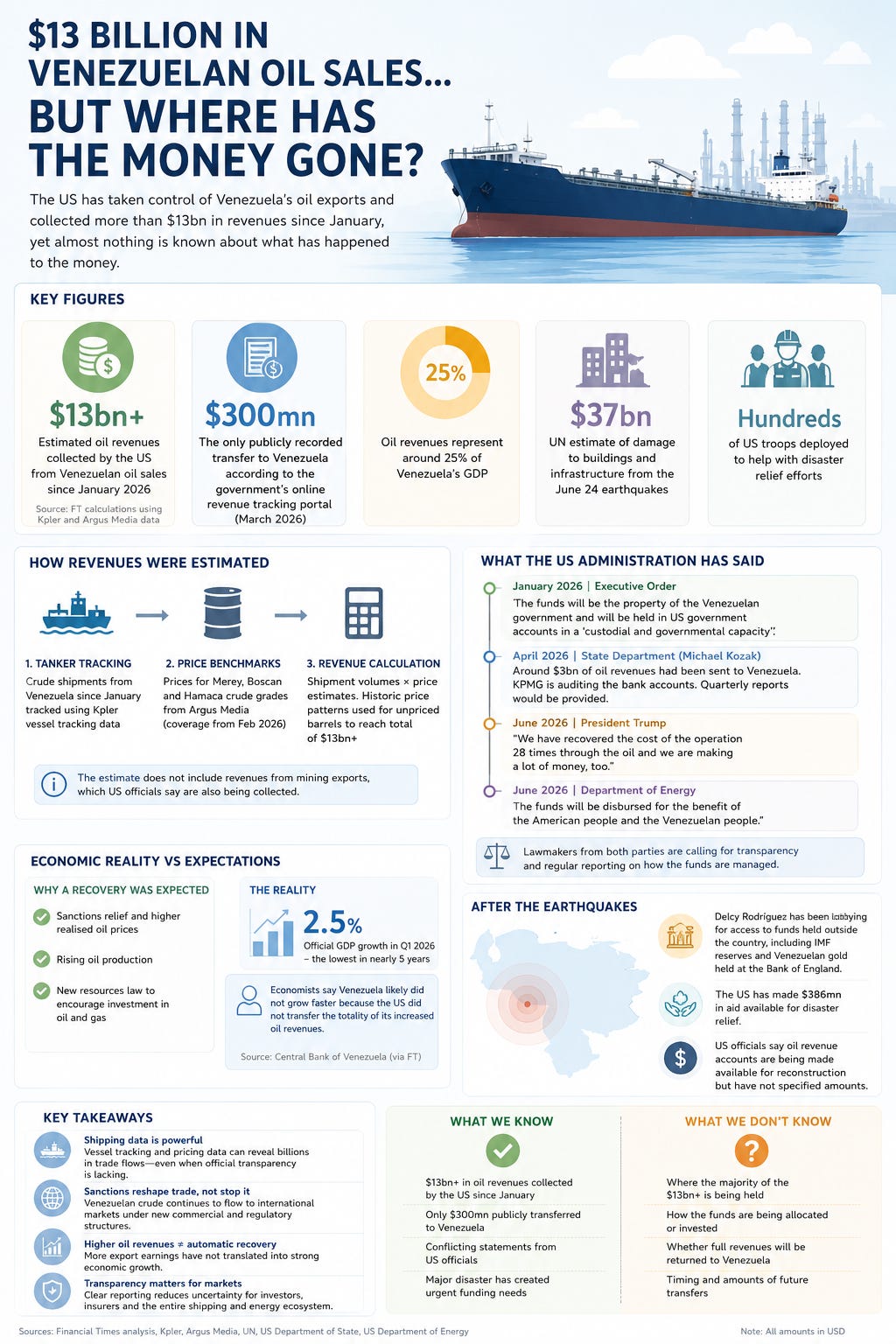
A recent Financial Times analysis estimated that the US administration has collected more than $13 billion in revenues from Venezuelan crude exports since January 2026.
Rather than relying on official financial disclosures, the analysis combined Kpler's tanker-tracking data with Argus Media's crude price assessments to estimate the value of exported cargoes.
Beyond the political implications, the article demonstrates how shipping data is increasingly being used to quantify commodity flows and estimate financial outcomes where official reporting is limited.
Beyond the political implications, the article demonstrates how shipping data is increasingly being used to quantify commodity flows and estimate financial outcomes where official reporting is limited.
The key figures
Several figures stand out from the analysis:
- More than $13 billion in estimated oil revenues generated from Venezuelan crude exports since January 2026.
- Approximately $300 million publicly recorded as transferred back to Venezuela through the government's online tracking portal.
- Oil accounts for around 25% of Venezuela's GDP, making export revenues a major contributor to the country's economy.
- Following the June earthquakes, the United Nations estimates reconstruction costs of approximately $37 billion, increasing the importance of access to these revenues.
Shipping data as a source of financial intelligence
One of the more interesting aspects of the Financial Times investigation is its methodology.
The revenue estimates were derived by combining tanker movements tracked by Kpler with price assessments from Argus Media for Venezuela's principal crude grades, including Merey, Boscan and Hamaca.
This approach illustrates how maritime data has become an increasingly valuable analytical tool.
Vessel movements provide visibility into export volumes, while commodity price assessments allow analysts to estimate the value of those exports with a reasonable degree of confidence.
As a result, shipping data is now used well beyond operational and logistics purposes. Investors, commodity traders, policymakers, sanctions specialists and journalists increasingly rely on vessel-tracking data to monitor trade flows and assess market developments.
As a result, shipping data is now used well beyond operational and logistics purposes. Investors, commodity traders, policymakers, sanctions specialists and journalists increasingly rely on vessel-tracking data to monitor trade flows and assess market developments.
This is Venezuela.
— Fabulero (@todorumba) July 29, 2026
Out in open waters -Bajo Barcelona- where ships anchor before coming in to load crude oil at the Eastern Cryogenic Complex (José)
There are 27 cargo ships visible to the naked eye!
Where is all that oil going? Where is all the money from those sales? pic.twitter.com/kd7aZe1UEI
The transparency gap
The article also highlights differing public statements regarding the management of Venezuelan oil revenues.
The January Executive Order described the United States as acting in a "custodial" capacity for the revenues.
The Department of Energy subsequently stated that the funds would benefit both Americans and Venezuelans.
President Trump later said the United States had recovered the costs of the operation "28 times" and was "making a lot of money" from Venezuelan oil.
At the same time, lawmakers from both Republican and Democratic parties have called for greater public reporting on how these revenues are being managed.
The differing statements, combined with limited public disclosure, have led to increased scrutiny of the administration of these funds.
The Department of Energy subsequently stated that the funds would benefit both Americans and Venezuelans.
President Trump later said the United States had recovered the costs of the operation "28 times" and was "making a lot of money" from Venezuelan oil.
At the same time, lawmakers from both Republican and Democratic parties have called for greater public reporting on how these revenues are being managed.
The differing statements, combined with limited public disclosure, have led to increased scrutiny of the administration of these funds.
Venezuela's economic performance
The article also considers the apparent disconnect between improving conditions in the oil sector and broader economic performance.
Despite:
- higher realised oil prices following sanctions relief;
- increasing oil production; and
- legislation intended to encourage foreign investment,
Economists cited by the Financial Times suggest that one possible explanation is that not all export proceeds have entered the Venezuelan economy.
While this is presented as one potential factor rather than a definitive conclusion, it offers a possible explanation for why stronger oil sector performance has not translated into faster economic growth.
A broader takeaway
The article provides another example of how maritime data is reshaping market transparency.
Where official reporting is incomplete or delayed, vessel-tracking data can provide an independent means of estimating export volumes and, when combined with pricing data, the value of commodity flows.
For those involved in shipping, energy or commodity markets, this reinforces the growing role of maritime intelligence.
Where official reporting is incomplete or delayed, vessel-tracking data can provide an independent means of estimating export volumes and, when combined with pricing data, the value of commodity flows.
For those involved in shipping, energy or commodity markets, this reinforces the growing role of maritime intelligence.
Shipping data is no longer used solely to monitor vessels and cargoes; it has become an important source of insight into trade flows, commodity markets and the economic consequences of geopolitical events.
Links :
No comments:
Post a Comment